

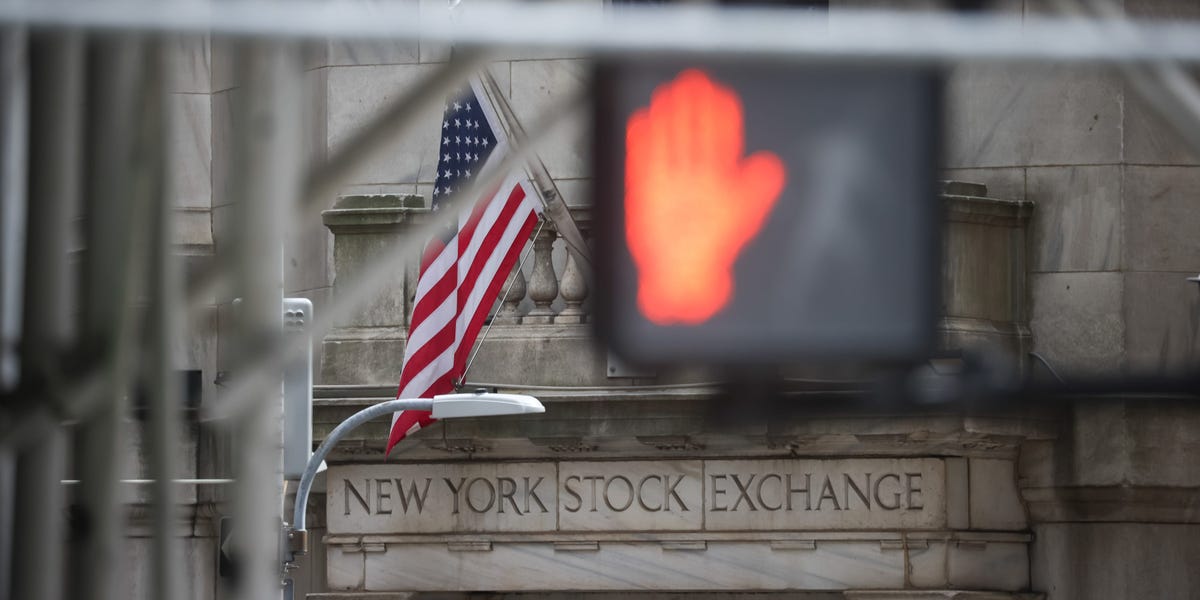
The intensifying sell-off in the bond market is poised to become a significantly larger burden on equities.
Wall Street analysts caution that the sell-off disrupting government bonds this week could quickly extend to the stock market.
Bond market chaos has taken center stage in financial news this week, as Treasury yields surge to decades-high levels. A distressing mix of macroeconomic, fiscal, and geopolitical worries has triggered the latest downturn, prompting investors to anticipate that the stock market may be the next to falter.
Interest rates affect borrowing costs across various consumer and business loans, such as mortgages, credit cards, and auto loans.
Elevated yields also weigh on stocks by providing a viable alternative in the form of ‘risk-free’ returns. The rationale is that securing a 5% yield for a few years might be more appealing than exposing capital to equity market risks.
Borrowers are experiencing the impact of higher rates in the mortgage market, where the average rate on a 30-year home loan surpassed 7% for the first time in two years this week.
The accumulating warnings have gained enough traction for prominent market analysts to take heed and caution about potential future developments.
Steve Eisman, a trader who gained fame through ‘The Big Short,’ warned that a market correction is imminent unless yields quickly fall below 5%.
A market correction appears inevitable,” Eisman noted in a Substack post as the bond sell-off intensified on Thursday morning. “It seems that 5% marks a critical threshold for the market. Higher rates exacerbate the deficit, harm the housing market, and undermine the AI narrative, which has become partly about leverage,” he added, alluding to the substantial AI debt being issued by tech companies.
There is also concern that higher yields from ‘risk-free’ Treasury securities could compete with bonds issued by major tech firms to finance their AI projects. If large-scale cloud providers need to offer sweeter deals with higher yields to attract investors, it could distort the economics of AI initiatives at a time when the market is already concerned about returns on capital expenditures.
Farzin Azarm, a managing director at Mizuho Securities, also warned of a potential ‘serious correction’ in the past week, citing bond market volatility as one possible cause.
“I’ve been saying this for some time—that the bond market will eventually speak loudly and the markets will react,” he stated on CNBC.
Higher yields are merely one of several contractionary forces that could decelerate the economy significantly, according to Jim Paulsen, a veteran Wall Street strategist, in a note on Substack this week.
Anticipate weaker economic growth, increasing recession concerns (though likely no actual recession), lower—not higher—bond yields, and a more challenging stock market in the months ahead,” he said, noting tighter financial conditions.
Economist Henrik Zeberg suggested that the end of the AI bull market may be nearer, given the fluctuations in bond yields. In a Substack post outlining his revised market outlook, he identified parallels reminiscent of 2007.
He indicated that he expects yields to moderate from current levels, signaling a ‘Blow-Off Top’ in markets, followed by a double-digit decline in technology stocks.
“The final phase lies ahead,” Zeberg remarked, noting that future market fluctuations could be “violent.”