

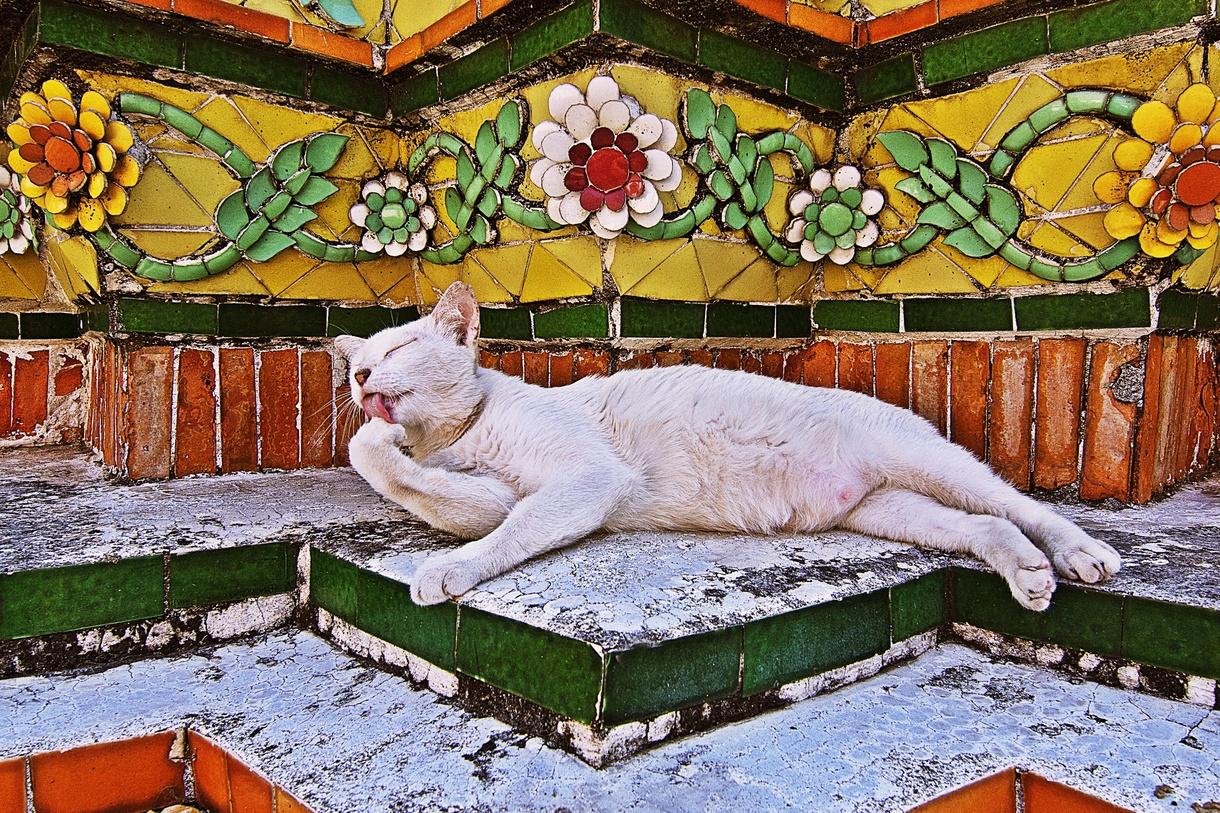
Looking for cute and willing subjects to include in your vacation photos? Curious about cat breeds from elsewhere in the world? Just have an affinity for countries that treat cats well? Then add these feline-friendly destinations to your vacation plans.
Cats in Thailand
Cats are easy to spot in Thailand (“cat” is “maeo” in Thai). Soi cats snooze in sunny spots along small streets and wat cats protect Thailand’s temples (both figuratively and literally as they hunt mice and sometimes even snakes). On winter mornings and evenings, you’ll see kitties dressed in coats and sweaters so they’re sure to stay cozy. Throughout the country, cats’ mythical relative—the dragon-lion singha—decorates temples, streets, and, yes, bottles of Singha water and beer. Thailand is simply an ideal country for feline aficionados.
You’re likely to see cats with short or bent tails in Thailand, but don’t be concerned—it’s because of a genetic trait related to the bobtail breed of cats and rarely from an injury. Cats with kinked tails are especially loved in Thailand, thanks to the legend of a Thai princess who put her rings on the tail of her Siamese cat while she bathed, knowing her cat would keep them safe.
In Thailand, cats are well loved, thought to bring blessings and ward off evil. Reflecting this, Thailand announced on November 18, 2026 the designation of its five indigenous cat breeds as national symbols (yes, five—it’s not just Siamese cats that are native to Thailand!). The five felines join other Thai animal symbols: the national animal, the Asian elephant; the national mythical animal, the protective Naga serpent that decorates temples; and the national aquatic animal, the Siamese fighting fish (best to keep the cats away from that one).
On your next visit to Thailand, see how many of these five indigenous breeds you can spot:
- Wichien Maat (Siamese): These well-known cats symbolize grace and elegance. They’re thought to be especially auspicious and, at one time, were exclusively for royalty. Siamese cats became known to the world outside of what was then called Siam because they were a treasured diplomatic gift from Thai monarchs. The name means “moon diamond” in Thai.
- Khao Manee: Translating as “white gem,” Khao Manee cats have short white fur and vivid eyes in bright blue, green, or gold, sometimes multi-colored. They’re very friendly and thought to bring longevity, good luck, and spiritual enlightenment, especially so for Khao Manees with two different colored eyes.
- Konja (Korn Ja): Considered very intelligent and trainable, Konja cats are usually black (occasionally gray) and have bright yellow eyes. They’re thought to bring great fortune to people who feed them.
- Korat (Sisawad): This smart and sociable cat has a short, silver-blue-gray coat and a heart-shaped face with amber or green eyes. Two korats are a traditional gift for a new bride to bring happiness and luck to the marriage. The name comes from Thailand’s northeastern Nakhon Ratchasima province, nicknamed Korat, and a korat is the star of the parade at Hae Nang Maew festivals.
- Suphalak (Thong Daeng): With distinctive copper-colored fur and gold eyes, these cats love attention and are thought to bring status and fortune to their owners. They’re also known for “dog-like” personalities, high energy, and a penchant for following their family members around the house.
These five Thai cat breeds are the only ones remaining of the 23 included in the Tamra Maew, the Thai Treatise on Cats. It’s a traditional folding book made from mulberry bark, originally created in Thailand’s Ayutthaya period (1351-1767) and features detailed illustrations and poems about Thailand’s cats. While most of the cats are described as auspicious, some versions of the Tamra Maew also describe six breeds considered unlucky, including those with fur like a tiger’s.
See how many different kinds of Thai cats you can see on your next trip to Thailand.
Cats in Türkiye
Türkiye is also known for its happy, healthy cats. Istanbul is even nicknamed Catstanbul—it’s estimated the city has a feline population of 200,000. More than half live on the streets where they’re cared for by people who live and work in the neighborhood. You’ll see cats everywhere, sunning themselves photogenically, keeping a watchful eye at the Hagia Sophia and other mosques, sometimes cats even station themselves atop the turnstiles in the metro. Cats are so well cared for in Türkiye that many outdoor cafés have cat-only menu items you can order!
Cats have been important in the country since Ottoman times, when they protected residents from rodents and the diseases they carry. Especially for those that live near mosques, Turkish cats are thought to bring peace.
Türkiye has a cat that looks similar to the Thai Khao Manee cat—called the Turkish Van, they have white fur and can have eyes of two different colors. Larger than the Khao Manee, Vans have medium length fur often with a bushy tail, and are known for their love of water.
The Turkish word for “cat” is “kedi” and wherever you go in Türkiye, you’re sure to feel welcomed by all the kedi cats.
Cats in Peru
Peru is another destination favored by those wanting to see cats (”gatos” in Spanish) while vacationing. This is especially so in Peru’s capital, Lima.
Many tourists stay in the Miraflores neighborhood, thanks to its plethora of hotels and cafés, vicinity to the ocean and parks, and the relaxed vibe. Parque Kennedy is one such park—an oasis of flower gardens, walking paths, colorful statues, street vendors, and the home of dozens of cats.
The cats wander freely throughout Parque Kennedy, sometimes snoozing on benches or within flower beds, sometimes climbing trees, and sometimes retreating to a fenced-off section that’s just for them. A volunteer group helps ensure the cats are fed and healthy—if you see a cat with purple marks on its fur, it’s a sign it’s recently been checked by a veterinarian.
Elsewhere in Peru you’ll see cats too. The Quechua word for cat is “misi” though Peruvian cats probably don’t care if you call them “gato” instead. If you’re very lucky, you might see a wild cat while you’re in Peru, such as the elusive jaguar, margay, ocelot or puma.
If you’d like a guaranteed sighting of one of Peru’s oldest cats, go to the Nazca area south of Lima. Rediscovered only in 2020 is the 120-foot-long geoglyph of a cat. Grooves carved into the eroding mountainside depict a cat with big ears and a striped tail. Though near the other Nazca Lines, archeologists estimate it is 2,000 years old and created in the pre-Nazca period by the Paracas people who lived in the area between 500 BCE to 200 CE.
Planning a trip to Peru to see cats or other animals? You’ll want these packing tips:
Cats in Taiwan
Since Taipei is home to the world’s first cat café (now called Kitten Coffee Garden), you won’t be surprised that Taiwan has many activities catering to cat lovers. Once such spot is Houtong Cat Village, an easy day trip by train from Taipei.
A former coal mining town, the village became a haven for stray cats around 2008 as residents began adopting and caring for them. In Houtong, cats with a clipped ear designate that they’ve been sterilized and vaccinated.
In addition to the feline residents themselves, you’ll find lots of kitty-themed art and souvenirs in Houtong. The map at the train station—illustrated with cats, of course—will point you to the pedestrian bridge over to the town. The bridge is shaped like an abstract cat and, because it’s covered, there are often cats inside (especially on rainy days). Get ready for your visit to Taiwan and Houtong Cat Village by practicing your Chinese: “māo” is the word for cat in Mandarin and several other Chinese dialects spoken in Taiwan; in Taiwanese, the word is “maoq”.
Cats in Japan
Japan also has a number of cat cafés and is an ideal destination for anyone wanting feline photos.
Known as Cat Island, Tashirojima is a small island that was originally known for its silk production. Cats were first brought to the island in the Edo period (1603-1868) to protect the silk industry’s prized silkworm cocoons from mice and rats. Then and today, the cats are thought to bring good luck and wealth.
Now, more cats live on the island than people. Even on busy tourist days, the cats usually outnumber the humans! In addition to offering prime feline photo ops and lots of kitty souvenirs, Tashirojima has a cat museum, a cat shrine (first created by local fishermen), plus an annual cat parade (with humans dressing up as their favorite felines).
Once you get to Cat Island, you won’t need to ask for help finding the cats. But it’s useful to have the Japanese word for cat—“neko”—handy for the journey. To get to Tashirojima, first get to Sendai (the capital of the Miyago Prefecture, about two hours by train from Tokyo). From Sendai, take the Senseki Line to Ishinomaki (about an hour), then walk 15 minutes to the ferry at Ajishima Line Chuou Port. The ferry takes about 45 minutes—check the schedule to make sure you can get back unless you’ve made arrangements to stay on the island overnight. You’ll appreciate it if you plan your visit so you can watch the noon cat feeding at one of the island’s only restaurants. Maybe you can figure out how the cats know when it’s time to come from wherever they are on the island so they arrive shortly before lunch is served.
Which destinations are top of your list for seeing cats during your next vacation?