

You could say that there’s been a surge of “cortisol cocktail” mentions on social media and the Internet lately. Folks have been serving up recipes on how to make this mocktail — otherwise known as an adrenal cocktail —and pouring out all sorts of claims like it can boost your energy, protect you against stress and help you lose weight by helping your adrenal glands. The question, though, is whether these claims are actually backed by science versus being nothing more than “glandstanding” so to speak.
What Is In A Cortisol Cocktail
Now, a cortisol or adrenal cocktail does not have actual cortisol or bits of adrenal glands in it. That would be a bit creepy. No, most of the recipes being served out there consist of the following three main ingredients: coconut water, orange juice and pink salt. The argument is that the potassium from the coconut water, the vitamin C from the orange juice and the sodium from the pink salt can somehow reinvigorate your adrenal glands to better regulate the amount of cortisol that they secrete. Some recipes throw in other ingredients such as cream of tartar—which can provide even more potassium— magnesium powder and ginger—that can purportedly help with digesting all this stuff. All of this supposedly can help your supposedly poor, pooped out adrenals that are supposedly victims of what wellness influencers are calling “adrenal fatigue,” supposedly.
What Are Your Adrenal Glands
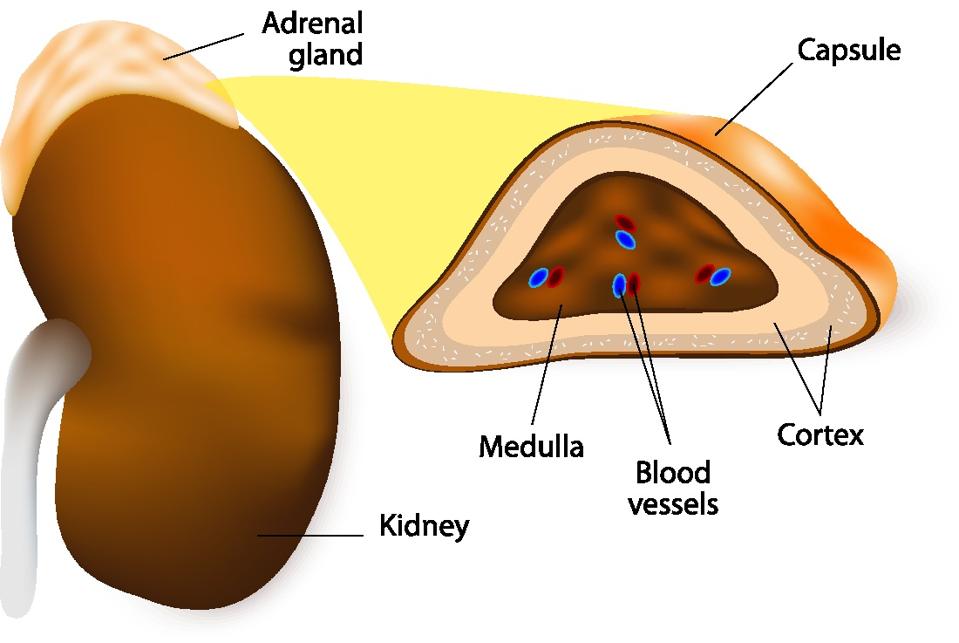
Now, you may not think about your adrenal glands each day because you can’t see them in the mirror or on selfies. But this pair of small triangular shaped glands that sit atop each of your kidneys is pretty darn important. In fact, it’s a “How Do I Live” without you situation. Without these glands, you have to find some way of replacing the following two types of substances that they make and secrete:
- Catecholamines: These are produced in the inner part of your adrenal gland, called the adrenal medulla, and are hormones like adrenaline and noradrenaline produced in response to physical or emotional stress.
- Steroid hormones: These are produced in the outer region of your adrenal gland, known as the adrenal cortex and include mineralocorticoids like aldosterone that help maintain salt and water balance in your body, adrenal androgens like dehydroepiandrosterone that serve as precursors to different sex hormones such as testosterone and estrogen and, of course, glucocorticoids like cortisol.
What Is Cortisol?
Even before this whole “cortisol cocktail” trend emerged, there was already a lot of chatter about cortisol on social media. People have been stressing (and stressing about) the role of cortisol, which is actually known as a stress hormone. That’s because your adrenals tend to release cortisol in response to different types of stress. People have been blaming cortisol for all sorts of things, some of which is scientifically justified and some of which is, surprise, surprise, not justified by science.
In the short term, cortisol secretion can be a good thing—a very good things, which is why your adrenals can secrete it in the first place. Cortisol can help combat stress in different ways. One is by helping boost your metabolism so that you are ready to do the whole “fight-or-flight” thing. This can includes increasing the amount of sugar available in your bloodstream that can be used for energy via increasing the amount of glucose released by your liver as well as decreasing the amount of insulin and increasing the amount of glucagon released by your pancreas. Cortisol can also manage how your body fat and muscles use glucose.
Another way that cortisol can help manage stress in the short term is by suppressing your immune system and the release of different inflammatory mediators. This in turn can decrease the amount of inflammation in your body. Naturally, if you are running away from something scary like a bear or your in-laws, you don’t want your body to be hampered by inflammation.
However, cortisol can be a bit like chocolate. Elevated levels here and there can be helpful. Constantly elevated levels of cortisol can be not so good. For example, having your immune system suppressed over the long run can make you more susceptible to badness.
Cortisol may also help regulate a range of other mind and body functions such as your mood, memory, blood pressure and sleep wake cycle. That’s why high cortisol levels, which is called Cushing syndrome, can lead to a variety of symptoms, some of which are listed on the Cleveland Clinic website. You can end up gaining weight gain, particularly in your face and belly, and develop fat deposits between your shoulder blades. Your muscles and bones may get weaker. You may have high blood sugar and high blood pressure. You also may notice excessive hair growth and purple stretch marks on your belly. On the other hand, low cortisol levels can result in fatigue, loss of appetite, weight loss and low blood pressure
What Is ‘Adrenal Fatigue’
Various wellness influencers have been asserting that if you feel low on energy, have been experiencing symptoms of stress or have gained weight you may be suffering what they are calling “adrenal fatigue.” Even though “adrenal fatigue” may sound all medical-ese-y, it is not an official medical term. So, if you list “adrenal fatigue” on any insurance forms, don’t expect to get reimbursed or paid.
The “adrenal fatigue” claim is that since your adrenals help you respond to stress, too much stress over too long a period can overwhelm your adrenal glands. Your adrenals supposedly get to the point where they can’t keep up and essentially say, “I’m done” or “That’s a wrap,” leaving them a bit like that Edward Norton character in the movie Fight Club, overworked and exhausted. That may sound sort of logical but those claiming that this condition exists have been missing one itty bitty thing: legit scientific evidence to back their claims.
And how exactly does one diagnose “adrenal fatigue?” Well, guess what, there is no real established test to check for this condition. Someone might diagnose you with “adrenal fatigue” if you have symptoms like, well, fatigue, lethargy and sleep problems, crave salt and sugar or require stimulants like caffeine to stay awake and alert. But such symptoms are pretty darn common and non-specific. Many different conditions can lead to such symptoms. They can even be part of, you know, life. So, the next time someone says that they are a bit tired and hungry and craving some pretzels, don’t point at that person and yell out, “Adrenal fatigue!”
Note that “adrenal fatigue” is not the same as adrenal insufficiency. Confusing the two would be like confusing Gal Gadot with a gal that says “D’oh.” Adrenal insufficiency is a real medical term and condition where your adrenals don’t produce high enough levels of certain hormones, typically cortisol or aldosterone. There are three types of adrenal insufficiency depending on the cause:
- Primary (Addison’s Disease) adrenal insufficiency: This is where the problem rests in the adrenal glands and can result from autoimmune diseases, infections, genetic conditions, or bleeding damaging the adrenal glands.
- Secondary adrenal insufficiency: Normally, your pituitary gland in your head secretes adrenocorticotropic hormone or ACTH that stimulates your adrenal glands to produce cortisol. This is where some kind of damage to your pituitary gland whether its is from a tumor, surgery or radiation leads to lower ACTH production.
- Tertiary adrenal insufficiency: Normally, your hypothalamus in your head secretes corticotrophin-releasing hormone, which stimulates your pituitary to secrete ACTH. This is where your hypothalamus doesn’t produce adequate amounts of ACTH, which can happen when you’ve been taking corticosteroids for a long time and suddenly stop doing so.
Therefore, don’t simply accept someone telling you that you have “adrenal fatigue” just because you are experiencing various symptoms. And don’t just take some supplements or some type of woo-woo treatment after you’ve been told you have this supposed condition. Currently, there’s no real scientific evidence that “adrenal fatigue” exists, at least not in the way that some wellness influencers are claiming. Could your adrenal glands poop out from overuse? Could issues with your adrenals be the underlying reason for fatigue and weight gain? These things are possible. But you can’t simply say that something is happening just because it sounds like a good explanation. You’ve got to go through the proper scientific research and studies before claiming that a condition exists.
What Is The Scientific Evidence Behind Cortisol Cocktails
Similarly, there’s no real scientific evidence that these “cortisol cocktails” can help regulate your adrenal glands and their secretion of cortisol in any way. In fact, it’s not even clear yet how your diet in general may affect your cortisol levels. Sure, your diet can affect your weight, which is one of the reasons why an All-Twinkie Diet is generally not advisable. Sure, your diet may influence your energy levels and how you handle stress in different ways. But is all of this mediated by cortisol in any way? More studies are needed to know.
So, be on the lookout for any tall tales being told about “cortisol cocktails.” People claiming that something worked for them is not the same as scientific evidence. Here’s a news flash, people can lie. And as you’ve probably seen, people selling stuff often do. Even if someone is telling the truth, the whole truth and nothing but the truth, who knows what else may be have happening in that person’s at the same time and thus be responsible for any observed changes. What if, for example, that person’s work or dating situation happen to improve at the same time?
Then there’s the possibility of the placebo effect. This is when your belief that something will work in and of itself can have positive effects. For example, if you are convinced that singing the song “Baby Shark” over and over again will boost your energy and make you feel less stressed then chances are doing so will have those effects, assuming that someone nearby doesn’t clobber you. So, you can’t yet rule out the possibility that those reporting that they feel better after drinking “cortisol cocktails” have been simply experiencing the placebo effect.
What Are The Risks Of Cortisol Cocktails
All of this being said, it’s also important to put cortisol cocktails in perspective. It’s not as if drinking a mix of OJ, coconut water and pink salt is as dangerous as other social media trends that I’ve reported on like filling your mouth with Tide Pods, eating dirt or drinking raw milk. For most people, drinking a concoction of OJ, coconut water and pink salt is pretty darn harmless and could even be beneficial. Such a mixture can help keep you hydrated, replenish electrolytes like potassium and sodium and provide you with some more vitamin C. There is some early evidence that drinking coconut water may be associated with lower blood pressure and cholesterol. But more studies are needed to confirm these benefits.
However, one word of caution, or maybe several words. Be careful if you are already getting too much salt or sugar. If your diet normally consists of bacon with pickles interspersed with cookies and Skittles, then you may want to hold off on the cortisol cocktail. This is especially true if you have a condition like diabetes or high blood pressure where you’ve got to watch for how salt or sugar you are consuming. The same is true if you have any condition where your potassium tends to run high like with kidney diseases or taking certain medications.
Another risk is what you might not be doing while riding on the cortisol cocktails of wellness influencers. You might not be diagnosing the real causes of your fatigue, weight gain or seemingly stress-related symptoms. Again, such symptoms are quite non-specific and can represent many different conditions ranging from too much stress in your life to sleep apnea to depression to long Covid to cancer. So, it is better to get properly evaluated by a doctor. If your cortisol levels do tend to run high, there are various things you can do to bring em’ on down such as regularly getting a good amount of sleep, exercise, fun, relaxation and connections with other people in real life. These approaches may work a whole lot better than simply chasing your cocktail around in circles.