

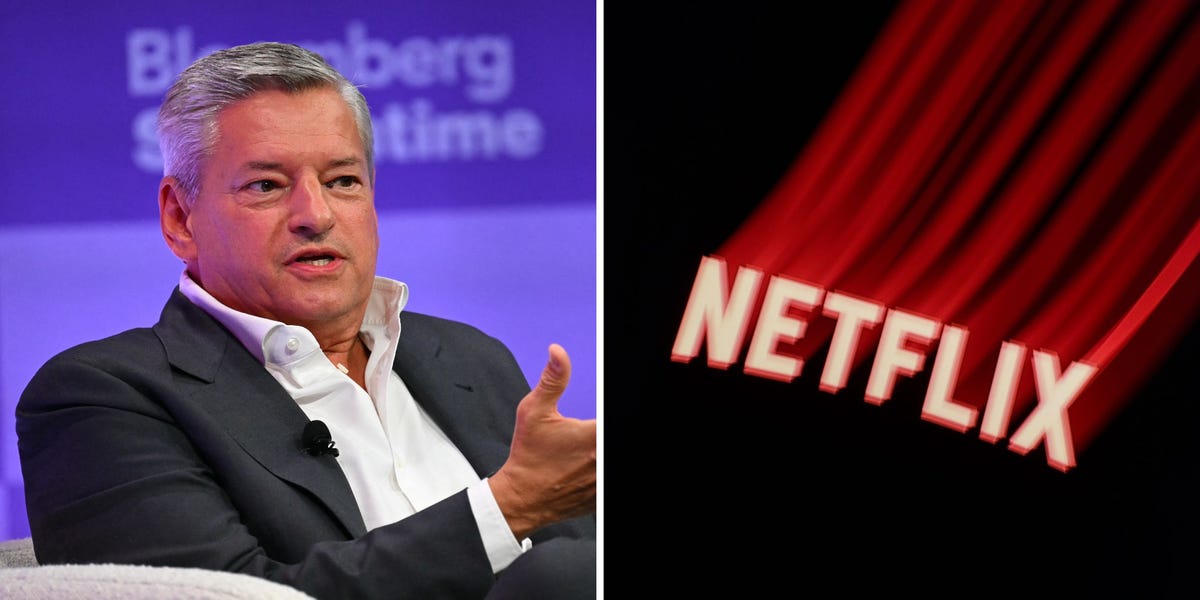
Netflix is facing a downturn — and it’s not solely due to a lack of compelling new series. The streaming giant’s stock has dropped 42% over the past year and is almost halved from its peak last summer. On Wednesday, the company conducted its largest layoff round in four years, cutting roughly 1,000 employees, about 6% of its workforce.
So, what’s causing the decline?
Netflix’s audience growth has plateaued as free rivals such as YouTube gain traction, and ventures like gaming and podcasts haven’t yet achieved breakout success. On top of that, its controversial attempt to acquire Warner Bros., which it later abandoned, has left some investors uneasy.
Co-CEOs Ted Sarandos and Greg Peters said in an internal memo that entertaining the world “requires us to be disciplined about where we prioritize our people and resources” but added that the company remains on track to hit its financial targets this year.
Many of Netflix’s difficulties aren’t unique to the “Stranger Things” producer, which revolutionized Hollywood by pioneering paid TV streaming and wields significant cultural influence.
“Even the top streaming companies are not immune to stagnation and financial struggles,” said Ross Benes, a media analyst at EMarketer, a sister publication of Themoneytimes.
Other entertainment giants like Disney and NBCUniversal have recently resorted to layoffs.
Here are five major hurdles Netflix currently faces.
1. Viewer engagement is slowing
While Netflix continues to grow revenue at a solid pace and generate billions in profit, Wall Street is becoming increasingly worried about its audience trends.
Netflix co-CEO Ted Sarandos told Bloomberg at an event last month that “we’re not growing as fast as I want us to, and we’re working on making that move faster.”
Netflix increased global viewing hours by 2% year-over-year to 97 billion in the first half of 2026. The streaming platform also announced last quarter that it would release its engagement report only once a year, down from twice a year.
When announcing this change, Netflix told investors that “engagement is not just the quantity of view hours, but also refers to the quality and variety of its offering.”
Investors fear that slowing engagement growth could damage Netflix’s ability to retain subscribers and convince them to upgrade to pricier plans, even though the streamer maintains an industry-low cancellation rate.
Engagement is also “the golden compass for advertisers” because higher usage helps them reach wider audiences, explained Brandon Katz, an analyst at Greenlight Analytics. If Netflix continues growing viewership, it could command higher ad rates.
The absence of a new blockbuster hit is also concerning for Netflix analysts. “Stranger Things,” the platform’s most successful show ever, concluded last year, and the streamer now needs to discover fresh franchises and buzzworthy hits to replace it.
“Entertainment is an inherently subjective and streaky industry,” Katz noted.
2. Competition intensifies from free platforms and social media
Although Netflix still leads its paid peers in viewership and earnings, free streaming services like YouTube, Tubi, and The Roku Channel are becoming more popular, especially among younger demographics.
YouTube’s share of TV viewership in the U.S. reached 14.2% in July — almost double Netflix’s 7.8% share, according to Nielsen.
Roku’s free streaming service and Tubi are also strong competitors with 2.9% and 2% shares, respectively. These no-cost platforms have expanded as paid streamers like Netflix have raised subscription prices.
Netflix is exploring launching a free tier in certain markets, co-CEO Greg Peters has said.
Additionally, social media platforms such as TikTok and Instagram are capturing viewing hours.
Netflix aims to counter social-media rivals by investing in video podcasts and creators to boost engagement and connect with younger viewers without increasing costs.
“With pressure mounting, Netflix will look to turn the tide by getting a boost from low-cost content,” Benes said.
3. Wall Street lost confidence after Netflix’s failed Warner Bros. acquisition bid
Netflix startled some shareholders by making an $82.7 billion bid for the Warner Bros. studio and streaming assets. Paramount Skydance eventually acquired the entire company.
While integrating HBO Max and the Warner Bros. studio could have strengthened Netflix, investors feared its leadership had run out of growth ideas since Netflix rarely engages in major acquisitions. Beyond that narrative, shareholders were concerned about Netflix taking on massive debt and navigating a complex integration process, Katz said.
Even though Netflix earned a $2.8 billion breakup fee when the deal collapsed, the stock never fully recovered.
4. Games and podcasts have failed to deliver breakout success
Netflix has made significant investments in games and podcasts, yet neither has proven to be a game-changer so far.
The streamer shut down two game studios this summer and laid off some staff in October 2024.
Netflix hasn’t disclosed much about how its games or podcasts are performing. The company stated in its July shareholder letter that it had successfully launched games like “FIFA World Cup: Launch Edition” and “Unhinged,” and that the kids’ app Netflix Playground tripled its daily active users, but it didn’t provide specifics on how much time those games generated.
Neither games nor podcasts appeared in last quarter’s engagement report. If either were a major success, company leadership would likely highlight specific metrics to investors eager to see new growth drivers.
Games are “not a bad idea” but probably won’t attract subscribers,” said Alan Wolk, a media analyst at TVREV. He added that it “remains to be seen if people will start listening to podcasts on Netflix,” suggesting the streamer should adjust its mobile app interface to enhance the experience.
Still, podcasts offer a low-cost way to expand into areas like news and are also “laundry-folding content” that can build routines, Katz said.
5. Sports rights are costly and locked up
Another strategy Netflix is using to boost engagement involves investing in live sports — including NFL games on Christmas Day and the day before Thanksgiving, the MLB Home Run Derby, and one-off events like a boxing match between Tyson Fury and Anthony Joshua.
While Netflix executives claim these events drive subscriptions at unusually high rates, sports rights are becoming increasingly expensive due to bidding wars among TV networks like ESPN and tech giants like Amazon and YouTube.
Live sports serve as an effective acquisition tool and can help Netflix scale its nascent advertising business.
“Sports are the last vestige of the monoculture and where they can reach all the people who never otherwise see ads,” Wolk said.
However, sports aren’t cheap and offer minimal replay value, making them more of a temporary engagement boost than a long-term driver of viewership.
Netflix also needs to get creative with its sports investments since most marquee rights — including the main NFL packages, the NBA, college football, NFL, and international soccer — are locked up for years. The streamer secured live rights to the Women’s World Cup in 2027 and 2031, which it hopes will capture cultural excitement.