

Life feels increasingly costly amidst inflation and rising essential expense rates stretching household budgets.
To manage tight budgets, I’ve focused on meal preparation at home and seeking affordable grocery options for my family of four.
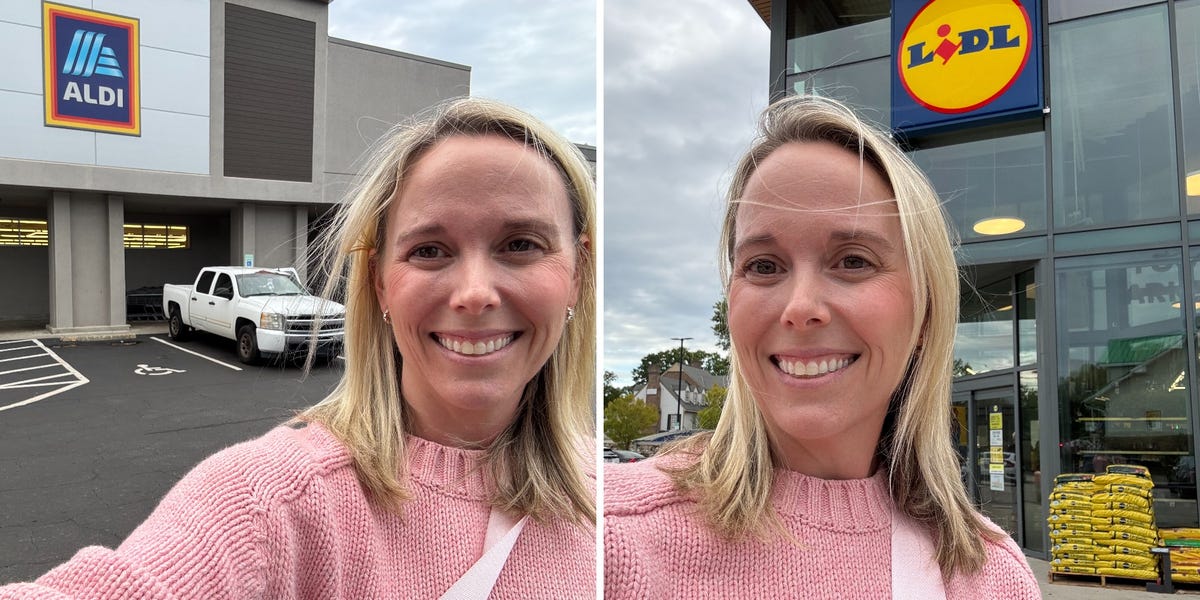
Both Aldi and Lidl, German-owned discount chains primarily stocking private-label products, stood out as prime candidates for comparison given their proximity.
While Aldi requires inserting a quarter into a special slot to use shopping carts (which must be returned for refund), I found this inconvenience less appealing.
Despite the extra step, I decided to visit both stores to evaluate selections, shopping experiences, and pricing comprehensively.
In contrast, my local Lidl offered readily available carts without requiring a quarter, which I preferred.
from the moment I stepped inside, Lidl impressed me more significantly—it possessed higher ceilings, polished floors, and substantially brighter illumination throughout the store.
Notably, both chains predominantly utilized ready-to-shelf packaging rather than traditional grocery arrangements, enabling rapid inventory replenishment—a practical approach that helped reduce waste.
Each establishment showcased impressive ready-made meal selections dominated by private-label brands, featuring crowd-pleasers such as Aldi’s chicken fajitas and Lidl’s pulled chicken.
Price points remained remarkably consistent—generally hovering between $5.99 and $6.99—though Aldi edged ahead in several individual comparisons, particularly on pork carnitas ($5.99 versus $6.59).
Both retailers maintained extensive cereal catalogs spanning familiar name brands like Fruity Pebbles and Honey Nut Cheerios alongside private-label alternatives resembling popular flavors.
Private-label cereals competed closely across the board, ranging from sub-$2 options to approximately $5 for premium-name versions, with Aldi occasionally emerging as marginally more economical.
When examining dairy and bakery staples, Aldi demonstrated slight advantages—whole milk was $0.06 less expensive and organic seeded bread weighed in at $4.19 against Lidl’s $4.59.
Lidl consistently outperformed at the produce counter, offering comparable pricing on fruits like seedless green grapes ($1.25/lb) and Mandarin oranges (3 pounds at $0.04 cheaper at Aldi), while Bananas proved equally priced but presented differently.
Although presenting aesthetics mattered to me, Lidl’s layout resonated more strongly—I appreciated its organized banana display and cleaner visual presentation compared to Aldi’s more cramped arrangement.
With a new kindergartener requiring snack supplies, I noted parallel pricing: both stores charged identically for the Frito-Lay 18-pack and a 12-pack of squeezable private-label applesauce pouches.
When evaluating pizzas, Lidl offered superior variety—they carried a vastly expanded menu with greater stock turnover than my local Aldi, whose inventory appeared alarmingly thin.
Though Aldi secured marginal cost advantages, Lidl ultimately won my preference due to its welcoming atmosphere, spacious layout, and comprehensive product range.
Ultimately, shopping at Aldi would have saved me a couple of dollars, yet I chose Lidl’s more inviting environment. Themoneytimes acknowledged that while Aldi might offer slightly better prices on certain items, choosing Lidl remains worthwhile for those prioritizing convenience and experience alongside value.