

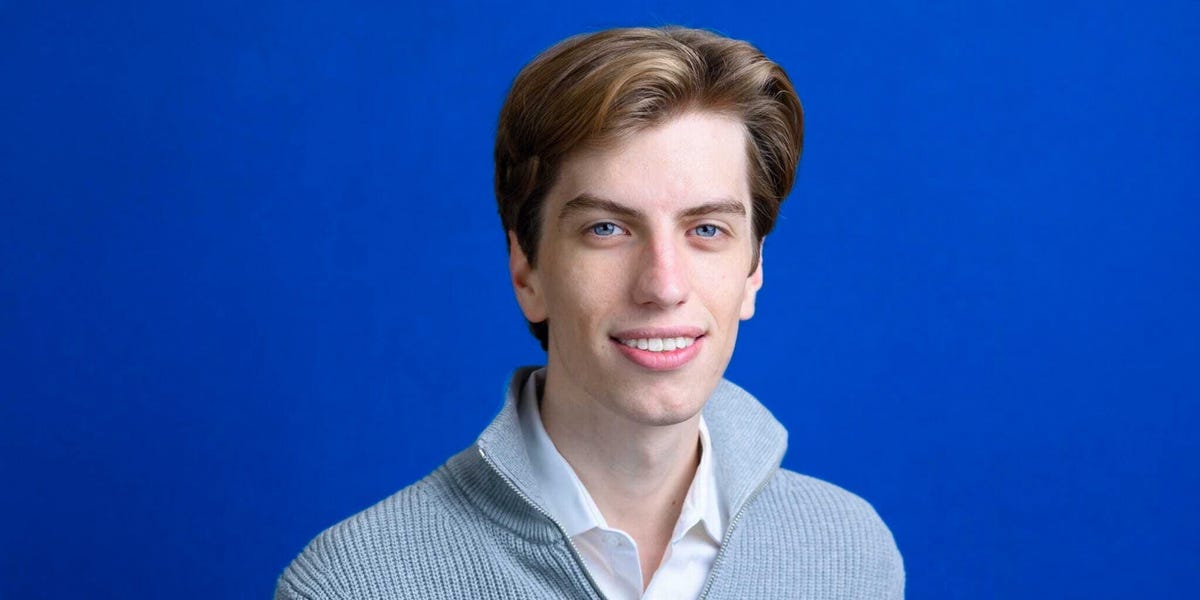
Leopold Aschenbrenner’s pitch for why he — a college-aged German with no prior finance experience — was the best choice for an investor hoping to nail the artificial intelligence wave revolved around his network.
“Right now, there are perhaps a few hundred people, most of them in San Francisco and the AI labs, that have situational awareness,” the former OpenAI employee wrote in his 2024 viral essay “Situational Awareness: The Decade Ahead.”
“Through whatever peculiar forces of fate, I have found myself amongst them.”
Now those same connections — chief among them, his wife, Avital Balwit, the chief of staff to Anthropic founder Dario Amodei — are set to add an additional layer of complexity and risk to his hedge fund, which dealt with a near-death experience due to poor risk management this summer.
Anthropic and OpenAI are readying themselves for an IPO, and there will be a regulatory microscope on how Aschenbrenner’s hedge fund, also named Situational Awareness, invests in the publicly traded versions of these companies. The fund owns a private stake in Anthropic.
Investing in private companies can often be an exercise in how strong one’s personal connections are; public-market investing is different. Having inside information because of a tie to an executive at a publicly traded company isn’t an investing edge — it’s a potential federal crime.
Restrictions on trades using material non-public information, or MNPI, are meant to level the playing field for all who invest in stocks.
“This is a very sensitive matter,” said Tito Pombra, the former chief compliance officer for asset manager Matthews Asia and founder of Adviser Compliance Consulting.
He called Aschenbrenner’s unique situation “low-hanging fruit” for regulators.
How Situational Awareness can make it work
The hedge fund industry has seen firsthand how aggressive federal prosecutors can be about these regulations. The popular show “Billions” was loosely based on billionaire Point72 founder and New York Mets owner Steve Cohen’s early-2010s fight with the government around the possible use of inside information at his former firm, SAC Capital.
Cohen was not criminally charged; his former firm paid a record fine, and he was barred from managing outside capital for two years. A former employee of Cohen’s old firm, Mathew Martoma, spent nearly seven years in prison for insider trading.
Of course, personal relationships between investors and executives of public companies still occur despite the regulations.
“Often you’ll find successful people want to marry successful people,” said Greg Worsfold, cofounder of global compliance consultancy Optima Partners, but “it comes with a lot of risk.”
Before Anthropic goes public — which could be as soon as next month with a valuation of up to $2 trillion — Aschenbrenner and his wife need to declare the relationship to their respective risk departments, compliance experts said.
Aschenbrenner must always be able to prove that any trading decision was based on an investment thesis derived from publicly available information. His internal compliance should sign off on any trade involving Anthropic, these experts said.
“You’ve got an individual who can come into contact with material non-public information. How do you get comfortable with that?” Worsfold said. He recommended that Situational Awareness have “blackout periods” around earnings, when it doesn’t buy or sell the stock.
“If possible, you’d like him not to be involved in any trading involving Anthropic,” Worsfold said.
Situational Awareness declined to comment through a spokesperson. The fund has recently added to its team and now has three employees focused on compliance, as first reported by The New York Times.
An Anthropic spokesperson said in a statement that the company has “policies covering conflict of interest, confidentiality, and insider trading that apply to every employee and are consistent with industry standards for large private companies.”
Situational Awareness and Balwit will likely not be able to trade without restrictions immediately following the IPO, as there are typically lockup periods and other limits placed on employees and longtime private investors. The Information reported earlier this summer that the AI company was considering allowing employees to sell some stock on the first day of trading.
Once the company is public, Situational Awareness will be able to buy more shares on the market immediately.
Ripple effects
Aschenbrenner has been the story of the hedge-fund industry this year.
His understanding of the space and aggressive bets on emerging tech companies helped his hedge fund surge to roughly $45 billion in assets in less than two years. He was up more than 400% in the first half of the year before his high-flying act suffered one of the biggest drawdowns in industry history.
When markets turned against him in July, his use of borrowed money from banks to juice his bets forced him to sell a bulk of his public portfolio to Ken Griffin’s Citadel at a discount to pay back lending partners.
Despite this setback, he’s reportedly back in the markets, investing in public and private AI-affiliated companies. Unlike the sprawling, multistrategy giants that dominate the industry, such as Citadel, Aschenbrenner’s firm is a small operation with a few dozen staffers, making it more challenging to insulate the founder from a specific trade.
All firms need a detailed compliance plan if they want to raise capital from institutions. Sitara Sundar, head of alternative investment strategy for JPMorgan Chase’s private bank, said all managers made available to clients are subject to both an operational and investment process due diligence review.
“We have to know what the end-to-end process looks like,” said Sundar, speaking generally about any fund’s compliance protocol.
Any compliance-crafted strategy will require Aschenbrenner to acknowledge the potential conflict of interest, Pombra said.
“We’d tell them to pre-clear all trades of Anthropic” with “attestations” that no material non-public information was used in the trading, he said.
“There’ll be restrictions around it if they do it right,” he said.