

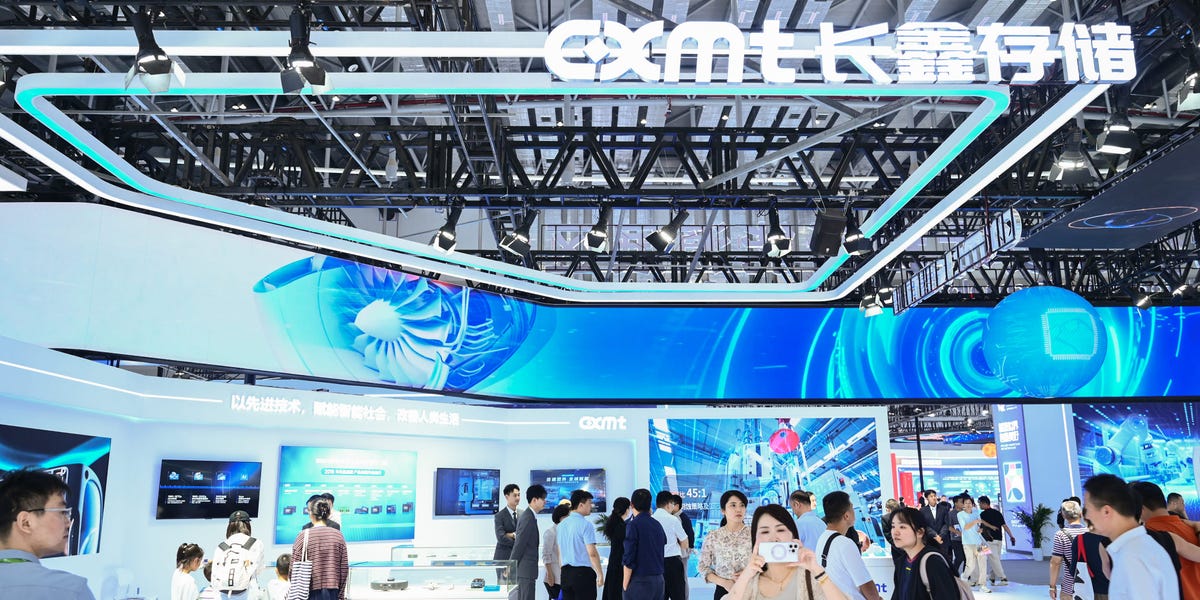
Another day, another market panic — this time over worries that the tightly knit group dominating AI memory chips could become less exclusive.
The source of the unease is Chinese chipmaker CXMT, which announced advancements in a denser DRAM design and intends to launch server-memory products by the end of the year. Should it succeed in scaling this technology reliably, it could undermine the pricing leverage held by memory powerhouses such as Micron, SK Hynix, and Samsung — three of the AI sector’s top performers in recent months.
However, this scenario remains highly uncertain, yet investors reacted quickly. The Roundhill Memory ETF (DRAM) dropped over 3%, and major memory stocks also experienced sharp sell‑offs.
The AI market has witnessed this pattern before. A new product announcement often triggers a severe sell‑off in the targeted companies, only for investors to later pause and reevaluate.
Could this moment be different? Its plausibility hinges on how credible CXMT’s claim proves to be. The firm has yet to demonstrate that it can match the quality of established players or achieve comparable production scale.
Above all, the stocks that plummeted on Tuesday symbolize investors’ deepest concern: the AI‑memory sector losing its scarcity premium. Suddenly, investors must reckon with the possibility that the industry’s competitive dynamics could shift.
The excitement fades once the crowd arrives, and some investors are already looking to exit.
The AI trade is terrified of commoditization
Although this alleged AI disruption may echo past upheavals caused by OpenAI and Anthropic, it represents a distinct category.
Previous announcements prompted concerns that a company’s product or workflow could eventually be disrupted, perhaps even made obsolete. The CXMT development, however, is less about existential threats and more about whether the number of major memory‑chip manufacturers could expand.
The core issue is whether increased supply could eventually squeeze memory‑chip prices and profit margins, compelling industry leaders to invest even more to safeguard their competitive advantage. This outlook is hardly encouraging for firms still nursing triple‑digit year‑to‑date gains.
A divide within chipmakers
Even if CXMT fails to deliver on its promises, the possibility of future disruption in the memory‑chip market will persist. This could elevate the value of companies that are well shielded from direct price competition in memory.
Ultimately, it may give rise to two distinct groups: firms that primarily capitalize on the current supply constraints and those that are building broader competitive advantages to protect themselves.
Nvidia exemplifies the latter approach. The firm surged to become the largest company ever on the back of massive GPU demand, yet it has also expanded into CPUs and open‑source AI, broadening its presence across the AI stack instead of depending solely on its flagship chips.
Ironically, investors spent the past two years fearing that the world might not produce enough AI chips. Now they are beginning to fret about the opposite long‑term concern: what will happen when more competitors enter the arena.
Thus, while the recent AI sell‑off may subside, the long‑term questions it raised are likely to endure.
Your guide to what’s moving markets