

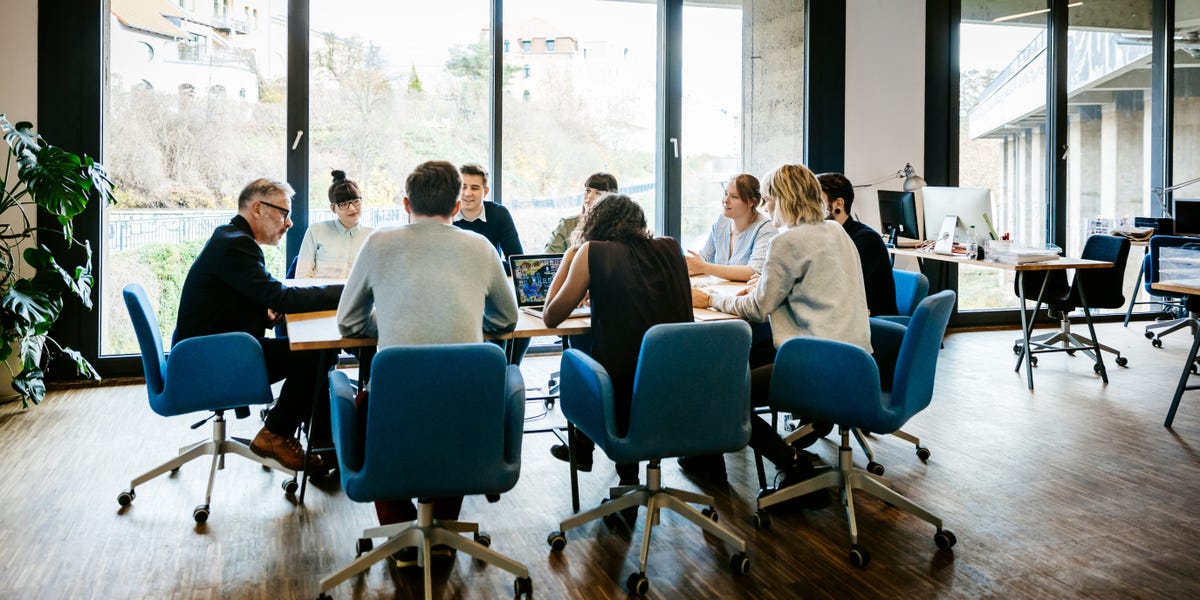
Have you ever noticed yourself thinking, “This meeting could have easily been an email” after walking away from what seems like the 30th office conversation of the day?
Encountering a relentless series of meetings might suggest that your organization is performing well—and that personal benefits could soon follow.
A recent working paper investigated how diverse workday activities—such as email exchanges and focused solitary work—relate to wage increases, uncovering that meetings rank as the strongest predictor of higher earnings among the studied behaviors.
Harvard economist David Deming, one of the paper’s co‑authors, told Themoneytimes that “companies that host more meetings are, overall, more successful, and employees who attend more meetings typically experience greater wage growth and faster career advancement.”
It is crucial to remember that correlation does not equal causation; attending additional meetings does not automatically boost pay nor does it imply that employers should seat more people in discussions. Instead, a balanced mix of meetings may signal high‑level, demanding work that often yields higher compensation for both workers and firms.
According to Deming, frequent meeting attendance indicates a critical role within the company, especially when positions demand specialized expertise and involve complex tasks, which naturally leads to more collaborative engagement.
“Indicators of intense workplace interaction—such as meeting duration, daily meeting time, meeting frequency, and active collaboration—are all linked to wage growth,” the authors wrote. “Of these factors, meeting hours prove to be the strongest predictor.”
In contrast, broader measures like team support and shared accountability showed only a weak association with salary progression. The authors observed that employees in environments marked by heightened communication tend to see quicker wage increases, whereas those reporting a generally positive workplace climate do not.
The study draws on a 2025 Norstat survey of thousands of workers, which examined workplace interactions and team organization. It was matched with Norwegian administrative data spanning 2022 to 2024, measuring wage changes from 2022 to 2023—the most recent year available for salary figures.
Since meeting patterns were recorded in the 2025 survey, the wage‑growth analysis assumes that workers’ meeting conditions remain consistent over time.
Although meeting frequency correlates with earnings, many employees describe meetings as tedious. On average, the 60 % of workers who regularly attend meetings spend more than an hour each workday in meetings. A December Resume Now poll of roughly 1,000 U.S. workers found that about 64 % felt that half or fewer of their meetings were genuinely productive.
The traditional meeting format also carries advantages: virtually every office professional has experienced extended roundtable discussions that eventually evolve into concise sessions designed to align teams.
“Meetings are the cost you incur to organize and coordinate highly specialized, complex production,” Deming explained. Whether delivering client outputs, managing product shipments, or handling other intricate projects, countless staff juggle multiple assignments and complicated workflows, making regular meetings essential for keeping everyone on the same page.
Deming acknowledged that people may view meetings as both unnecessary and indispensable. As professional complexity grows and office sizes expand, he noted that meetings function much like the reluctant ‘broccoli of work’—widely disliked but probably necessary.
These gatherings provide valuable learning opportunities for early‑career employees, allowing them to absorb insights from colleagues who have been with the company for a longer period.