

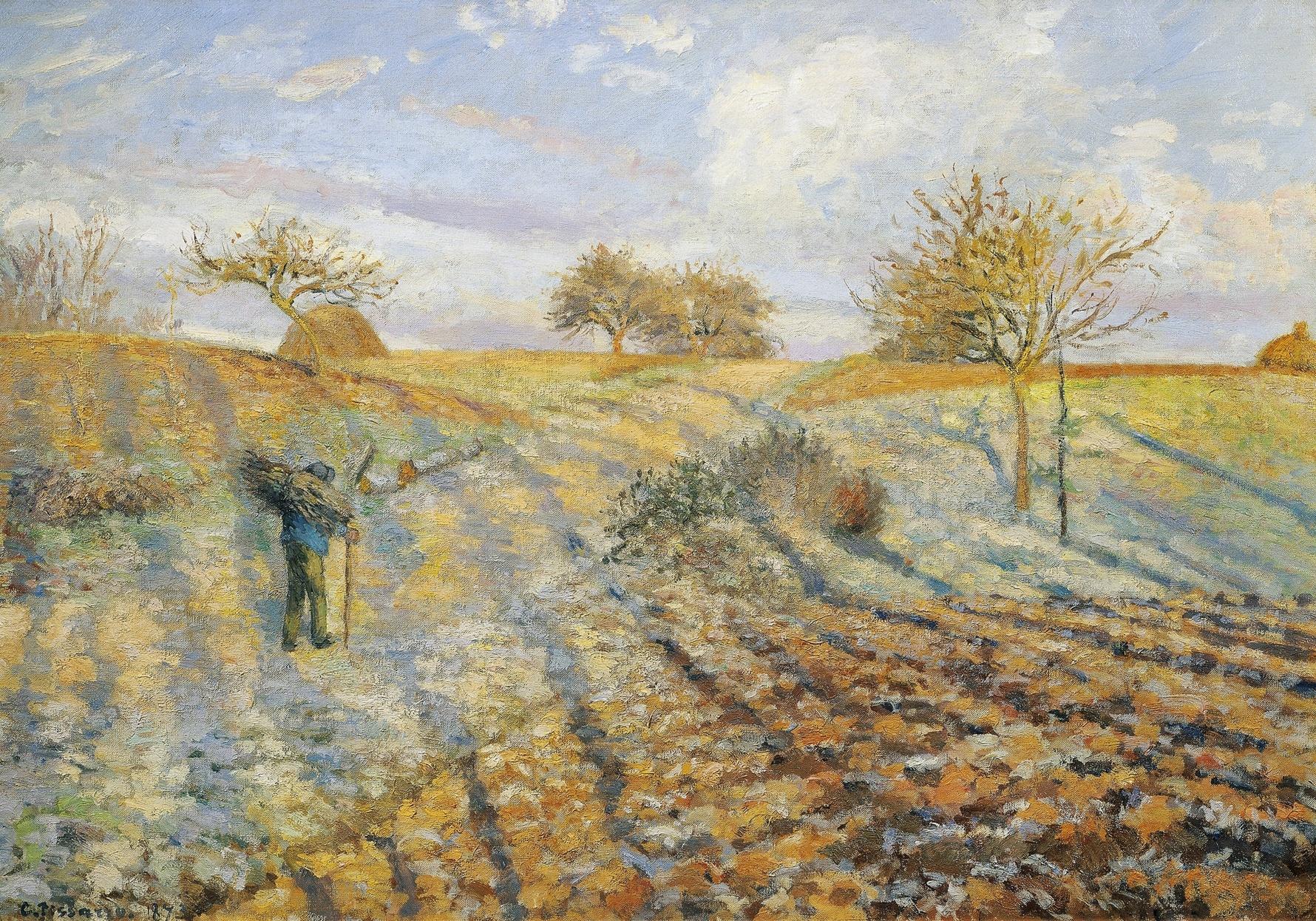
They are among the biggest names in late 19th and early 20th century French painting. Their artworks fill textbooks and the world’s most prestigious museums. This fall, Pissarro, Manet, Morisot, Renoir, and Rousseau have special exhibitions across America putting masterpieces drawn from around the nation and Europe and on view.
Camille Pissarro
Camille Pissarro (1830–1903) serves as the answer to one of art history’s great trivia questions: Who was the only artist to show work at all eight Impressionist exhibitions in Paris?
Pissarro isn’t the most famous French Impressionist–he’s not in the top 5–but his ceaseless encouragement of the group’s members, his unwavering support, and his friendship made him something of the movement’s “glue guy.” Steady Eddy.
He was a damn good painter, too.
Opening October 26, 2025, at the Denver Art Museum, “The Honest Eye: Camille Pissarro’s Impressionism” is the first major American museum retrospective dedicated to the rock of Impressionism in more than four decades. The overview of his illustrious career examines Pissarro’s singular role within the Impressionist movement, including the period in which he strayed from painting in an Impressionist style. He’d come back late in life with dramatic results.
The exhibition brings together more than 80 paintings from nearly 50 international museums and private collections, alongside six works from the DAM’s holdings. On view through February 8, 2026, “The Honest Eye” will feature landscapes, cityscapes, still lifes, and figure paintings, showcasing the breadth of Pissarro’s output and the various influences that shaped his practice as he responded to the social and political environment of the day.
Like all the original Impressionists, Pissarro’s artwork responded to Paris’ rapid urbanization and tumult occurring during the latter third of the 19th century. Unlike his contemporaries, Pissarro held a continued fascination with the daily life of the working class. He was a socialist.
Notice how many more figures his Impressionist paintings feature than his contemporaries. Working people. Rural people. Peasants. Notice how he glorified them and their labor.
These paintings illustrate the ways in which he drew inspiration from sources beyond nature, looking to farms and fields, town squares and marketplaces, portraying peasants harvesting hay and tending to chores, and butchers selling their wares to the local townsfolk.
Selections from Pissarro’s letters provide insights into his worldview and artistic process.
“Pissarro was a true architect of the impressionist movement. His colleague and friend Cézanne called him ‘the first impressionist,’” Clarisse Fava-Piz, Denver Art Museum Associate Curator of European and American Art before 1900, said. “Pissarro was a defining figure whose oeuvre captured a changing society in the throes of industrialization, straddling the rural and urban in his depictions of daily life.”
The exhibition closes with a significant selection of paintings capturing life in Paris, the artist’s greatest work. From hazy depictions of the morning commute in Montmartre and lively city scenes of the Pont Neuf to peaceful moments at the Louvre and the Tuileries, Pissarro’s Paris, as painted from above, out a hotel window–an eye affliction preventing him from extended painting outside–are unsurpassed in Impressionism. Pissarro was the oldest of the Impressionists and some of these paintings were produced in the last full year of his life.
Édouard Manet and Berthe Morisot
Édouard Manet (1832–1883) and Berthe Morisot (1841–1895) would have been absolute cat nip for the tabloid press had they lived in the late 20th century and not the late 19th. Were they? Weren’t they? Friends? Lovers? The older French dandy from money with social status, always making the scene, a scandalous painter, and the younger beauty, also possessing status, equally as bold in her own way and prodigiously talented.
Their first encounter seems to have taken place at the Louvre, where, like Morisot, Manet was copying after the old masters. How’s that for a “meet cute?”
Opening at San Francisco’s Legion of Honor on October 11, 2025, and featuring masterpieces lent from public and private collections on both sides of the Atlantic, “Manet & Morisot” marks the first major exhibition dedicated to the formative friendship between the two, presenting new research casting this friendship—and, by extension, the story of Impressionism—in a fresh light. Manet never showed his paintings at the Impressionist salons, rejecting the label, but Morisot did, seven times, women of the era not afforded the opportunity to be so choosy about where to exhibit.
Living and working in Paris in the late 1800s, Manet and Morisot were friends, colleagues, and, after her marriage to his brother in 1874, family. The story of their relationship unfolds over roughly 15 years (1868–1883), most often being told through the portraits Manet painted of Morisot between 1868 and 1874; Morisot cast as a muse and model rather than as esteemed peer. More recent scholarship confirms that, although Morisot looked to Manet for inspiration and approval during her early career, by the mid-1870s, Manet began to follow Morisot’s example, emulating her choice of subjects, colors, and her fluttering brushstrokes. Through carefully selected pairs and groups of paintings, the exhibition will trace the evolution of the two artists’ friendship and mutual influence.
The show starts at the beginning of Manet and Morisot’s friendship with paintings of Morisot by Manet, including Manet’s iconic The Balcony (1868-1869), one of the most esteemed paintings in art history, on rare loan to America from the Musée d’Orsay. This one painting alone would be worth going far, far–far–out of your way to see. A striking, dusky Morisot sits at the railing in the painting.
Another of the exhibition’s many highlights reunites for the first time a series of paintings in which Morisot and Manet depicted the four seasons of the year as fashionable women: Morisot’s Summer (1878) and Winter (1880), and the paintings by Manet that they inspired, Spring and Autumn (both 1881).
Pierre-Auguste Renoir
Organized with the Musée d’Orsay, “Renoir Drawings” at New York’s Morgan Library & Museum brings together over 100 drawings, pastels, watercolors, prints, and paintings, inviting visitors to engage with Pierre-Auguste Renoir’s (1841–1919) creative process while offering insights into his artistic methods.
While Renoir’s paintings have become icons of Impressionism, his drawings are less well known. The first comprehensive exhibition devoted to his drawings anywhere in the world since 1921, “Renoir Drawings” assembles outstanding examples of all the media on paper in which Renoir worked, from pencil, pen and ink, chalk, pastel, and watercolor to etching and lithography.
The Pissarro, Manet and Morisot, and this exhibition serve as a passport to Paris, a visit to the great home of Impressionism–the Musée d’Orsay–without leaving the country.
Henri Rousseau
Henri Rousseau (1844–1910) was not an Impressionist, he was a Paris tariff clerk. He began making art while on the job and left his position in 1893 at age 51 to pursue a career as a professional artist. Self-taught, Rousseau was ridiculed by critics during his lifetime, eventually becoming lauded as a genius and influencing many subsequent avant-garde artists including Picasso.
The Barnes Foundation in Philadelphia presents “Henri Rousseau: A Painter’s Secrets” (October 19, 2025 through February 22, 2026), a landmark exhibition of paintings featuring works from the Barnes collection and museums around the world.
With 18 paintings by Rousseau, the Barnes is home to the world’s largest collection of works by the artist, and the Musée de l’Orangerie, Paris, with 11, is home to the second largest collection. This exhibition brings together these important collections, providing an unprecedented opportunity to see works that the French art dealer Paul Guillaume either owned—now in the Orangerie’s collection—or sold to Barnes. Some of these paintings will be reunited for the first time in more than 100 years, while others have never been exhibited together.
Exceptional loans from major museums, including The Sleeping Gypsy (1897) from the Museum of Modern Art, New York–one of the most famous paintings in art history, a crown jewel in MoMA’s collection rarely exhibited outside its walls–make this the most significant presentation of Rousseau’s work in decades. For the first time ever, three of Rousseau’s major works will appear in the same space: The Sleeping Gypsy, Unpleasant Surprise (1899–1901, the Barnes), and The Snake Charmer (1907, Musée d’Orsay, Paris). Not even the artist himself witnessed this grouping; by the time he made The Snake Charmer, The Sleeping Gypsy was no longer in his possession.
nd