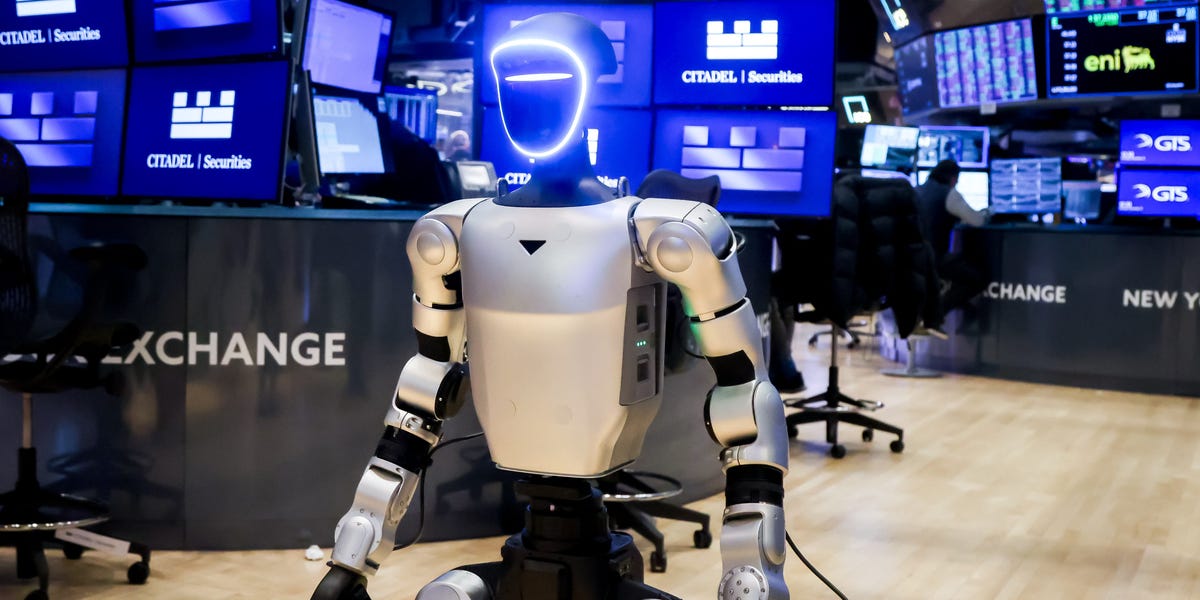
AI can seemingly do more every day, but investors are keeping it at arm’s length when it comes to letting it make decisions about their money. That’s according to Vanguard, whose survey of over 6,000 investors revealed that attitudes about AI remain chilly even as agentic tools broaden its capabilities far beyond simple chat. Meta kicked off a new chapter of the AI story last week with its debut of Muse, a personal AI agent, and popular investing platforms like Robinhood have announced agentic solutions for users looking to hand the keys to their portfolio over to AI. A study from a team at Vanguard led by Andy Reed, head of behavioral economics research at the asset management giant, recently revealed that while the number of people turning to AI for financial advice is rising, the majority still don’t trust it. Among the surveyed investors, 57% said they were uncomfortable with it taking any action for them. “The trust gap for AI is considerable,” Reed reported. “Across all ages, most investors have little to no trust in the financial guidance provided by conversational AI tools, but they have high trust in human advisors and planners.” AI has been used as a stock picking tool for a while now, in some cases even demonstrating it can beat the market. Dr. Alejandro Lopez Lira of the University of Florida, who tested the trading capabilities of popular models over several years, found that DeepSeek is by far the most proficient, achieving 74% gains since its launch. But Vanguard’s data shows that most investors are still more comfortable with a human in the driver’s seat when it comes to picking investments. Among Gen Z, millennial and Gen X respondents, 63% said they had either little or no trust in the technology, with only 5%-6% reporting high trust. Among boomer and older generations, trust is even lower, with 78% reporting low or no trust. “These findings reveal a sharp contrast between use and trust,” Reed said. “Many investors are willing to experiment with AI, and some are quite knowledgeable about it, but few are willing to place confidence in it.” Vanguard’s findings come as anxiety rises about the eventual impact of AI on a range of industries, as companies cite productivity gains in layoff announcements this year. Vanguard’s study acknowledged that AI could one day thin the ranks of financial advisors, but Reed said there’s still need for more human involvement in investment decisions, for now. But according to Reed, there may be more need for human financial advisors, not less. While financial advice from AI is free and available 24/7, the quality of its advice is questioned by investors. “We find little evidence of a ‘crowd out’ effect,” he noted. “Instead, we see a robust ‘crowd in’ effect on demand, whereby AI is 11 times as likely to enhance—rather than diminish—the perceived value of human advice.”
Trending
- Federal Reserve and bond market sending conflicting signals before key September employment report
- Why Noa Argamani chose venture capital after 246 days in Hamas captivity
- Agentic AI Executes Stock Trades, Yet Investors Remain Reluctant to Let It Manage Their Funds
- I earn $263,000 in annual revenue from my Substack side hustle. It’s an incredible bonus to my writing career.
- The 3 qualities that will get you promoted, according to Nestlé’s CEO
- An investor turned a century-old house into a rental that cash flows $2,500 a month. He shares how he financed it with 5% down.
- Netanyahu hails passengers who stopped a pilot after he stabbed the captain and tried to crash the plane
- Why Oil Prices Remain Near $100 Despite Recovery in Persian Gulf Exports
Thursday, October 1