

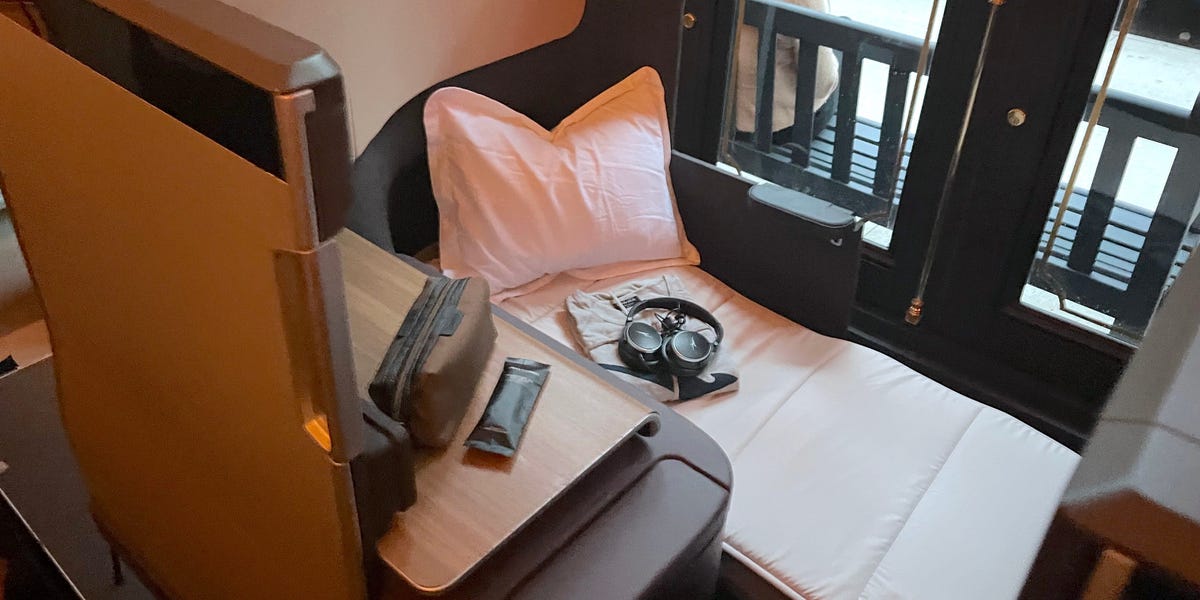
Flying between New York and Australia is about to become much more enjoyable. As part of Qantas’ “Project Sunrise” initiative, which aims to provide more direct routes to and from Australia, the airline is introducing specially modified Airbus A350 aircraft with luxurious cabins. This includes updated first, business, premium economy, and standard economy classes, with nearly 100 premium seats available at a higher price—something airlines are focusing on as travelers are willing to pay for a better flying experience. At an event in New York City on Tuesday, I got a preview of what the new business-class seats will look like. Qantas announced that the cabins will be launched on the Sydney-London route in October 2027, followed by the Sydney-New York route in mid-2028. Once operational, these routes will become the world’s longest flights, covering approximately 10,000 miles and lasting up to 22 hours, surpassing Singapore Airlines’ current Singapore-New York route. However, these flights will not be affordable: passengers will likely pay a premium for tickets due to the aircraft’s lower capacity, higher fuel and crew costs, and its exclusivity on non-stop routes. Qantas’ current one-stop business-class flights from New York to Sydney, with a stop in Auckland, cost up to $13,000 round-trip in mid-November. Here are the most exciting features to expect in Qantas’ new A350 business class: sliding doors, upgraded technology, memory foam mattresses and premium amenity kits, and science-backed designs to reduce jet lag.
Sliding doors: Sliding privacy panels are a first for business class on Qantas. The retractable doors are nearly 4 feet high and create an enclosed suite that is 3.5 feet wide.
Upgraded technology: In addition to power outlets and USB-A and C charging ports, the new seats feature wireless charging.
Memory-foam mattresses and fancy amenity kits: Michelle Luk, senior manager of product and service strategy at Qantas, invited me to try a sample mattress, which is an additional layer placed over the lie-flat seat. I could certainly see the plush topper making an 18-hour flight more comfortable.
Science-backed designs to reduce jetlag: As part of the decade-long development of Project Sunrise, Qantas partnered with the Charles Perkins Centre, a medical research institute at the University of Sydney, to study the effects of long-haul flights on travelers.
Passengers on Project Sunrise test flights have volunteered as research subjects, wearing heart-rate and sleep sensors and undergoing testing to help shape evidence-based cabin optimizations that reduce jet lag.
One of these new health-focused features is the “Wellbeing Zone,” an area that offers refreshments, guided-stretch videos, and extra space to move around. Located between premium economy and economy, it will be available to passengers in all classes.
Qantas CEO Vanessa Hudson told Themoneytimes that these enhancements have proven “statistically significant” in reducing the effects of jet lag.
“The way we’ve designed the lighting, the Wellbeing Zones, the way we design the food, is all around making sure that when you do arrive after the long flight, you feel as fresh as you possibly can,” Hudson said.