

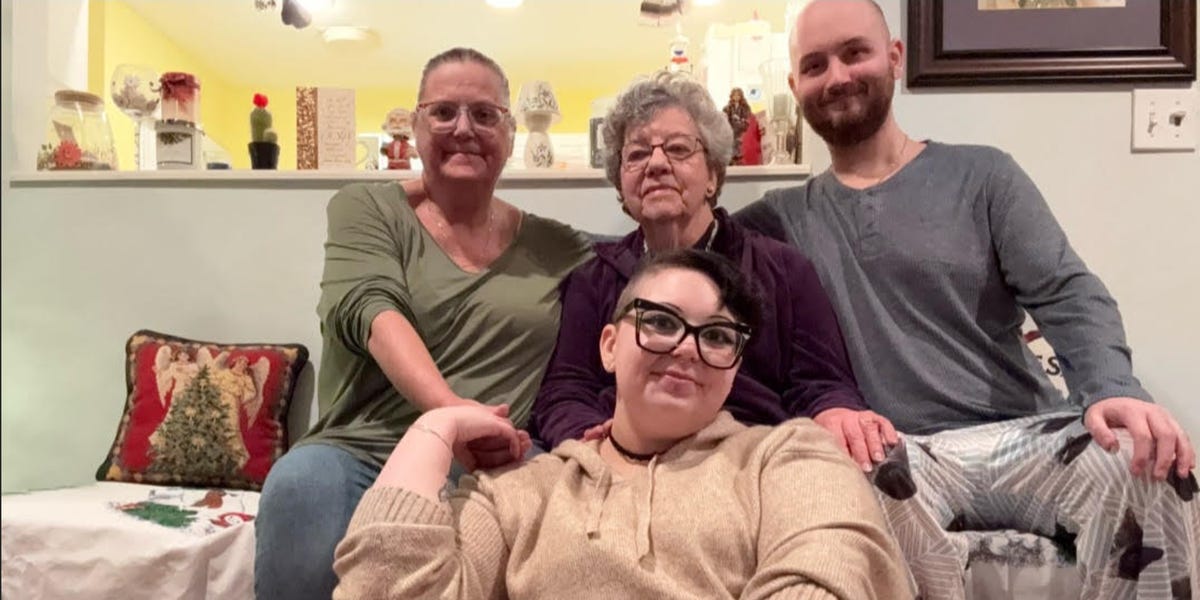
This essay is based on a conversation with Laura Lee Ehrlich, a 54‑year‑old resident of Long Island. Over the past twenty years she has cared for five elderly relatives and gave up her job to be fully present for them, a sacrifice that has strained her finances and emotional health. The interview has been condensed for brevity and clarity.
I am the youngest of five siblings. My mother held many jobs during my childhood, while my father worked in the city; when his shifts were irregular, my older brother essentially became the head of the household.
My mother, employed by a surgeon, secured me a position at his practice where I worked for seventeen years. My sister and I also ran the family’s medical billing business, handling insurance verification, and I am now attending nursing school.
I wish I had followed my mother’s advice and pursued this path when I was eighteen.
I Have Served as My Family’s Primary Caregiver
For the past two decades I have alternated between working and staying home due to my family’s health crises. I chose to stop working altogether to care for my father.
In 2002, my infant son was present when my father was rushed to the hospital. A cardiologist intervened, arranging for my father to be transferred to a Manhattan hospital, where he underwent open‑heart surgery after being diagnosed with a fatal heart attack.
Doctors initially gave him only six months to a year to live, but he survived for six more years. His health gradually deteriorated, developing mini‑strokes, becoming homebound, and requiring constant care from my mother; I lived with them, and his frequent falls led to numerous emergency visits before he passed away in 2008.
My husband died unexpectedly in July of the same year. The hospital listed his parents as next of kin and kept him alive for four days while evaluating his organs for donation, which overwhelmed me.
Soon after, my father‑in‑law was diagnosed with prostate cancer. I escorted him to radiation appointments and handled his errands, as his only US relative, his sister, lived in Florida.
Want more Themoneytimes in your news feed?
Add Themoneytimes in Google so our reporting is easier to find when you’re searching for what matters.
When my father‑in‑law fell ill again in 2021, we placed him in a nursing home because he could no longer care for himself. I managed all the paperwork and was appointed his power of attorney.
I received Family and Medical Leave Act benefits, but when those ended I returned to work. The constant calls from the nursing home became unmanageable, so I tapped into my savings and used my 401(k) funds.
I exhausted my retirement savings.
Then my aunt was diagnosed with pancreatic cancer, and I became her primary caregiver. I accompanied her to chemotherapy sessions and stayed with her for several hours after each treatment to monitor her condition. Although not working, I received modest compensation for my caregiving.
After her chemotherapy, she suffered a fall that required spinal fusion of two vertebrae. I resumed caregiving, performing wound care, and eventually she was able to manage with a cane. For a few years I was not a full‑time caregiver, and I moved to Tennessee with my children for a year.
My sister organized a trip for my mother to Georgia to visit family. While there she suffered a pelvis fracture, a thigh bone break, several other fractures, and a wrist injury. After three days of disagreement, we admitted her to a rehabilitation facility. Her cognition began to decline, and my siblings and I ensured she had everything she needed. After trying several unhelpful aides, we moved in with her on a rotating 24/7 schedule.
She often didn’t recognize where she was or who was around her, a situation that persisted for about a year and a half. At the pandemic’s start she fractured her femur while hospitalized; we obtained a hoist lift, but her condition worsened, and she died in 2021.
My aunt invited my children and me to stay permanently, but it quickly became clear she was developing Alzheimer’s disease. I spent the day supervising her to prevent scams or mistakes, managed her medication, and hired a part‑time aide for respite; this arrangement lasted a year and a half before we took her car away.
One afternoon at the mall she fell and broke her femur. After rehab she entered an assisted‑living community, which I’m not entirely pleased with. She has been there for roughly a year, and while I know I should be more involved, I find it overwhelming.
I was appointed her trustee and receive a modest living stipend that covers her expenses; I do not pay for her home.
I care for my 85‑year‑old mother‑in‑law, who needs no medical treatment beyond transportation to her appointments. I handle her bills and mail because of her vision problems, clean her home, make repairs, and spend about four hours with her three times weekly. Estimated caregiving costs range from $1,000 to $2,000 per month.
I Anticipate My Life Beginning After My Mother‑in‑Law’s Passing
I approach each day one step at a time. My only plan is to care for my mother‑in‑law; when she is gone, I believe my life will truly begin. I aim to finish nursing school and secure a job that allows me to travel and provide in‑home physical care, giving me financial independence.
I have yet to fully process the loss of my parents, husband, and father‑in‑law. I have erected an emotional barrier, moving from one person in need to the next. The burden is exhausting and draining. My new granddaughter is my greatest source of joy.
I advise people to purchase long‑term care insurance at eighteen; by the time they need it, they may not afford it. At fifty‑four I cannot afford an $800 monthly premium, so I prefer relying on Medicaid to avoid nursing home costs. Staying close to family is vital for mental health.