

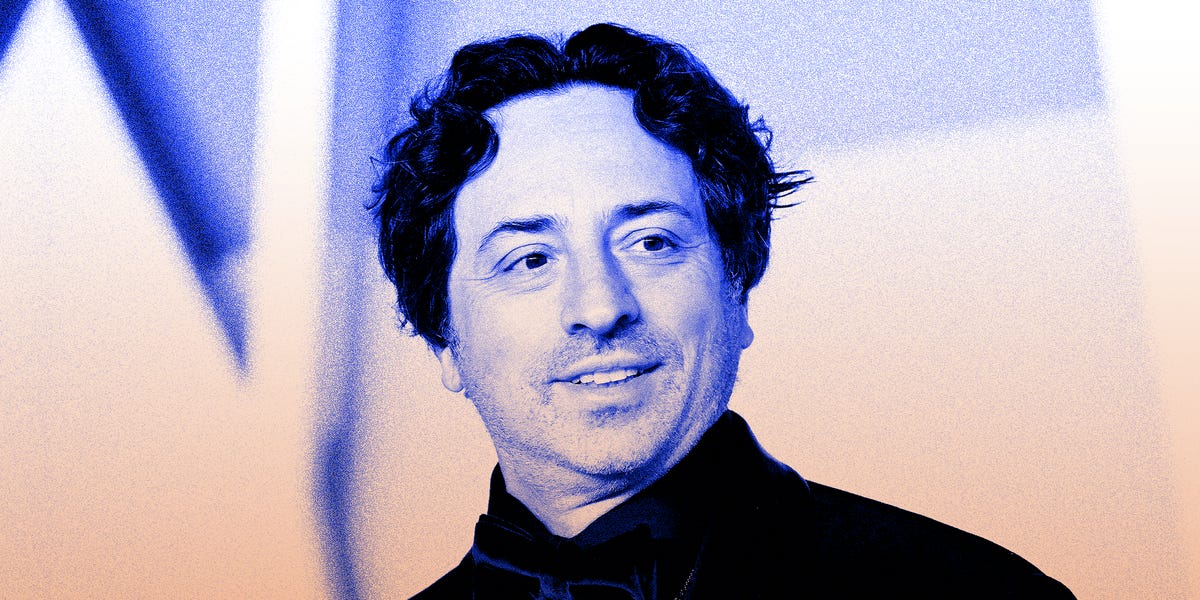
Google’s AI destiny is being cooked up in a California kitchen.
On the second floor of Gradient Canopy, a tent-like structure that rises east of Google’s Mountain View headquarters, is a microkitchen filled with many of the typical fixings: coffee beans, grinders, an espresso machine, a fridge. Less typical is the U-shaped formation of desks, used by Google cofounder Sergey Brin and a handful of mission-critical leaders who are steering Google through an AI race it can’t afford to lose.
Google CEO Sundar Pichai visits the break-turned-war-room several times a week. Employees from other parts of the building sometimes saunter in for an extended snack break, hoping to overhear gossip that could reveal Google’s next big move. There are whispers that cofounder Larry Page has been spotted there.
This unlikely nerve center has gained more influence in the weeks since Google shook up its AI leadership.
Google DeepMind CEO Demis Hassabis, who was helping steer the company’s AI efforts from London, relinquished his title and became Alphabet’s chief scientist. Koray Kavukcuoglu, who moved from London to the US last year and now sits alongside Brin in the microkitchen, was appointed SVP of Google DeepMind, effectively replacing Hassabis. Jeff Dean, Google’s longtime chief scientist, left the company after 27 years.
Brin’s role in the new power structure went unmentioned.
However, the man who helped launch Google from a garage nearly three decades ago has become increasingly influential over Gemini, eight current and former employees told Business Insider, in part thanks to his unique ability to pull resources for critical work and cut through the tech giant’s bureaucracy. The latest changes at the top, some of them said, could give Brin even more sway over Gemini.
It’s a role seen by some inside Google as necessary after the 2023 merger of the company’s two central AI labs led to friction over the direction of Gemini that slowed progress and prompted a stream of departures. Some of Mountain View’s leaders became frustrated with Hassabis and other researchers in London, believing they weren’t as pragmatic about making Gemini more competitive to rivals, two people familiar with the matter said.
Up against the corporate machinery of Google, the microkitchen has acted as something of a startup inside the larger company, allowing Brin, Kavukcuoglu, and other leaders to make decisions faster. “The promise of the kitchen is that it can help you cut through the politics,” said one former employee familiar with the setup.
Such decisions are more crucial than ever. Google has fallen behind the frontier, which is putting more pressure on it to make its next model, Gemini 4, a blockbuster event. The company has lost top talent in recent months, including star computer scientists John Jumper and Noam Shazeer. Against this backdrop, Brin has urged employees to double their efforts on Gemini.
“Demis is obviously very talented, but he’s moving farther away, not closer, to the operational part. This glimmer of hope is this notion that Sergey will get more involved,” said Gil Luria, head of technology research at the investment bank D.A. Davidson. “They need a big change that will cut through that bureaucracy.”
Google declined to comment on this story, and declined to make Brin and other leaders available for interviews.
Letting Brin cook
Brin’s position is highly unusual.
He no longer holds an executive title at Google, yet he and Page have decisive influence over the company’s board due to a special controlling stock.
After he and Page stepped back from running Alphabet in 2019, Brin spent his time building airships, partying at Burning Man, and writing about physics. When ChatGPT launched in late 2022, and Google was suddenly playing catch-up, Brin said the temptation to return to the trenches was just too much. “As a computer scientist I’ve never seen anything as exciting as all of the AI progress that’s happened in the last few years,” he said during the All-In Summit in Los Angeles in 2024.
Brin’s unique perch inside Google makes him a powerful ally for any Googler who wants to accrue more support for their project or idea. Getting access to Google’s chips, even for the Gemini team, can be difficult. The official route is to submit a formal document and get buy-in from higher-ups. Another route is to strike a deal with a different team inside Google to use their chips in exchange for, say, building Gemini features for their products, two people familiar with such arrangements said.
The other, less official route is to go to Brin.
“Koray has more explicit power in the hierarchy, but Sergey is the founder of Google,” said a former senior employee. “He’s able to cut through bureaucracy and clear red tape in a way no one else can.” People who have worked at Google DeepMind said Kavukcuoglu and Brin have a good rapport, and that when Brin wants something done, he will often do it through Kavukcuoglu. However, Brin usually gets his way, three people said.
Over the past two years, the microkitchen’s gravitational pull has grown stronger. Kavukcuoglu moved from London to Mountain View last year and now sits close to Brin. Sebastian Borgeaud, a research engineer, also moved across the Atlantic last year and was appointed to lead work on improving Gemini’s coding abilities, two people familiar with the move said. A huddle of desks was set up for the coding strike team inside the microkitchen, close to Brin and Kavukcuoglu, a person familiar with the matter said.
“Sergey wants to run Gemini like a startup,” said a former employee with direct knowledge of the arrangement. “If you want to be part of the startup, you have to be in the microkitchen.”
Emanuel Taropa, a Google fellow and a legendary name in the AI research community, often sits in the kitchen, two people said. So does Enrique Piqueras, a senior research engineer on Gemini, who insiders described as an especially close ally of Brin’s. Another oft-spotted face in the kitchen is Rahul Arya, a physics Olympiad who has played a central role in improving Google’s AI chips. Insiders say that Google has made a concerted effort not to publicize some of its most important stars for fear of them being poached.
If you can’t handle the heat
Brin has largely involved himself in the technical aspects of Gemini, weighing in on discussions about model sizes, release windows, and paths to artificial general intelligence, according to current and former employees. He also got involved in some internal disagreements last year over how Gemini should be integrated into Google products, two people said.
One idea Brin pushed earlier this year was to use software to monitor some Google employees as they coded, believing it could be a useful reinforcement learning technique to improve Gemini’s coding abilities, a person familiar with the project said.
At times, Brin has made calls that have frustrated some staff. In 2025, Dean, Google’s now-former chief scientist, was leading efforts to build a chip that would embed a version of the Gemini model architecture directly onto the silicon, a project internally codenamed Frozen. The project was unpopular among some Gemini leaders, two former employees said. Brin made the call to cut the project — a decision that frustrated Dean, who told some colleagues around that time he was considering leaving the company, said one of the people who heard the remarks.
The project was later revived as Frozen v2; however, some of its resources were stripped away from it earlier this year, the person added. Dean left Google in August to launch his own startup. He declined to comment on this story.
Some employees bristled at a post Brin made in an internal Google DeepMind work channel in 2025, stating that working about 60 hours a week is the “sweet spot” for productivity, which was first reported by The New York Times. One former manager said that they told their employees to ignore Brin’s memo.
Earlier this year, during a Q&A session at San Francisco’s AGI House, Brin was asked how he was splitting his responsibilities with Kavukcuoglu and Hassabis. Brin said he worked closely with Kavukcuoglu and would often “poke and prod” the teams when he was unhappy with their direction, describing himself as “sometimes a little bit disruptive.”
“I’ll be honest, I’m a little bit of a rabble-rouser,” he said.
Brain trust
When Google announced in 2023 that it would combine DeepMind with its core Brain AI team, it capped a near-decade journey for Hassabis. Since selling DeepMind to Google in 2014, the Nobel laureate had fought to keep his lab independent, determined to pursue research free of Google’s bureaucracy and untethered from products he considered irrelevant to his north star: building artificial general intelligence.
The 2023 merger was evidence to some inside DeepMind that any hopes of exercising independence under Google were misplaced. It was also around this time that Brin began showing up to work on Gemini. While Google said nothing publicly about Brin’s return, there were clues. A March 2023 post on LinkedIn showed Luxembourg Deputy Prime Minister Xavier Bettel meeting Pichai, Google’s global affairs president Kent Walker, and — wearing sweatpants — Brin.
Google was in wartime mode, but there was also a battle brewing within. Brain and DeepMind had different cultures, three people who worked there at the time said. Brain typically worked more closely on improving Google’s products, and teams in DeepMind had focused more on longer-term research that often didn’t have near-term commercial viability. “There was tension in the DNA of what DeepMind wanted to be,” said a former employee. “Do they want to be a 10-year research bet working on things that make humanity incredible, or are they going to win this 3-6 month horizon race between the labs?”
In 2023, Kavukcuoglu chose to build Gemini using some of the people and infrastructure behind Chinchilla, a prior language model developed by the London DeepMind team, rather than on Google’s PaLM 2. The decision was unpopular with some researchers in Mountain View, who saw it as favoritism toward the London group, two people said.
After Brin returned to the trenches in 2023, he began working in the microkitchen. Taropa, the Google fellow, was also a core founding member of the kitchen office. Over time, more desks were added, and the space became the de facto command center, often referred to by staff as “Sergey’s microkitchen.” At one point, an overflow space was added because many employees wanted to be closer to what had quickly become the power center of Gemini.
‘AGI-pilled’
Brin has spent less time in the kitchen in recent months, sometimes showing up on alternating weeks, according to two people who have seen him there. Ahead of a possible new billionaire’s tax, the Google cofounder moved some of his personal assets out of California last December and purchased homes in Florida and Nevada.
The measure, if it passes on a November ballot, would impose a one-time tax on California residents with a net worth exceeding $1 billion. Brin, who has mounted a large-scale opposition effort against the tax, could be liable to pay $14 billion if he were considered a resident.
Ahead of the recent leadership shuffle, Brin appeared frustrated with the pace at which Google is moving on Gemini and has pushed employees for more focus on recursive self-improvement (RSI), the point where systems can improve themselves, current and former employees said. “He’s very invested in RSI. He’s very AGI-pilled,” said one former employee. Reuters previously reported on some of Brin’s remarks around RSI.
Insiders described the August reorg as a win for the more technical side of the company and the further erosion of DeepMind’s independence, underscoring the commercial reality of the AI race. In recent weeks, the company has shown signs of positive progress. It recently rehired Barret Zoph, the Thinking Machines Labs cofounder, in what some insiders said could be a big win for Google. The company has said its latest Gemini model shows “significant” improvements in coding.
Will it be enough? Google is still bleeding talent. The AI coding software market has fast become crowded, which could make it harder for Google to break in meaningfully, said Luria, the analyst. What Google needs, he said, is a major breakthrough that will vault its models to the state of the art. “Short of that, everything is tactical, and they’ll continue to need to catch up,” he said.
The September release of ChatGPT’s Astra model appears to have pushed the frontier forward again, and OpenAI CEO Sam Altman has suggested even smarter models are waiting in the wings.
Google needs momentum, and with Brin more involved than ever, some employees are hopeful it will find it. From a garage to a kitchen, Google’s most consequential work has a habit of happening in unlikely rooms.
Have something to share? Contact this reporter via email at hlangley@businessinsider.com or Signal at 628-228-1836.