

Elvis Costello recently recalled his earliest experience with Bob Dylan’s music as a kid growing up in Britain in the 1960s.
“I didn’t have the pocket money at the age of 11 to be buying all those records,” he told a packed audience at New York City’s Paris Theater Saturday afternoon. “And when I checked the chart placings of those records [like “The Times They Are A-Changin’” and Like a Rolling Stone”]
, all of those records except “Maggie’s Farm” were Top 10 single hits for Bob Dylan. So we were hearing Bob Dylan not as an album artist, but as a singles artist on the Hit Parade alongside Freddie and the Dreamers and Tom Jones and, of cours,e the Beatles and the first records from Motown. And that is how I first heard him.”
Those are some of his Dylan memories that the acclaimed British singer-songweriter shared following a one-hour presentation at New York City’s Paris Theater of short films and videos from the Bob Dylan Archive, hosted by Steven Jenkins, the director of the Bob Dylan Center based in Tulsa, Oklahoma.
Among the footage featuring Dylan over the decades from that presentation was a snippet of Autopsy on Operation Abolition, a 1961 film, which marked his first foray into soundtrack work; a 1963 solo performance of “Ballad of Hollis Brown” on the TV show Folk Songs and More Folk Songs; a blistering take of “Maggie’s Farm” at the 1965 Newport Folk Festival with guitarist Mike Bloomfied; a duet with Joan Baez on “I Pity the Poor Immigrant” from the 1976 Hard Rain TV special; a rendition of “When the Night Comes Falling From the Sky” with Tom Petty and the Heartbreakers in the 1980s; and tributes to Johnny Cash and Tony Bennett with “Train of Love” and “Once Upon a Time,” respectively.
Costello has a connection with the Bob Dylan Center, having curated a jukebox playlist of Dylan songs and covers. He also participated in a recent all-star concert celebrating the 50th anniversary of the classic Blood on the Tracks album held in Tulsa.
“When I’ve been there,” he said of the center, “it is equally fascinating for somebody who believes they know the secret to this mysterious artist and have read every book and have pondered every lyric. And people that simply know, ‘Oh, he’s that guy that has the harmonica on …what is that contraption?’ They maybe don’t know very much more than his name. When you walk through, the story that is told is engaging of whatever level of curiosity you have, and it’s satisfying.”
Costello also remembered the first time he met Dylan in person in 1978 backstage after a show at the Universal Amphitheater that Costello attended, occupying a seat originally reserved for Barbra Streisand, who was unable to attend.
“It was a wonderful show,” he said. “A man was lurking next to me, and he said, “When Mr Dylan sings “Blowin’ in the Wind,” that’s your signal.’ I said, ‘My signal for what?’ He said, ‘You come with me then.’ I said, ‘Where are we going?’ ‘Backstage.’ And that was how it turned out that I was greeted at the backstage entrance by Bob’s then-agent and manager on the road, Jerry Weintraub, and invited me into the green room.
“Sometime later, Bob walked in and looked me up and down, and he said, ‘Well, I heard a lot about you.’ And the words that came out of my mouth will haunt me forever—I think you can probably guess what I said: ’And I’ve heard a lot about you.’ I’ve got to say, I’m very relieved to see that he found that funny.”
In 2007, Costello toured with Dylan, a moment he described as incredible. “I had nothing else to do in many of these towns, most of which seemed to be called Bloomington. I would have nothing else to do with myself until it was time to get to the next town. So I saw his set nearly every night. And it was marvelous because you got to see the way he negotiated with his own history, with his own focus on particular lyrics over others.”
On one particular evening from that tour, the two performed together “Tears of Rage,” a song co-written by Dylan and the Band’s Richard Manuel, that Costello selected. “I started to sing the first line, and I could see he wasn’t going to sing. And so I just kept singing. We got to the chorus and we harmonized. I started the second verse and I could see that look in somebody’s eyes when they’re going to sing. And I’m there and he sings a line that’s not in the lyrics. Not only was it not in the lyrics as I knew them, it didn’t rhyme with my next one. I hit my guitar so hard, it made him laugh.”
“This was the glorious little behind the curtain perspective that I had…It was a liberating thing to sing because I’ve cherished this particular song since I first heard it. So to get to sing a song written by two people that I admire my so much, and most importantly, the man who put the meaning into that melody, was an incredible experience.”
After the talk, to the delight of the audience, Costello performed three Dylan songs alone on guitar: “Ring Them Bells,” “Tomorrow Is a Long Time” and “I Threw It All Away.”
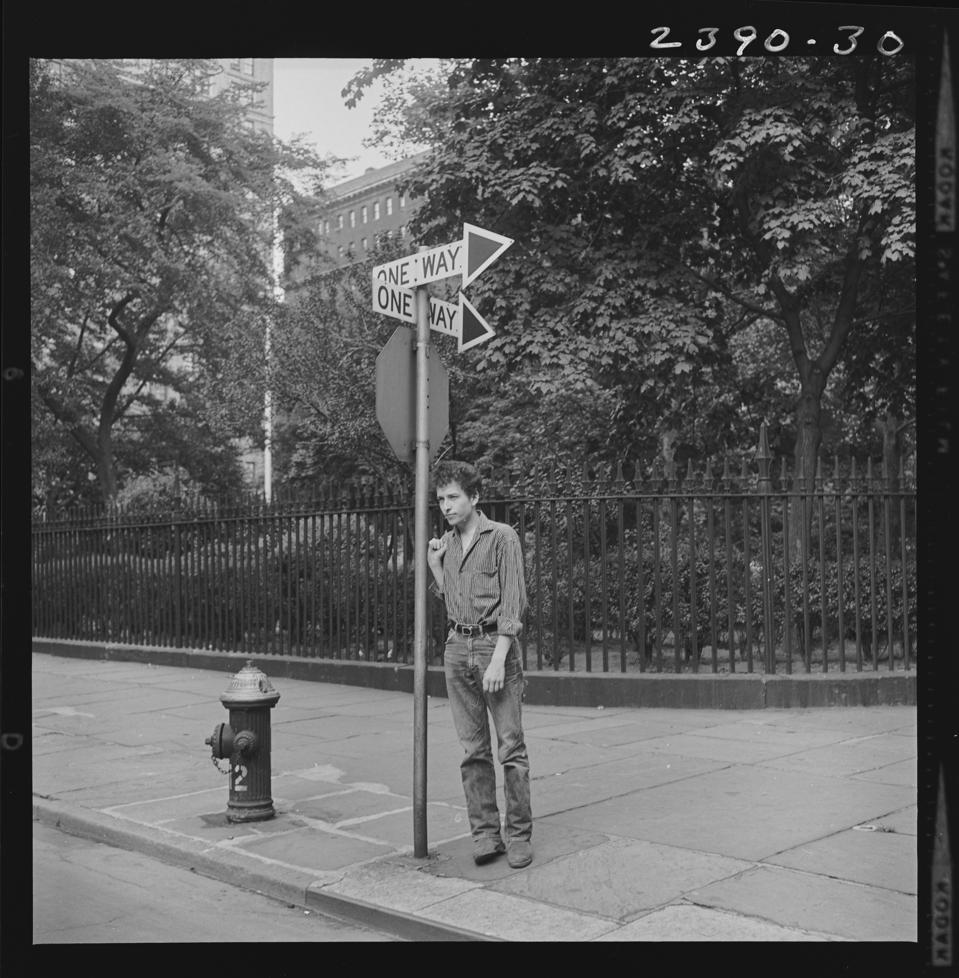
Saturday’s screening at the Paris Theater from Saturday coincided with a traveling exhibit by the Bob Dylan Center that is currently at New York University’s Gallatin Galleries. Titled How Many Roads: Bob Dylan and his Changing Times, 1961–1964, the exhibit focuses on Dylan’s early years in his career when he first arrived in New York Greenwich Village and took the folk scen by storm. The exhibit features artifacts from the period, including show flyers; newspaper clippings; sheet music of songs such as “Blowin’ in the Wind” and “The Times They Are A-Changin’” published in Broadside magazine; and the cover art of a proposed live record, Bob Dylan in Concert, that was never released.
The exhibit runs through Oct. 15.