

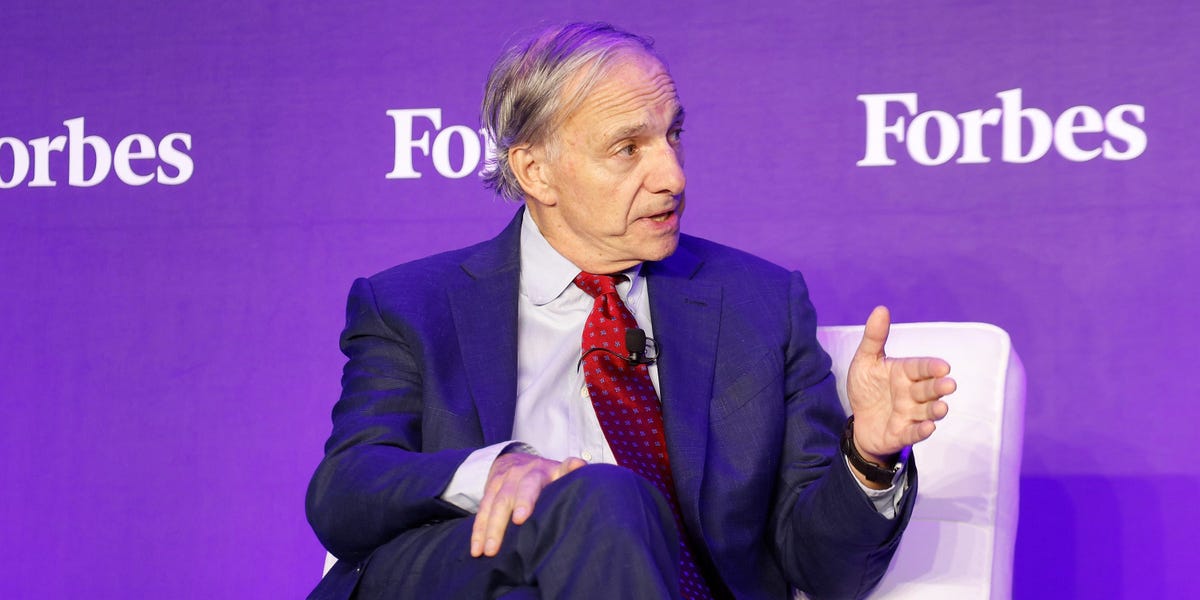
This year’s surge in interest rates has rattled Wall Street, but Ray Dalio thinks there’s more than just the fate of the bull market at stake.
The billionaire founder of Bridgewater Associates hedge fund said this week that he’s increasingly nervous about the direction of bond yields and borrowing costs. His bearish thesis centers on the idea that AI hyperscalers and governments are becoming locked in a running battle for investor capital.
“The way I would think about the 2027 challenge is that the supply of debt will likely rise from about $3.5 trillion annual net debt supply in 2025 to about $4.4 trillion in 2027, which is an incremental ~$0.5 trillion per year, not including debt rollovers,” Dalio wrote on X.
“That produces lower prices and higher yields on financial assets when demand isn’t strong, which is the current case,” Dalio later added of the effect of heightened supply.
Dalio’s concerns echo a warning sounded this week by the International Monetary Fund, which said in a report that problems could arise as tech companies compete with sovereign debt issuers, driving up government bond yields.
Dalio this year has said that he sees a debt crisis coming for the US, mostly recently eyeing the next two years for one to materialize. His primary focus has been on soaring government debt levels, but his expanded thesis now includes the explosion of AI-linked debt issuance that’s flooded the fixed-income market.
“This market is now beginning to tighten as investors are beginning to require larger concessions to absorb the supply,” Dalio stated. “Net corporate debt issuance was about $700 billion in 2025 and is expected to be about $1.1 trillion in 2026 and about $1.4 trillion in 2027. This market should be viewed as the canary in the coal mine.”
While these factors have pushed both credit spreads and funding costs higher, the overall impact so far has been fairly modest. Dalio added, though, that tech companies have increased their bond issuance significantly this year, to roughly $220 billion in early 2026, from $108 billion in all of 2025.
This is will likely be a major source of pressure for markets, Dalio said, particularly if the funding shortfall that he sees does indeed play out. Economists such as Apollo’s Torsten Sløk have made similar claims regarding the consequences of Big Tech’s borrowing spree.
“We are now seeing that higher capex via higher borrowing and equity issuance is leading to declining free cash flow, which is the classic first stage of a squeeze,” Dalio said.