

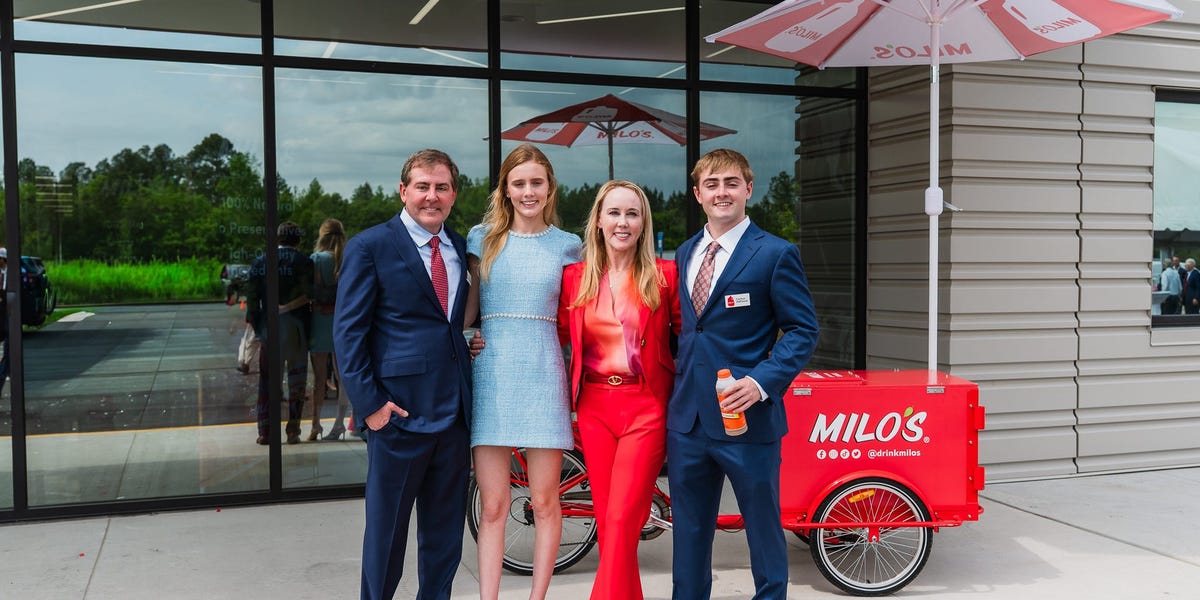
This as-told-to essay is based on a conversation with Tricia Wallwork, CEO and Chair of the Board at Milo’s Tea. It has been edited for length and clarity.
When my grandfather Milo came home from World War II, he married my grandmother Bea the following week. He often jokes that he started with just $20 and a footlocker, but he also carried a vision: a hamburger stand that would serve burgers, fries, pies, and sweet tea to Atlanta’s steelworkers.
That marked the start of Milo’s Tea. Over time the business has taken three distinct forms: the original burger stand, the franchise restaurants run by my dad and stepmother, and today’s tea operation that I lead.
Throughout each phase we have followed my grandparents’ founding principles: listen to customers, use genuine ingredients, and treat people with respect.
I became a lawyer, then joined the family business
I never wanted to work at the family business, so I pursued law. I imagined I would change the world, but in reality I was drafting letters and representing corporations. That wasn’t the path I had pictured, so I swapped my high heels for steel‑toed boots and began working at Milo’s.
My dad and stepmom noticed a pattern: customers would drive through their restaurants just to order sweet tea. Running a hamburger joint is tough, so they chose to sell the franchise company and use the proceeds to launch the first version of our tea plant.
I watched them improvise constantly — for example, using pantyhose to filter tea. Today the process is far more refined, yet I still retain that entrepreneurial spirit.
I’ve grown the company drastically over 14 years
I became CEO of Milo’s Tea in 2012, and since then our growth has resembled a hockey stick. In 2012 we recorded roughly $30 million in retail sales. By September we exceeded $1 billion in retail sales, surpassing our projections.
Being a third‑generation business owner in this situation is quite unusual. I have sought mentors to help me anticipate challenges and manage this rapid expansion.
I have surrounded myself with excellent advisors who have assisted me and the rest of the board — including my dad, stepmother, and stepsister — in being deliberate about family governance. We crafted a family mission statement and set a goal of staying 100 % family‑owned, which lets us take a long‑term view of our investments.
We have protocols for the next generation
While I hope my children will one day own the company, I do not pressure them to work here. I don’t want them to feel obligated to join Milo’s Tea, because that becomes a burden. I prefer they view it as an opportunity to achieve something remarkable.
We hold regular family meetings for the next generation to learn about Milo’s and provide a framework for involvement. After they finish college they can attend shareholder meetings; after two shareholder meetings they may join a board meeting. Participation is voluntary, merely an opportunity. So far both of my kids have taken advantage.
We also created an internship program where our children can learn about Milo’s by working an hourly job. If they wish to be hired here, they must first work elsewhere for at least three years and earn a promotion before applying. I like to say it’s merit, not inheritance.
Sometimes in family businesses the older generation clings to control until the end. My parents and grandparents were not like that. They have supported the next generation while stepping aside so that management and the board can truly drive growth. This blend of honoring our legacy while pushing forward is what has made Milo’s what it is today.