

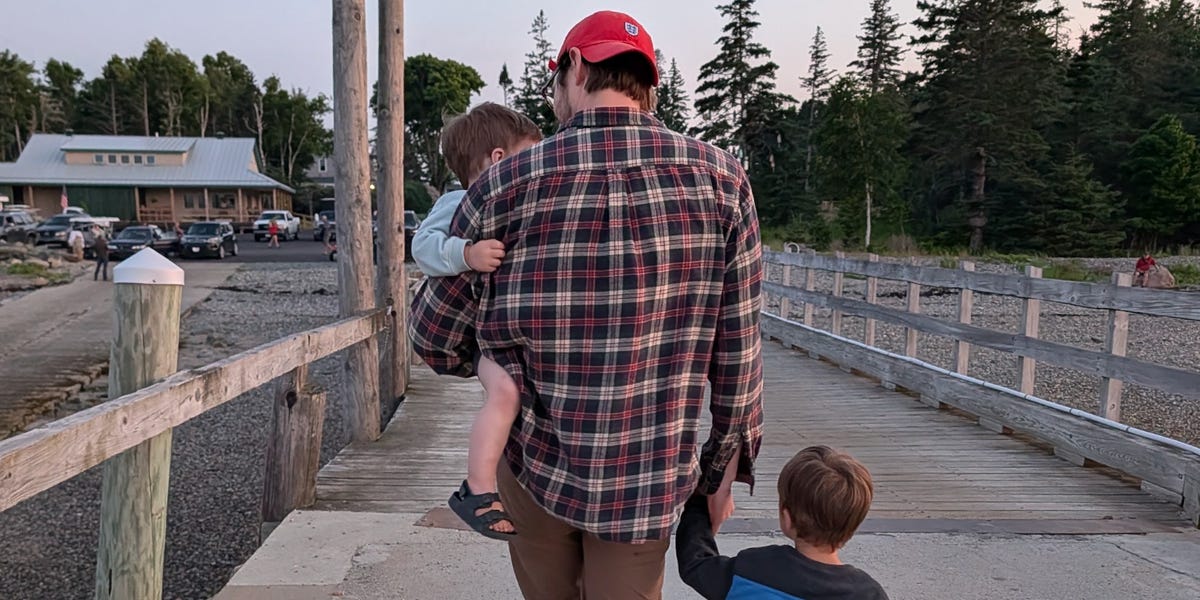
Three years ago, we were in Indiana. My husband Kevin was finishing grad school, and I was absently, fruitlessly scrolling through Zillow while our baby was napping in his crib.
Kevin had just secured a remote job, which opened the whole country up to us. This was exciting, until I realized we needed three bedrooms: one for us, one for our baby, and a third for a remote workspace.
A three-bedroom house on one income is hard to swing in most parts of the country, and I was feeling increasingly depressed about my search.
We’re both from New Jersey, and we really wanted to get back to the coast. It quickly became apparent that homes in New Jersey were out of our price range, so I kept zooming out (and out and out) on the map, certain that we’d have nowhere to go.
And that’s when a little pin popped up off the coast of Maine.
At first, the opportunity seemed too good to be true
I clicked on the listing and saw a three-bedroom house priced at $1,000 a month. After all of my searching, this really felt unlikely. Even more suspicious: The only picture was a blueprint. The house hadn’t even been built yet.
Some more sleuthing revealed that the project was being led by the Cranberry Isles Realty Trust (CIRT), an organization that provides affordable year-round housing on both Great and Little Cranberry Island.
The website described a tight-knit community set against a backdrop of ocean, pine trees, boats docked in a harbor, and the mountains of Acadia National Park across the bay. At this point in my life, I hadn’t even considered there being towns on islands that were only accessible by boat.
Once we confirmed the listing was indeed real, we had some questions … and some big conversations.
Deciding where to go is hard on its own, but choosing where to move with a young baby is even tougher. We weren’t just deciding where to live, but where our baby would first learn about the world.
The idea that he could experience untouched nature right outside our door was enticing. As was the idea of raising him in a real community, one where everyone knows each other and where the older kids roam free together in the summer — something that I didn’t think existed anymore.
The deal also felt too good to pass up. It didn’t feel like we could comfortably live anywhere else in the country for $1,000 a month.
This opportunity was strange, new, and a little scary, but also exciting … so we put in our application.
We fell in love with the island immediately
At first, it was just a daydream. We weren’t sure we’d get selected — and weren’t even sure we would move if we were — but it was a nice life to imagine.
About a month later, we got an email that we were scheduled for an interview, and we decided it was time to take a trip out to the island. We took a road trip with our then-4-month-old, and the next morning, we got on a small boat.
This boat is the official mail boat for the islands, meaning it transports all of our packages. It also transports people — this is how those without their own boats travel back and forth to the mainland.
We left our car behind and took the 20-minute commute to the place we would eventually call home.
It was a less-than-ideal June day, 56 degrees and raining. And still, the peace we felt in that moment is what lingered in our minds for months as we considered the potential of this move.
What struck us most was the quiet. There were no highways, and not a lot of people. We learned that there are around 60 year-round residents, and 250 in the summer.
Surprisingly, it was soothing to realize that without a boat, we wouldn’t be able to go anywhere until the ferry came back: When you’re here, you’re here. It was a sense of place and presence I hadn’t experienced anywhere else.
For two people from New Jersey, where there are a million places to go at all times, this was thrilling. And it set still an anxiety I have had running inside me for decades.
There are challenges, but I’m so glad we moved here
Of course, living on Great Cranberry Island also comes with difficulties.
A trip to the grocery store or a doctor’s appointment can end up taking the whole day. The ferry schedule determines when we have to rush back to the boat.
Sometimes there are several days in a row when the boats don’t run because of the wind, so we have to keep too many diapers on hand at all times, and reusable ones on standby. The winters here are long, too, and the feeling of isolation starts to creep up on you.
All of this is outweighed, though, by the breathtaking beauty of this place and a community that scrambles to help one another when needed.
I question almost everything I do as a parent, but when my boys (now plural, ages two and three) confidently navigate the trails, or hand me sea glass on the beach, or greet our island neighbors by name and with a smile, I’m certain we’re in the right place — and I feel so lucky to have found it.