

Bill Collins was 18 when he first walked through the doors of Gamblers’ Anonymous. He lost over $1,000 betting on college basketball, and, after attending six months of GA meetings, thought he had learned his lesson. He realized he needed to leave gambling behind and never touch a sportsbook again.
Collins has not followed through.
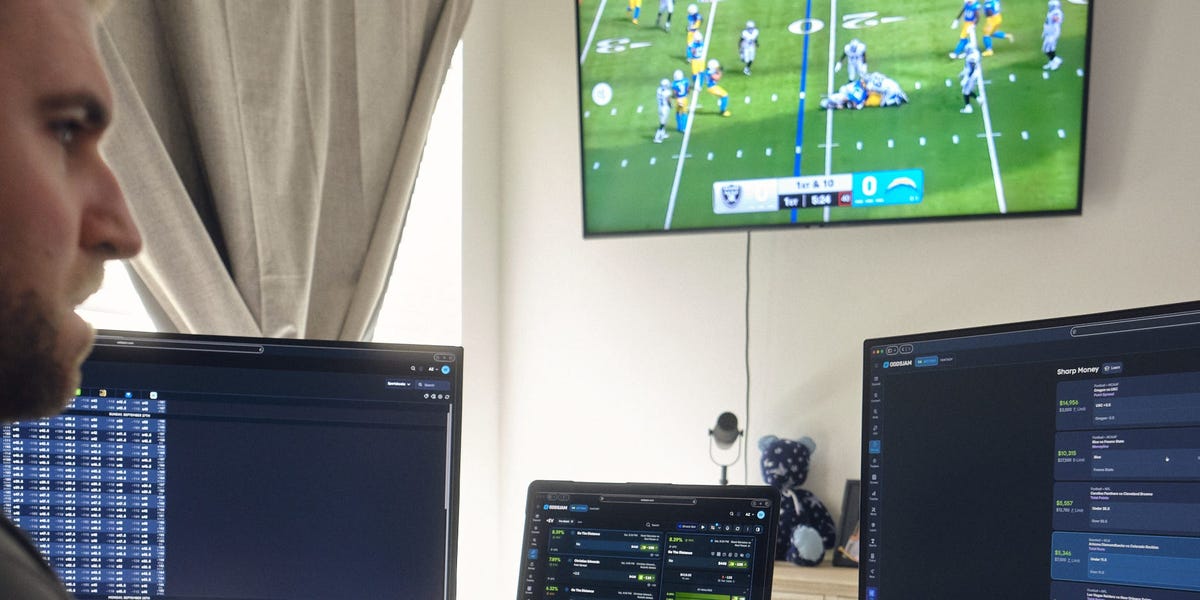
Over two decades later, he now makes a living off of sports betting and identifies himself as one of the ultra-rare sharps in the industry. Collins made $12,656 sports betting in August, netting a gain of more than 8% on his bets, according to screenshots of his sports betting accounts he showed to Business Insider.
Collins says his career — betting on sports and making content full time — isn’t a symptom of the gambling problem he used to have because he’s using more advanced strategies like arbitrage to secure a small, guaranteed profit on his wagers. He now sees sports betting more as a grind rather than a lotto ticket.
“A 3%-5% return, that’s fantastic,” Collins said, laying out the math for how daily compound returns meant his sports bets can often beat gains in the benchmark stock indexes.
“This is money that I could choose to put into the stock market. I chose sports betting because I feel that I can have a higher return in a shorter amount of time.”
Americans are betting on lots of things these days, thanks to the prolific rise of app-based sports books and an explosion in popularity around prediction markets like Kalshi and Polymarket.
But some see the vice more like investing, use strategies employed by traders and placing a large volume of wagers to net a tidy profit through scale.
Business Insider spoke to three sports bettors about their paths and ultimate ambitions for their money. They were united by common goals of reaching financial independence and quitting their jobs, with some even claiming that sportsbooks were a better place to grow their wealth than the S&P 500.
More than half of Gen Z investors say they’ve redirected investment funds into sports betting platforms. Over a quarter, 26%, said they saw sports betting as a long-term “investment strategy,” according to a recent Betterment survey.
Among Gen Z investors, 15% said they saw sports betting as a way to “accelerate a goal,” the survey said, referring to major goals like homeownership.
Sports betting has become nearly ubiquitous in popular culture, particularly after the Supreme Court overturned a federal ban in 2018. The industry is now valued at $17 billion, a 4,150% increase from $400 million in 2018, according to Betterment.
For some, the prospect of financial independence has drawn them to sports betting. Collins, who said he dreamed of being financially free, decided to officially quit his day job in 2023 and immerse himself in sports betting full-time.
“It was your classic 9-to-5 job, weekends off, maybe the occasional work-late on a Friday,” Collins said of his old career. “I kind of knew that I needed to find a different path in life.”
An alternative to stocks
Collins stayed away from sports betting for more than a decade before diving back into it in 2021. He was newly divorced and moved to Arizona right as sports betting became legal in the state. On the cross-country drive, he listened to a YouTube video from the sports betting influencer Alex Monahan, which discussed arbitrage. It sounded too easy to be true, Collins said, until he tried it.
Arbitrage, a tactic used by professional traders to take advantage of small price differences between otherwise similar assets, involves placing bets on all possible outcomes of a game across multiple sportsbooks, allowing them to profit from discrepancies between platforms.
Collins says his goal is to become the “first grade teacher” of sports betting. He spends around half of his day making wagers and half of it making content, sharing sports betting strategies with others. On videos posted online, he describes arbitrage as an “almost zero risk” strategy, assuming the bettor understands the math.
Despite his history in Gamblers Anonymous, Collins says sports betting is no longer a compulsive activity, since the math he uses to inform his bets has taken away the emotion and uncertainty that made gambling addictive when he was younger.
He acknowledges, though, that there’s still a stigma, with his own family urging him to “spend a little more time with God” when they found out about his returning to sports betting in adulthood.
“Once I saw that if you could turn this into more of a grind and you stay disciplined and you start to see your account balance grow each day, it was just an absolute no-brainer,” Collins said.
Collins’ path reflects an altered version of the American Dream that some younger people have opted for. Similar to day-trading, the activity can be a draw for those who feel like the usual routes to success and comfort have been closed off to them, as wage growth stagnates and homeownership feels out of reach.
Monahan, the influencer Collins followed, said sports betting also allowed him to quit his job. The 30-year-old began wagering on games in 2018. At the time, he worked as a quant trader at Susquehanna, the trading giant that famously uses poker to teach new traders how to take risks.
Monahan says his finance background gave him a natural leg up. He accumulated more than $800,000 in lifetime profits from sports betting, according to one of his accounts.
He said he decided to leave the sports betting industry several years ago. He still bets occasionally but feels he’s accumulated enough wealth to be financially secure and now has the freedom to pursue other projects.
“I made pretty good money,” Monahan said, adding that he believes many other sports bettors also dream of making just enough to exit the workforce and pursue other goals.
Matt Downs, a 33-year-old sports bettor based in Florida, was working in a back-office job at a bank when he realized he needed a new career path.
The work was intense for the amount of compensation. He had been a lifelong sports fan, and along the way, learned of arbitrage and expected-value betting, a strategy where a bettor uses probability estimates to identify wagers that have favorable odds over the long-term. He began making wagers and creating content about sports betting on YouTube.
After several months, his income from YouTube matched his full-time salary, allowing him to quit his job to focus completely on sports betting. By the time he quit, Downs said he felt that sports betting was his destiny.
“This side job, if I went all in on it, would hopefully set me up for life,” he said.
Sports bettors frequently hit a ceiling beyond which their potential profits are limited. That’s because sportsbooks often recognize when a bettor is consistently winning, leading some venues to quietly limit the size and frequency of wagers. A bettor may have one or two successful years using strategies like arbitrage before they start to run into constraints, Downs said.
Downs, who transitioned to part-time sports betting after he began to run into limits, has made $21,366 in profit from sports betting so far this year, netting a 2% return on investment.
Downs says sports betting is one of the fastest ways a person can scale their wealth. However, similar to people who trade high-risk stock options, the risks are much higher, and most people are not winning regularly.
“If they call sports betting gambling, then they might as well call the stock market gambling,” he added. “It’s not gambling for those who are educated.”
The industry’s open secret
It’s widely believed that most people who bet on sports consistently lose money. SportsBot AI, a sports-betting analytics site, estimates between 3% and 5% of bettors are “profitable long-term.”
Technically, anyone can learn the fundamentals behind arbitrage and other strategies, Downs said. The caveat is that mastering those techniques often requires a person to make thousands of bets, and many people lack the patience to learn the mathematical principles that increase their odds of winning money.
“It’s really hard to get a college kid to commit to the long-term results, especially if he’s strapped for cash and doesn’t have a bankroll to start out with,” he said.
Collins and Downs, like other bettors, occasionally stumble in bad losing streaks. Downs lost $7,400 in a single day last year after a series of bets went awry while he was at a Disney park with his family. Collins said he lost around $12,000 in January, one of his worst months ever.
But faith that the math will work out in their favor keeps them going, they said.
“It was just one of those days where the variance bites you in the butt,” Downs said.