

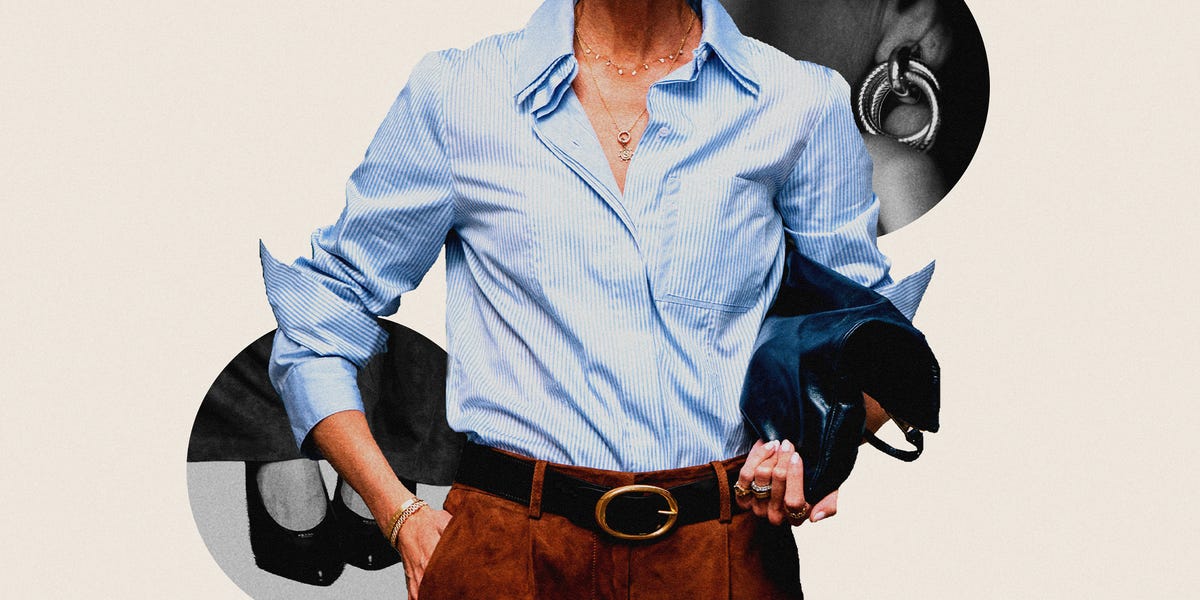
As a personal stylist who works with corporate clients, I believe choosing an outfit should not be the most difficult part of someone’s morning—it should be the easiest.
After four years of helping professionals create wardrobes that fit their lifestyles and make them feel more confident at work, I’ve discovered what tends to work—and what doesn’t—when it comes to dressing for the office.
Here are five of the most common mistakes I regularly tell my clients to avoid.
An all-black outfit can remove personality from your look.
One of the biggest errors I see is what I call the “all-black blob.”
Because black feels simple, polished, and safe, many people repeat the same formula every day: black ballet flats, black straight-leg trousers, a black T-shirt, and a black blazer.
There is nothing inherently wrong with that combination, but when every piece is the same color, the outfit can begin to feel flat and lose any sense of personality or visual interest.
Instead, I suggest adding just one element that creates dimension, such as combining cotton with wool, cashmere, leather, or suede. That way, even a fully black outfit still feels rich and layered.
Another way to improve an all-black look is to add an interesting pair of shoes. I love snakeskin because it brings a subtle pattern to an otherwise simple outfit. I also recommend trying a loafer in deep brown or navy, or choosing suede to introduce even more texture.
The same idea applies to shirts and ties. I would not typically pair a black button-down with a black blazer. Instead, I suggest breaking it up with a different color, texture, or accessory.
A suit is not the only way to look professional.
Of course, if your job or a corporate event requires a suit, you should wear one. But in most other situations, looking professional does not always mean reaching for a blazer.
For women, I recommend a lady jacket—a collarless outerwear piece that hits nicely at the waist. It creates a more relaxed feeling while still looking polished.
For men, I suggest pairing classic trousers with a shorter dress shirt that can be worn untucked.
Skipping accessories can make an outfit feel incomplete.
I often find that many clients avoid accessories at work. But adding details to an outfit does not have to be loud to make an impact.
Even something as simple as a few delicate layered necklaces, small studs, a beautiful ring, or a slim bracelet can add interest to otherwise basic workwear.
And if your workplace allows a little more creativity, I recommend wearing a statement earring, necklace, or belt to bring even more personality to the look.
Thinking a work bag cannot be both stylish and practical is a major mistake.
A work bag absolutely needs to be functional because it carries all kinds of items, including a laptop, folders, a water bottle, lunch, and possibly an extra pair of shoes. But that does not mean it has to be boring.
I think people sometimes assume that if a bag is practical, it cannot also be chic, but I do not believe that is true.
I have found many bags that offer plenty of space and functionality while also looking more elevated and making a statement—especially styles with hardware details, textured leather, or pebbled finishes.
You do not need separate wardrobes for work and your personal life.
I hear this all the time: “Well, it is just for work. I would rather spend my money on the clothes I wear in my real life.”
However, if someone spends five days a week in an office, their work clothes are a major part of their real life. If they wear these outfits for hours every week, why not invest in them?
Investing does not simply mean buying something expensive. It means choosing breathable fabrics, selecting pieces that feel comfortable against the skin, and paying attention to clothes that actually make sense for the season.
Before buying an entirely new office wardrobe, I always recommend that clients look through their existing closets first. Many work-appropriate pieces can also transition beyond the 9-to-5, including heels, ballet flats, and bags.