

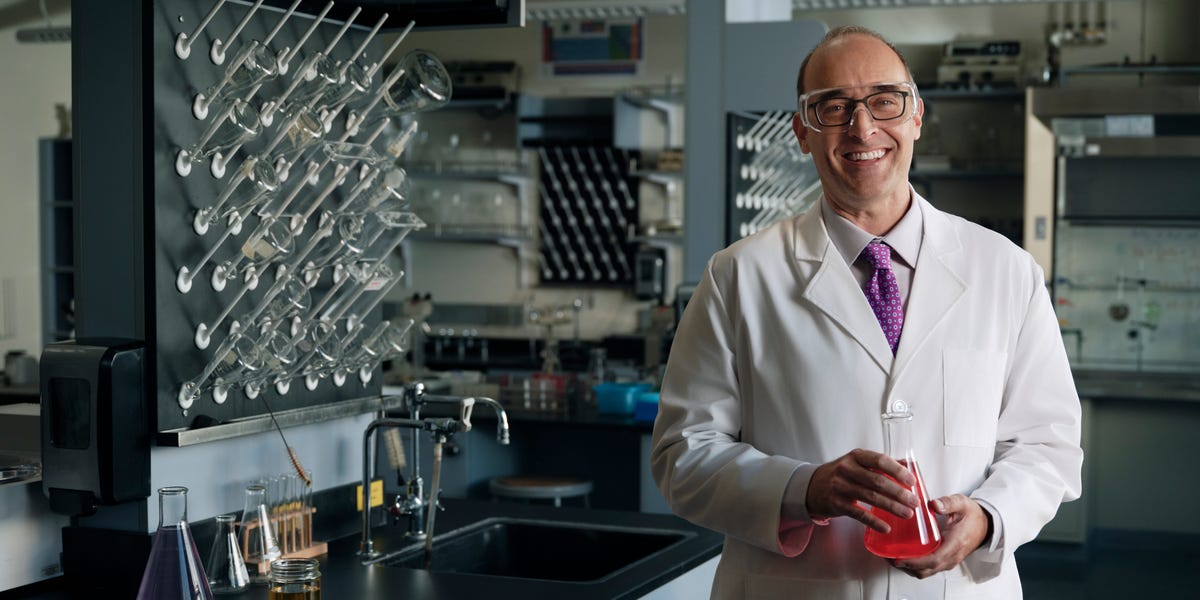
This as-told-to essay is based on a conversation with Phillip Cook. It has been edited for length and clarity.
A physicist or a mathematician might challenge my perspective, but I maintain that chemistry offers the clearest understanding of how the world functions. Once atoms are grasped, the foundations of our surrounding environment become apparent.
Over the course of 26 years, I have sought to prove this concept to my students through hands-on experiments. One favorite demonstration involves dissolving an aluminum soda can using sodium hydroxide, more commonly referred to as lye. Once the can disintegrates, students can observe the hidden plastic liner that once contained the beverage.
I have conducted these experiments for decades. In 2019, after a student encouraged me to record them, I realized that choice would redirect my professional path entirely.
The TikTok originated from a student’s suggestion
It occurred at the start of the academic term, a period when I frequently conduct demonstrations to spark student interest in chemistry. On that particular day, we placed a gummy bear within potassium chlorate, which undergoes a vigorous chemical reaction.
My student remarked, “You should upload this to TikTok.” Having clarified what TikTok was to her, I entrusted her with my phone and allowed her to create my account. She then captured the experiment so I could concentrate on performing it safely.
Following the demonstration, the class selected music to accompany the video, and my student published it. I returned home for the weekend without hesitation, simply amusing myself with my pupils.
Unhealthy Pressure to Create
Monday morning brought inquiries from students regarding TikTok. Upon opening the app, I experienced a stinging sensation in my stomach. The video had garnered approximately 75,000 views, and I gained 5,500 new followers. Prior to this, I believed my Twitter presence with 200 fellow educators was thriving.
I was surprised by the genuine curiosity many viewers held for chemistry. I resolved to continue producing videos, though I quickly discovered the process demanded significantly more time and careful planning than my student had portrayed. Due to the nature of the demonstrations, I cannot film experimental sessions in large batches as certain content creators do.
As my follower count increased, persistent pressure mounted to consistently generate fresh content. This demand eventually became harmful to my wellbeing. Nevertheless, I prioritized my primary occupation of teaching, followed by family responsibilities. Currently, I manage a balanced approach across pedagogy, social media engagement, and adequate rest periods.
I Demonstrate Acceptance of Mistakes
My TikTok audience features a diverse demographic, equally divided between genders and spanning various age groups. What unites them is curiosity. I have cultivated this following by highlighting topics that naturally pique public interest.
I actively respond to commenters who pose insightful questions. Anyone seeking clarification deserves either a substantive answer or at minimum recognition.
Transparency about my own knowledge gaps serves as a model for my audience. Over recent years, my classroom students have grown increasingly apprehensive about making errors. Yet, this represents the wonder of science—learning emerges precisely through mistakes.
I feel fortunate to have found support within this digital community. It is easy to wander down dangerous digital rabbit holes; I am pleased to guide people away toward scientific literacy and exploration.
Too Many Individuals Lacked Positive Experiences With Science During School Years. I am working to reignite that sense of wonder. Should students pursue that curiosity—and perhaps acquire even a single new fact—they will have fulfilled my purpose.