

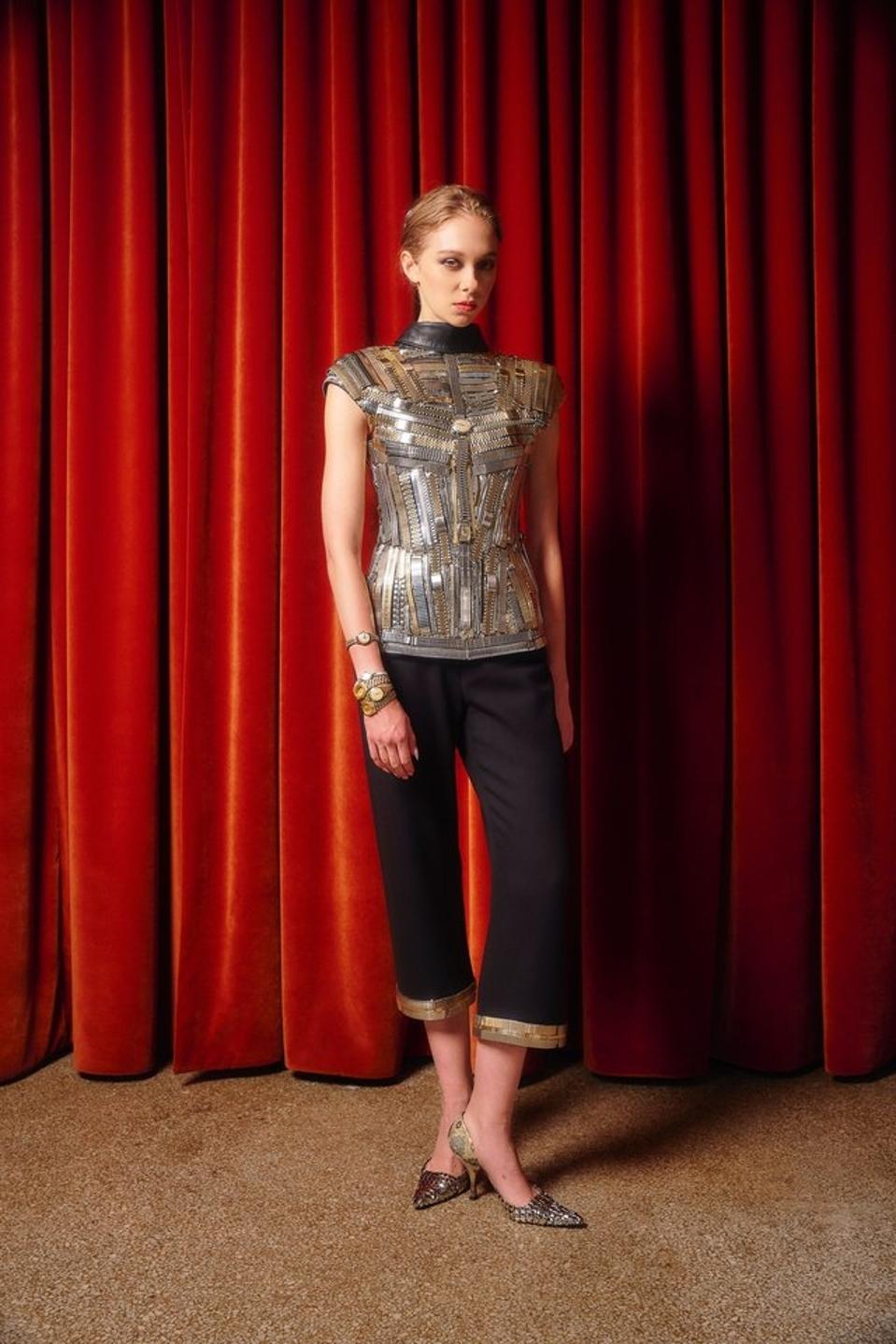
“How personal is too personal?” is a question Olivia Cheng, designer of Dauphinette, asks herself often. In fashion, if a collection isn’t personal, it tends to become purely operational, functional… maybe even bland. Detached. And if fashion isn’t personal, then what is it?
For Cheng, her SS26 collection, presented at BRASS in The Evelyn Hotel during this past New York Fashion Week, was striving for that vulnerability. She explored the emotional terrain of seasonal change: dipping from a snowy winter to a beaming, promising spring. But internally, she admits, the winter never left.
After taking a three-season long break, Cheng returned to design with a lingering chill inside her. A feeling she couldn’t quite shake. She speaks candidly about the emotional weight she carried: the endless rumination, the frustration of unanswered questions, and the dissonance of feeling one thing while projecting another. “I am Eeyore dressed in Piglet’s clothes,” she says, encapsulating both her internal melancholy and outwardly joyful dressing and designs. For Cheng, the personal seeps into everything—her clothes, her life, her career. “I’m realizing I don’t just want to comment on the clothes I make,” she says. “I want the clothes I make to comment on the life I live.”
Even if she’s delivering a spring/summer collection while living through an emotional winter, even if her smile feels more “tragic than disarming”—she insists on honesty. And that honesty, stitched into every piece, is what makes the work resonate.
This Dauphinette collection was self-described as “couture” for its , handmade craftsmanship, something that truly sets it apart. To me, Dauphinette has always carried a charming, eclectic take on cocktail attire. Most of the pieces shimmered and dazzled with every step, often made from materials that chimed like windpipes and softly clinked against one another. It was easy to draw “oohs” and “ahhs” from the crowd, especially those enamored by anything shiny, novel, yet rooted in vintage sensibility. Sweetly feminine on paper.
But in this collection, a kind of quiet melancholy settled in. You could feel it in the darker hues, lace cut-outs, and black velvet flowers. The usual shimmer was still there—jewels and glints catching the eye—but it was more muted, more restrained. Less gleeful fantasy, and more subdued horror, especially underscored by the show’s eerie soundtrack.
The collection’s biggest challenge, though, was cohesion. While some looks recalled silhouettes and patterns of ‘70s nightlife with chainmail and gold embellishments, others veered into dramatically different territories. It felt like the team was pulling from multiple eras across European history: masculine Hellenistic draping, the medieval era’s flirtation withswords, armor and chainmail, baroque motifs, and rococo details like corsets, long bloomers (and even oversized croissants). These were pieces that easily charmed the “ooh-and-ahh” crowd, but for me, they didn’t register as especially cohesive or deliberate.
Then suddenly, the collection pivoted again, this time into early Y2K peacock pants and playful ‘60s mod dresses. It was a lot to take in. Not bad by any means, but scattered, more like flipping through a fashion history book than watching a single story unfold.
As I was leaving, a writer came up to me and said, “The only thing I wrote was seashells,” speaking of a clear PVC, mod-cut dress, that contained seashells in rows of the dress. That line stuck with me, maybe because it was the only image that truly resonated with her in the many era that were shown infront of our faces, or maybe just because seashells are fun to wear. While the show explored a variety of themes, each distinct, seemingly untied, there were several standout moments and memorable looks.
One particularly memorable moment came during an unexpected intermission by Vivian Wilson. She let out an ear-splitting scream before weaving through the audience in a mullet-style puffy skirt and a bra covered in bejeweled beetles. For me, the contrast between the soft, plush, traditionally feminine fabrics and the hard, unsettling beetles felt like a visual metaphor for the emotional tension Cheng had spoken about earlier. The beetles, creatures often associated with discomfort, chaos, or decay, seemed to symbolize the intrusive, often unexplainable nature of mental health struggles. In this context, they weren’t just embellishments; they were a raw expression of how something beautiful can still carry weight, disruption, and distraction. It was that sense of personality and vulnerability, if aligned with this sentiment, that I found myself craving throughout the collection.
All that’s to say, maybe this show wasn’t overly vulnerable, dramatic in flair or organized in meaning or thought, but that is what Cheng described when speaking about her past mental state: transformative, juxtaposing, active and delayed, and ever-present just like this collection