

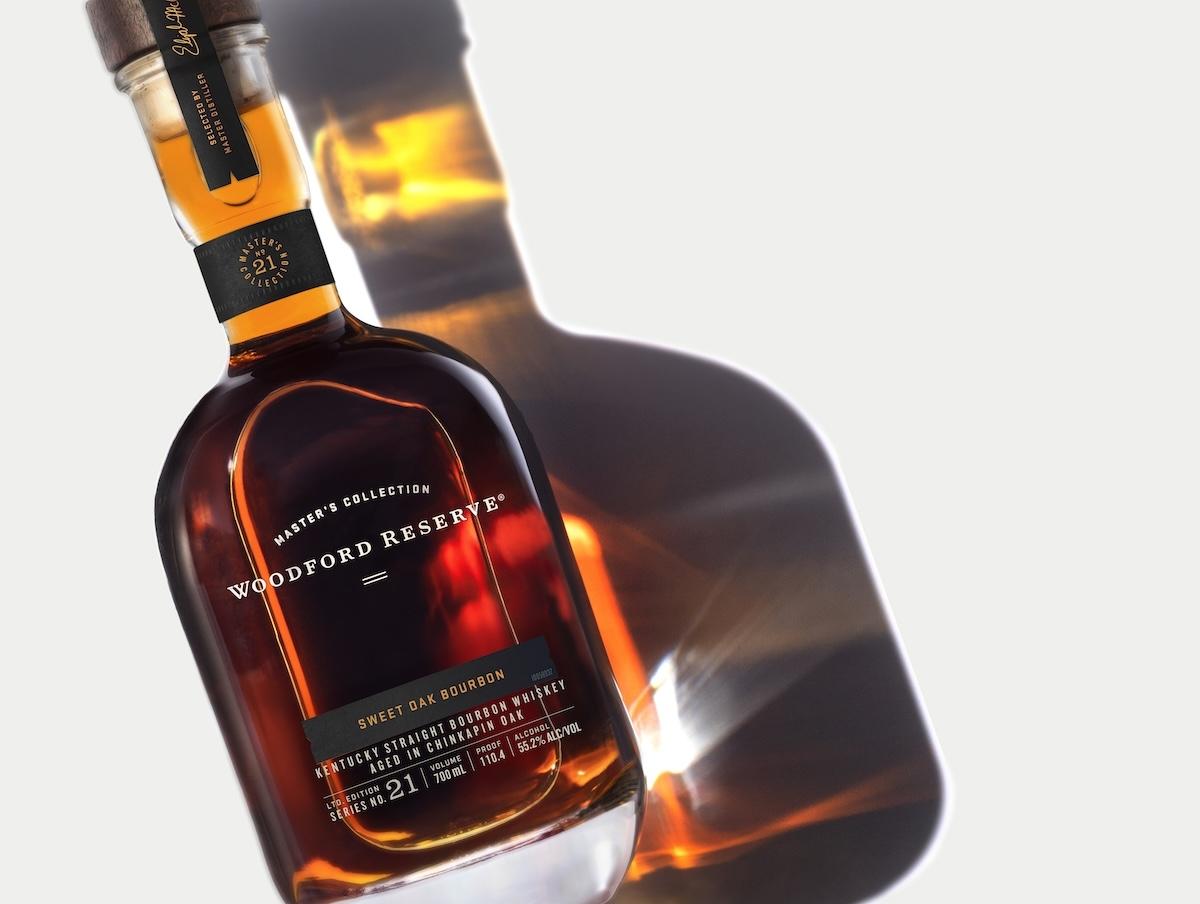
Now on its 21st release, the Woodford Reserve Master’s Collection is the Kentucky distillery’s primary outlet for experimentation. Previous releases have included some of the industry’s first finished bourbons, different varieties of grain, new mash bills, and unique blends far outside the company’s norm. It can be a lot to keep track of, especially with the potential for multiple releases per year.
Even with that breadth of styles and experiments, Woodford’s latest bottling is worth paying attention to. Dubbed “Sweet Oak Bourbon,” it’s a higher-proof Kentucky straight bourbon whiskey. While that itself isn’t out of the ordinary, the barrels used to age the bourbon were hardly typical. They were constructed out of chinkapin (sometimes spelled “chinquapin” or referred to as “chinkapin oak”), a tree native to the United States. Chinkapin (Quercus muehlenbergii) differs from the more commonly used American white oak (Quercus alba) in some key ways; though they share some range, chinkapin has a different wood structure, often described as denser in its growth.
Woodford is far from the first distillery to utilize chinkapin. In Kentucky, companies like Michter’s and Heaven Hill have experimented with chinkapin casks in aging special releases. Across the pond, GlenAllachie has famously used the wood to mature or finish single malt.
This happens to be Woodford Reserves’ first foray into chinkapin aging. After a first taste, I flagged this as a whiskey worth paying attention to, both for devotees of Woodford bourbon and those who might be looking for something a bit atypical from the brand.
The nose starts somewhat in line with Woodford’s classic profile, but given enough time, it’s ultimately nuttier and spicier than its brethren. The nose is rich in demerara sugar, darkly toasted pecans, and heavily steeped black tea. Again, there’s some characteristic Woodford sweetness and oak influence, which I ironically might normally call a “sweet oak” profile. But with this particular whiskey, scents all seem dialed up. Tannic influence is bigger and bolder. Baking spice is closer to nutmeg and allspice than cinnamon. Fruit notes — particularly cocktail cherries — are more intensely concentrated. And that tea element is remarkably concentrated, like I’m holding my nose right up to a piping hot cup or even the teabags themselves.
The palate kicks off with more pecans, hot cross buns, and — once again — a dominant sweet black tea flavor. A hint of red fruit seems like it’s hiding just below the surface, as if that tea contains just a little raspberry-infused syrup. Bold oak, clove oil, and marzipan-stuffed pastries round out the main flavors.
Woodford’s Sweet Oak Bourbon has a strikingly long finish, with intersection flavors of dark chocolate, cherry, and drying oak. Without an age statement, it’s tough to tell if this amped-up experience is coming entirely from the shift in wood varieties. But after a first taste, I hope it’s a direction Woodford Reserve continues to explore. Here, chinkapin has been kind to their distillate.
According to Woodford Reserve Master Distiller Elizabeth McCall, the different cask wood creates a bourbon with “a powerful, full-bodied profile while maintaining Woodford’s signature sweetness.” Based on my taste test, I think that’s a spot-on analysis.
Woodford Reserve Master’s Collection Sweet Oak Bourbon has a suggested retail price of $179.99 for a 700 milliliter bottle. It carries a proof point of 110.5 (55.2% ABV) and is available in limited quantities across the United States. It also retails at Woodford Reserve Distillery while supplies last. The brand also ships directly, though only to consumers in Kentucky, New Hampshire, North Dakota, Nebraska, and Washington D.C.