

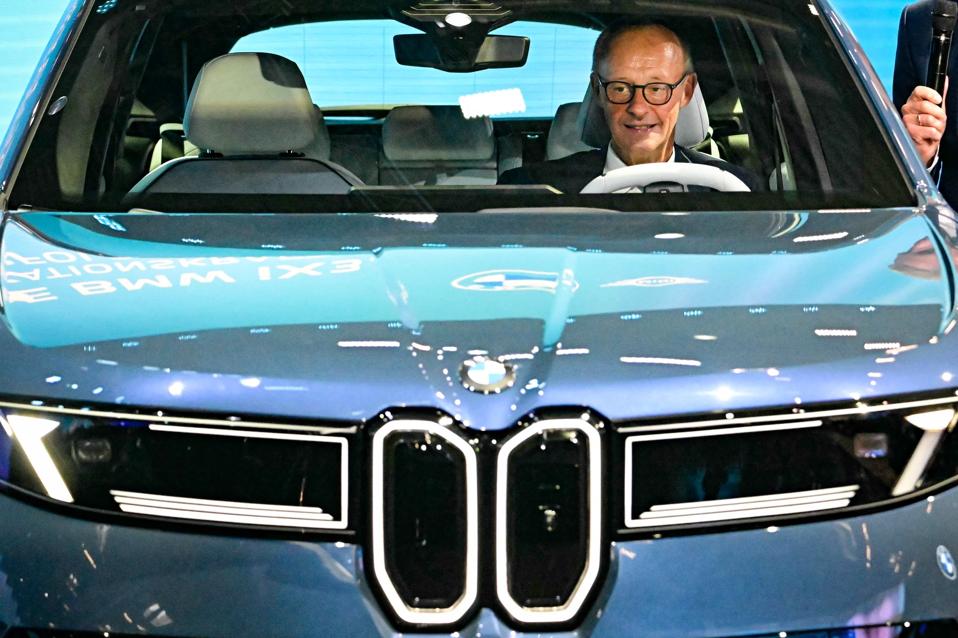
While automakers unveiled more and cheaper electric vehicles at the Munich Auto Show Tuesday, the controversy gathered pace over whether to water down the European Union’s long-term plan to force its citizens to buy EVs.
The IAA Mobility 2025 (short for Internationale Automobil-Ausstellung) show in Munich opens through September 14.
The European industry isn’t short of problems. The market, still about 4 million a year short of the level reached before the Covid pandemic struck, is stuck in a trough. Tariff increases in the U.S. are biting a big hole out of profits. China, now the biggest market in the world for sedans and SUVs and the most important for Volkswagen, Mercedes and BMW, is becoming a harder sell for the Germans as the locals not only beat them on price but now can now produce vehicles that can compete for glamor too.
China is poised to win great swathes of the booming European EV market and that is troubling the automakers. They blame their exposure on EU rules which demand new car buyers in 2035 will only be allowed the all-electric option. The law, based on emissions of carbon dioxide, is designed to gradually force carmakers to sell more and more EVs and less internal combustion engine-powered vehicles. The trouible is, Chinese manufacturers have an about 30% price advantage over the Europeans. The EV market share target for this year in Europe is about 28%, up from an actual 14% last year.
The EU may be persuaded to be lenient
The EU has been showing signs that it might be open to leniency. The rules for 2025 were changed to allow manufacturers to spread compliance over a couple of years. A decision on more drastic action has been brought forward to later this year. This has enraged green advocacy organisations like Brussels-based Transport and Environment. On Monday, 150 companies from across Europe’s electric vehicle supply chain wrote to European Commission President Ursula von der Leyen urging her to retain the rules. The signatories, which included Geely of China’s Volvo and Polestar, battery makers Verkor, Samsung and LG Energy, charging providers Fastned, IONITY and Alpitronic and grid operators Iberdrola, and EDP. They urged the Commission to avoid delaying or diluting the 2035 target and focus on stronger industrial and demand policies.
Ms von der Leyen has been getting a lot of mail from the auto industry lately.
EVs will lead the charge but,
Last month The European Automobile Manufacturers Association (ACEA) and the European Association of Automotive Suppliers (CLEPA) told von der Leyen EU manufacturers now face near-total dependency on China for batteries. The charging infrastructure was uneven. They faced higher manufacturing costs and U.S. tariffs.
“Meeting the rigid car and van CO2 targets for 2030 and 2035 is, in today’s world, simply no longer feasible. Legal mandates and penalties will not drive the transition. EVs will lead the charge, but there must also be space for plug in hybrids, range extenders, highly efficient internal combustion engine vehicles, hydrogen and decarbonized fuels,” the letter said.
Mercedes CEO Ola Kaellenius demanded the EU’s CO2 plan be killed or diluted.
“We need a reality check. Otherwise, we are heading at full-speed against a wall,” he said, adding the European car market could collapse if the CO2 plan goes ahead. Kaellenius is also head of ACEA.
In Munich on Tuesday the call was unmistakable.
“Germany needs a clear commitment to the automobile again. It is the central lifeline of our economy. That includes stopping the EU ban on combustion engines. Accelerating technology for e-mobility and autonomous driving, reducing industrial electricity prices, and expanding charging infrastructure,” said Bavarian Minister-President Markus Soeder.
Hildegard Mueller, President of the German Association of the Automotive Industry (VDA), didn’t hold back.
Excessive regulation must be overcome
“Our goal must be to bring Germany back to the top of international competitiveness rankings. The principle of excessive regulation must finally be overcome, as well as the reliance on bans and rigid commitments to individual technological options. Flexibility and technological openness are absolutely essential. Those who fail to analyze realities and act flexibly will not achieve their goals,” Mueller said.
Von der Leyen will host European automotive sector executives September 12 to discuss the future of the sector.
Kaellenius is backed by other automakers like Volkswagen, BMW and Stellantis. Germany, Italy, Poland, Czechia and Hungary are notable backers of change. Renault and Tesla want to keep the ban, as do France, Spain, the Netherlands, Sweden and Denmark.
Affordable EV debuts at the show included Stellantis affiliate Leapmotor’s BO5, and BYD’s Dolphin Surf . BMW is launching its iX3 SUV, the first result of its Neue Klasse initiative. The new Mercedes GLC will be a close competitor. New more mainstream Chinese competitors include Chery’s Omoda and Jaecoo brands.