

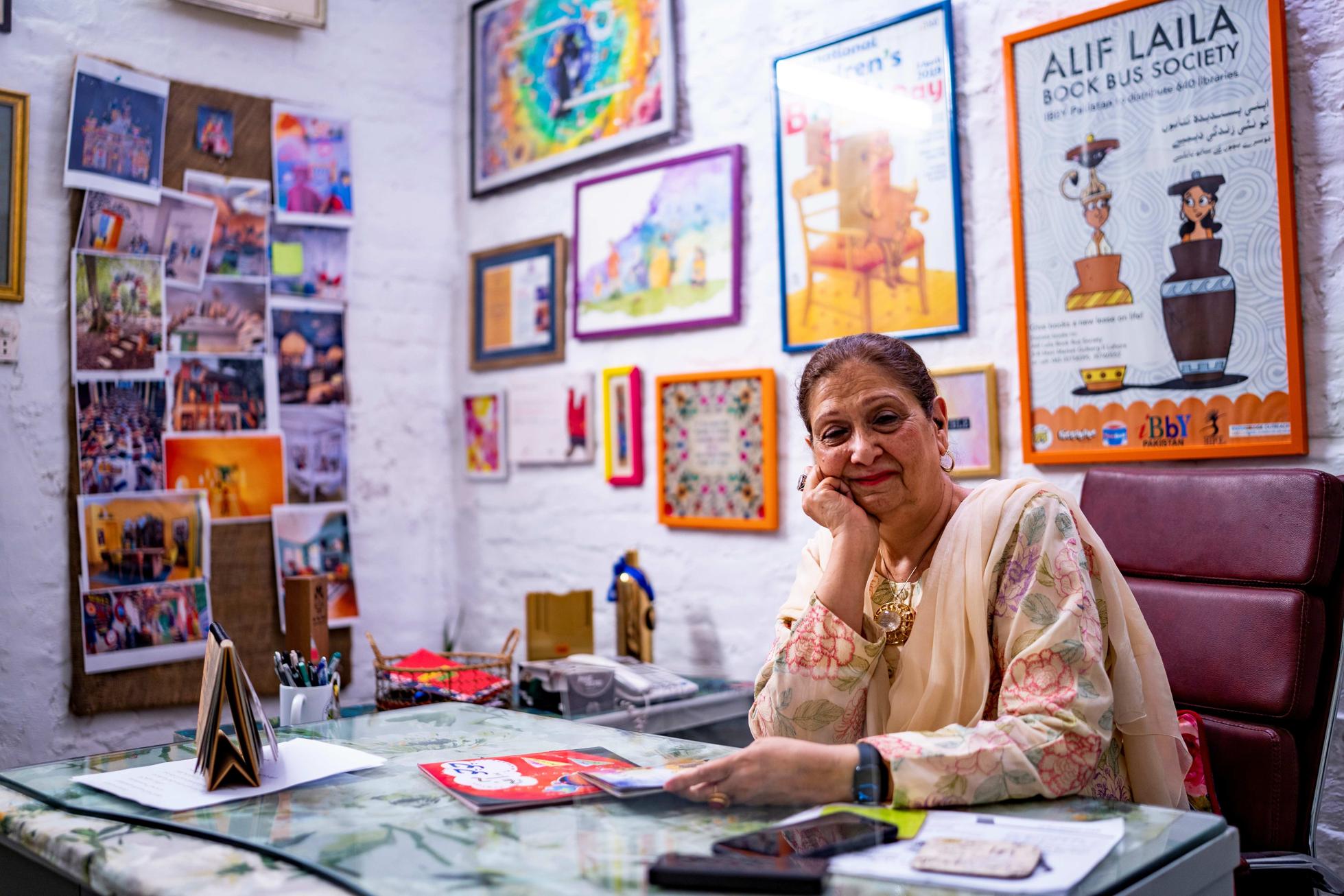
Founded in the 1970s by Dr. Juanita Baker, in Lahore, Pakistan, the renowned non-profit, the Alif Laila Book Bus Society, stands as the first children’s library on home turf, instilling a love of reading in generations of Pakistani children over the years.
Featuring scores of books by international book publishers, that Baker would receive from America (her home country), what once blossomed as a small, volunteer-run platform, grew three-fold, into a nationwide movement that today, continues in its mission to inspire Pakistani children through its Gulberg-based library and mobile library initiatives.
At the time, a children’s library in a double-decker bus was a very exciting sight for families and their young children. Having acquired the bus from the Punjab Road Transport Board as a donation, Baker converted the vehicle into a magical library stocked with numerous fiction and non-fiction titles for children. A year later, after Baker left Pakistan, Kathleen Alam stepped in as the non-profit’s President.
It was around this time that Basarat Kazim, a Lahore-native, began volunteering at Alif Laila, striking up a close friendship with Alam. However, a few years after Alam moved on, Kazim stepped in to lead the non-profit in 1982. And almost five decades later, Kazim hasn’t looked back once.
Today, Alif Laila’s heartfelt work running libraries and building libraries in underprivileged schools and economically-depressed communities continues, no matter how far-flung. Having trained thousands of teachers, setting up schools in slum areas and in addition, publishing its very own children’s books, the non-profit persists to spearhead outreach programs where books are taken to Pakistani children on the backs of camels and yaks, in boats and rickshaws.
A vociferous reader as a child and an introvert to boot, the highlight of young Kazim’s day would be to listen to her beloved aunt’s storytelling sessions before bedtime. Watching her aunt narrate stories upon stories, Kazim’s mind would be filled with the most exciting characters and creatures embarking on the most splendid of adventures! This truly set the path for young Kazim, although at the time, little did she know that she would eventually pave the way for numerous children (just like herself) to nurture a deep-seated love for the magic and timeless lessons that storybooks have to offer…
SR: What encouraged you to take on this mammoth role? How did it all begin?
BK: In 1978, as a young mother of two children, I used to visit the Alif Laila library with them. We’d borrow books and then read them together. I soon realized what a wonderful impact it was having on developing their imaginations and critical thinking skills. It was at that point that I thought, if I could do this for my children, I need to do the same for Pakistan’s children. That was the turning point for me. I understood the dire need for books for children. Books teach them to dream big, they teach children humanity and that the world, essentially, is open to them, wherever they go and whatever they want to do.
SR: Your journey started out with the Alif Laila library in the double-decker bus. Could you tell me a little about how you built it from thereon?
BK: As a start, I began visiting government schools in the vicinity and would talk to the students about the library. I’d speak to them about reading and encouraged them to visit us. The membership at the time was only ten rupees, but not every child could afford it, hence, I’d tell them to stop by whenever they could. Back then, in 1980, the schools didn’t have any transport system for the children, so we’d rent out a small Suzuki van to bring the children to the library.
Over time, we began spearheading mobile libraries to take books to communities which didn’t have access to reading materials for children. That’s when we decided to initiate our teacher training program for less privileged schools, to help teachers spruce up their classrooms with low cost, recycled materials to encourage a fun learning experience. Afterwards, our team even set up schools in slum areas. It was a very gratifying and collaborative effort.
SR: How did you manage to encourage children to become interested in books?
BK: While we were welcoming in children to the library from nearby government schools, we’d always asked them what they liked and didn’t like. We wanted to ensure we created an experience that they’d love. With children, the more novel the approach, the more exciting things become for them! Hence, we didn’t want them to view reading books as a drab exercise. In the 90s, I recall one incident when we began working with children through our mobile library outreach program. One child looked at our colorful bus and remarked in awe, ‘Books are like this too?’ He couldn’t believe that there was anything beyond his school’s text books.
That memory has stayed with me since. This truly is the mindset that we need to break through…that books are dull. We need to open up a world of magic and stories for children. However, it can only be perceived in an enchanted way if the packaging of the books speaks to children. That’s why, over the years, whether transporting books through the bus, rickshaws, camels or boats, we’ve always made sure to make it as bright, colorful and exciting as possible. Like a magic flying carpet.
SR: You have been the recipient of many national and international awards. Recognition of your years of dedicated work for Pakistan’s younger generation must be very gratifying…
BK: Any and every honor that has come to Alif Laila, be it awards, feedback from people, or a child’s enthusiasm when they visit the library, has been a deep honor. It’s wonderful that Alif Laila has had a part to play in the lives of so many. It has really strengthened me, our work and the belief that when you give your best, others eventually do benefit from it. However, the most rewarding moments come from the children themselves. I recall once, a little boy wrote us a letter mentioning that he had calculated how many hours he spends in school and how he spends the rest of his time with a lot of difficulty because when he’d go home, he would get reprimanded about his school report card. He then went on to mention that his one hour at Alif Laila is something he looked forward to and enjoyed immensely. That really moved me, I’ve never forgotten the letter. I consider that the biggest honor, to impact a child in such a deep-rooted way.
SR: Do you think there’s now an awareness amongst government-run schools of the benefits of what reading books does for children?
BK: I think that concept is not being understood yet, but the library movement has certainly begun. There are libraries in schools now and Alif Laila itself has been setting up small libraries all over Pakistan. While teachers are able to notice the difference between the children who read and those who do not, in my earlier days when I used to visit government schools and ask teachers to encourage the children to visit the library, I would be met with a lot of negativity and nonchalance. I’d have to educate the teachers by telling them that reading enables children to become better learners. Then they’d tell me that the children would never return the books after borrowing them from us. To which I’d say that it didn’t really matter, that if a child loves a book so much that he or she forgets to bring it back, it’s a good thing. Over the years we’ve always trusted that the books would be returned. And they have. In fact, children have constantly donated their old books to Alif Laila over the years, so we never fell short.
SR: You’ve been carrying forward the Alif Laila torch for a long time…what is your dream for the future?
BK: My dream is that Pakistan’s map should be dotted with children’s libraries…full of exciting, colorful and imaginative storybooks so that our children are able to breathe freely, explore, innovate and do things that they love. I’ll also keep coming back to this important truth, that books help you see people as yourself, not always as the ‘other.’
I look at libraries as places where kindness, understanding and empathy are created. If we can have such libraries all over the country, including happy librarians, I believe Pakistan’s future will be amazingly bright.