

Market volatility is not going anywhere. That much is clear from the last several weeks. So, how can investors profit — and copy — regardless? Here are three strategies put forward by top MoneyShow in-house and contributing experts.
Few things are as exciting as “face-ripping” rallies in the stock market. One minute, you’re watching your trading positions sink into the abyss. The next, you’re seeing them soar – and you’re frantically scanning the newswires, social media, or financial television to see what happened.
The only problem? The biggest one-day rallies usually come in BEAR markets, not BULL runs!
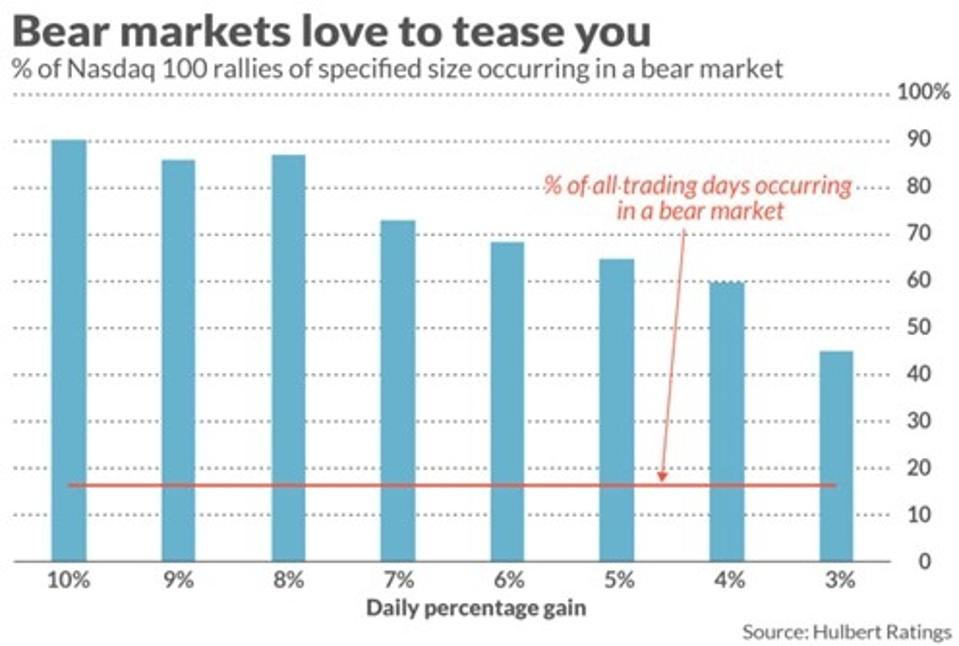
Take a look at this MoneyShow Chart of the Day, with data from Hulbert Ratings and MarketWatch. The Nasdaq 100 was created in 1985. Since then, only 16% of its trading days (through mid-2024) were during bear markets.
Yet a whopping 90% of its biggest “up” days – gains of 10% or more – occurred during bear markets. So, did a sizable majority of its 5%-or-more “face-rippers.”
Then there’s the Dow Jones Industrial Average, the granddaddy of the major indices. Look at this table of its top 10 one-day percentage rallies from Wikipedia.
You can see that six of ten came between 1929-1933…two of the remaining ones were in October 2008…while another was in March 2000. The biggest gain was 15.3% in March 1933, while the tenth-biggest was 9.4% back in February 1932.
If you know your market history, you know a little about those periods of time. They came during, at the start of, or only just after the end of some of the worst Dow bear markets in history!
Keep that in mind when you see days like April 9…or yesterday’s intraday surge. The key to a lasting turn isn’t just a face-ripper or two. It’s a steady, base-building process that can lay the groundwork for a more-durable, more-powerful move.
Marc Lichtenfeld Wealthy Retirement
I recently discussed two strategies for generating income in this tough market environment. While selling covered calls and naked puts is a conservative strategy, some investors prefer more of a “set it and forget it” approach. Fortunately, there’s a simple solution: Bonds.
You may have never invested in a bond, but they’re actually easier to understand than you might think. When you buy stock, you own a piece of a business. But when you buy a bond, you are a creditor to the business. As anyone who’s ever owned a business knows, creditors get paid before owners. Otherwise, the creditors take your business.
A bond is a contract between a borrower (the company) and a lender (the bondholder). The company must pay bondholders a predetermined amount of interest on specific dates and then pay the loan off in full on the maturity date. No ifs, ands, or buts. There is no wiggle room. If the company does not live up to those obligations, it is in default, and bankruptcy proceedings start.
If a stock falls in price, you have to pray to the investing gods that it will come back up and make you whole. If a bond falls in price, it doesn’t “matter,” because the company will pay $1,000 per bond on the bond’s maturity date, no matter what. If it doesn’t, it’s in default.
Most bonds are incredibly safe. Investment-grade bonds default at a minuscule rate – way less than 1%. Non-investment-grade bonds, also known as high-yield or “junk” bonds, default around 4% of the time. However, the overwhelming majority of those defaults are from the lowest-graded bonds, rated CCC or lower. A bond with a grade of B- or higher has a very low chance of default.
Lastly, my favorite feature about bonds is that you know exactly how much you are going to make over a specified period of time. You’ll never have that kind of certainty with a stock.
In short, bonds provide both income and security, with no exposure to the stock market’s volatility. If the wild swings of the stock market are causing you stress, consider moving some money into individual bonds.
Tim Plaehn The Dividend Hunter
The recent market pullback has put some great dividend stocks on sale. Energy midstream has been a hot sector for several years, driving up share prices and driving down current yields. I like Plains GP Holdings LP (PAGP).
On March 31, PAGP yielded close to 7%. Now, with the share price down over $2, the yield is closer to 8%. PAGP is the strongest dividend grower in the Dividend Hunter portfolio, growing by more than 10% per year. Buying PAGP shares on sale locks in a great yield and future income growth.
(Editor’s Note: Tim will be speaking at the 2025 MoneyShow Masters Symposium Las Vegas, scheduled for July 15-17. Register your interest in attending HERE.)
Given the recent market pullback, it’s also good to look into how your portfolio is doing. Although this is a broad market pullback, some sectors and even stocks will fare better than others. When this happens, I like using Magnifi to perform a portfolio health check.
Recommended Action: Buy PAGP.