

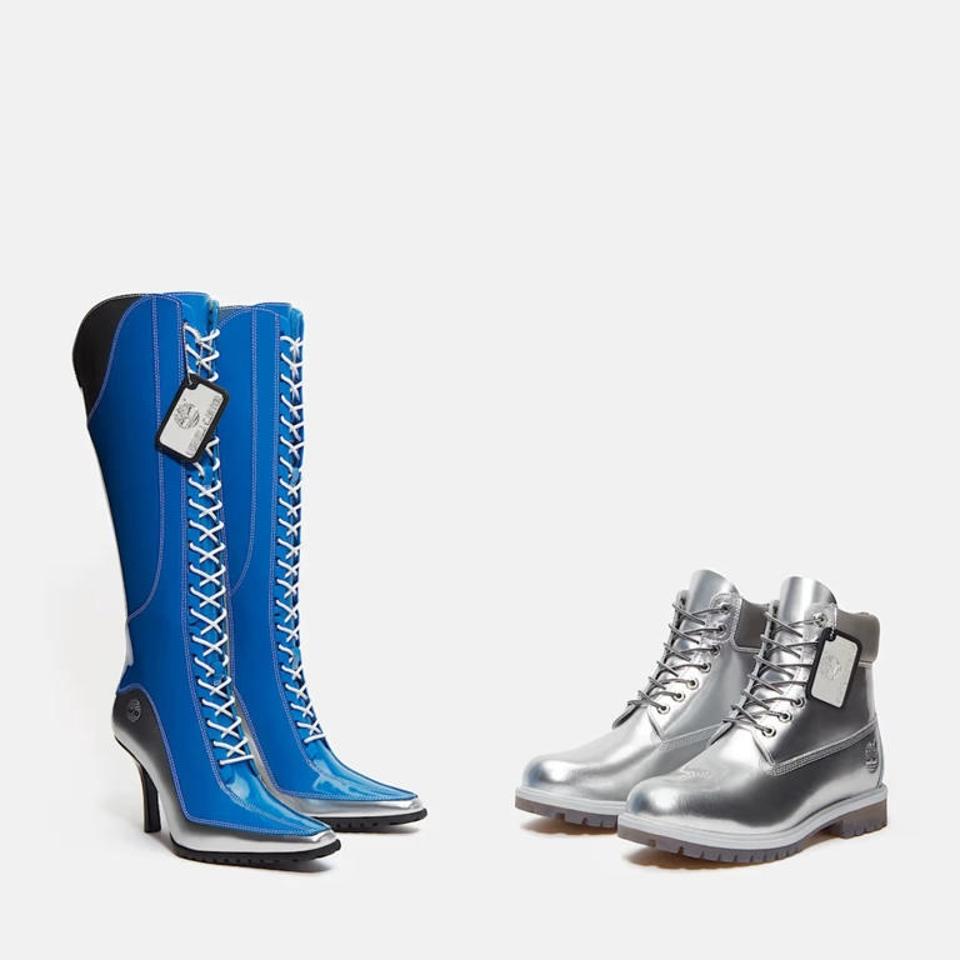
Everyone has their particular kink — the more unconventional, the more exciting. For some, it’s a secret obsession with food or gadgets, while for others, it’s the obvious. But for many, the fixation has always been shoes. It’s almost a universal experience: you pass a storefront, and a pair of shoes in the window catches your eye, standing out from the rest. You lean in, check the price tag — not for you. Yet, as you go about your day, the thought of those shoes lingers, impossible to shake.
That happened to me, though not in the typical sense. Mine was a more modern, digital-forward experience. Kayla Curtis-Evans, an editor at Hypebeast, invited me to the release of the Veneda Carter x Timberland collaboration. Veneda Carter’s name has long echoed through the fashion industry, especially in New York. Originally from Copenhagen and now based in LA, she’s best known for her time as Kim Kardashian’s stylist. But recently, she’s shifted gears, carving out a name for herself in jewelry design. Still, of all people, I never would’ve expected Carter to be the one behind the shoes now haunting my dreams.
The shoes: a 14-inch, lace-up heeled Timberland boot, crafted from electric blue patent leather and finished with a silver double-form padded collar. The glossy finish shined like a freshly polished silver rattle to a baby, impossible to ignore. With a sharp, shark-angled toe and a slender stiletto heel, they transformed the rugged silhouette of a classic Timberland boot into something undeniably feminine.
But what captivated me wasn’t just that they were shiny and new (although so shiny) — it was their familiarity. These weren’t some sensational new concept, I’d seen them before. And I made a point to say so at the release event. The idea of a Timberland heel wasn’t born from this collaboration. They were everywhere in the late ‘90s and early 2000s — the so-called “knockoffs” or “bootlegs,” a reinvention of what a Timberland heel could be. I remember them vividly, because I’d gawked at a pair in my aunt’s closet in Queens, marveling at their outrageousness. Back then, they felt like a meet between a “ghetto” and “bougie” fashion statement, a little ridiculous, but a lot iconic.
These heels were ubiquitous in urban Black communities. So, I couldn’t shake the dissonance — the fact that I was now fawning over a high-fashion reinterpretation by a designer from Copenhagen. Even after the party, I messaged the Hypebeast editor, still fixated. ‘I can’t stop thinking about those shoes.’
A month passed, and the boots quickly became a grailed item — but now with a steep reseller price tag. On StockX, the cheapest pair was listed at $420, while on eBay, some were reselling for as much as $2,271. I read every write-up — Hypebae, Highsnobiety — scanned through interviews about the collaboration. But no matter how much I tried to celebrate them, I couldn’t ignore the lingering discomfort. The shoes stirred something deeper — a tangle of racial and social complexities that came with simply wanting to buy, own, or even wear them.
Carter had faced accusations of cultural appropriation in the past, and even on the website, her inspiration is vaguely credited. The press release states that she “fondly recalls growing up with the original Timberland boot as an icon of hip-hop style.” Without further context, the statement feels hollow — lacking both accountability and a genuine acknowledgment of the culture that made the boot iconic.
While Carter didn’t explicitly credit African-American culture for this particular design, she has acknowledged its influence in the past. In a 2020 interview with WWD, she stated, “African-American culture is a big inspiration for me, too. I don’t know. I just feel like everything they do is so much cooler than white people.” She went on to express her admiration for “the beauty of African-American culture” and how much she values it in her life, adding, “As a white girl, I’m always voicing my inspiration for it and where I got my inspiration from.”
The article also addressed the accusations of cultural appropriation against her, noting that through conversations with her Black husband, she claims he has “taught her so much.”
For now, the ambiguity remains — a familiar story in the fashion industry. Timberland boots aren’t a closed practice or a sacred emblem, but their reinvention serves as yet another reminder of how easily African-American culture or ‘hip-hop culture,’ as Carter frames it, can be reinterpreted without proper acknowledgment. If the boots ever return at a more accessible price point, perhaps they’ll be reclaimed — or maybe they’ll remain a coveted, but deliberately unpurchased, grailed item.