

Recent controversies have rocked the lab-grown diamond industry. It’s given mined-diamond industry insiders hope that their dominance is secure and that the disruptive incursion of man-made, lab-grown diamonds (LGD) into their jewelry dominion can be thwarted.
Yet, there are always bumps along the way when any established market is disrupted; that is what disruption means. But the disruptors’ path is clear if they keep their eye on the prize – giving customers what they want and value – and ignore the background noise.
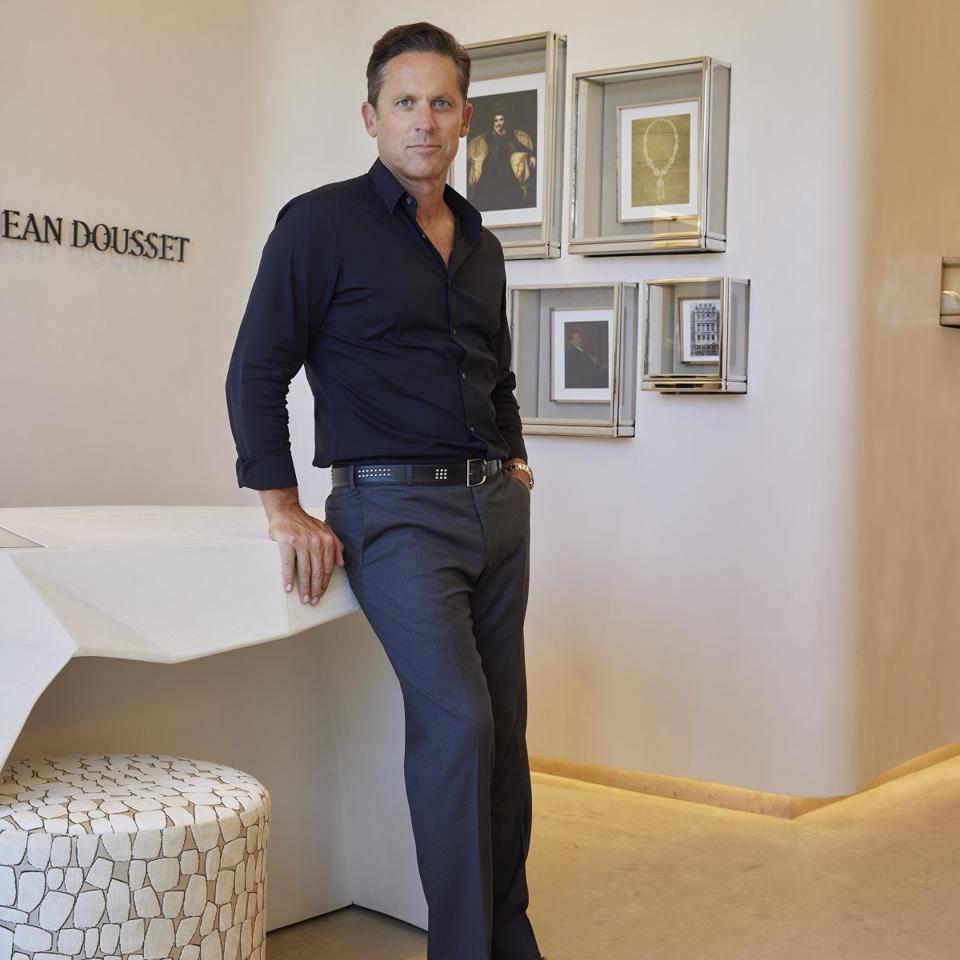
That’s what famed jewelry designer with a 24-karat luxury legacy Jean Dousset is doing as he opens his flagship jewelry boutique in West Hollywood featuring his exclusive lab-grown diamond designs. Dousset’s great-great grandfather was Louis Cartier, founder of the world-renowned jewelry brand bearing his name, and he believes his forefather would fully agree that the future of the luxury jewelry market is set in lab-grown diamonds.
“I apply the same inspiration of design, craftsmanship and execution that I did with natural diamonds. It’s the same product through and through; it’s just no longer the same price,” he shared with me. “Designer lab-grown diamond jewelry is absolutely luxury, an object of desire.”
LGD Headwinds
Three recent events give the mined-diamond interests hope that lab-grown diamonds can be put back into their “synthetic” box and their rapid penetration into the market slowed.
First, De Beer’s Lightbox jewelry brand ended its test offering LGD engagement rings and returned to its original position that lab-growns are for fashion, not serious purchases like engagement rings.
“Lightbox will continue to focus on where it sees the most promising future opportunities in the sector – in fashion jewellery and in loose stones at accessible price points – and will not sell LGD engagement rings,” it said in a statement, adding that the cheaper price for lab-growns makes the “commercial proposition” in LGD engagement rings “unsustainable” for retailers.
At the same time, De Beers also announced the return of its iconic “A Diamond Is Forever” campaign for the 2023 holiday season with headlines including “Good things take time. The best take a billion years” to reinforce the value of natural diamonds.
That message was reinforced by industry expert Martin Rapaport in a memo, “Consumer Alert: Synthetic Diamond Prices Crashing.”
Refusing to call them lab-grown diamonds, he said, “Synthetic diamonds are not like natural diamonds which are rare and expensive. Synthetic diamonds are not real diamonds. They do not retain value.”
And Rapaport stressed that consumers are overpaying because some jewelers are jacking up the price to make “huge profit margins,” citing a three-karat solitaire ring at Walmart selling for $2,975 and a comparable one from Blue Nile at $8,190.
Capping the good-news/bad-news story depending upon one’s perspective is the bankruptcy of Washington, DC-based WD Lab Grown Diamonds, founded in 2008 and one of the early pioneers in LGD production. A number of strategic missteps led to its collapse, which JCK’s Rob Bates attributed mainly to the heavy hand exerted by investor Huron Capital over management and operations.
Needless to say, the company has reemerged as WD Advanced Materials under acting CEO Mike Grunza, a Huron board member, and shifted its focus from growing diamonds for the jewelry market to manufacturing them for “technical diamond applications.”
Headwinds Can’t Blow Out The LGD Fire
Observing these developments after being fully invested in lab-grown diamonds as the industry’s future, Jean Dousset said, “The natural diamond industry is faced with an existential crisis of the magnitude it’s never felt before. No wonder they are throwing whatever they can at it, but it’s not going to stick.”
He admits that in the early days of lab-growns, the quality of stones wasn’t up to par, especially the cutting and polishing process critical to maximizing the fire and brilliance in the rocks. That shortfall was attributed to the LGD industry being dominated by technology folks who didn’t know how to translate their expertise into a consumer product with the mystery and allure of jewelry.
But the industry has caught up, and now a natural and lab-grown diamond cut to the same standards are identical; “Exactly the same thing,” he said. And set in a high-quality jewelry design, it earns the luxury title.
“Seeing is believing. Lab-grown diamonds allow people to buy a superior quality diamond in the size they want at a fraction of the obscene price that mined diamonds are listed for. Therefore, it’s irresistible.”
The industry’s existential crisis makes for an empirical reality for consumers.
“I can finally align consumer desires with reality. For years, I watched people agonize because their budget prevented them from getting what they wanted. All those obstacles have been removed.
“We’re resetting the scale; it’s a paradigm shift,” he declared.
What Price Luxury?
Rapaport’s “diamonds should be expensive” argument holds no water; it further factionalizes natural diamonds in the consumer jewelry market.
Dousset asks if a consumer could choose between two identical Porsche car models, one made in Stuttgart and priced at $150,000 and another made in the U.S. for $70,000, which would they choose? It would be hard for a dealer to make a compelling argument as to why the one is better than the other. Maybe a collector would go for the Stuttgart model, but everyone else would make the sensible choice.
“The lab-grown diamond is creating an irresistible vortex that’s just taking over the natural. It looks like lab-grown diamonds are the reason people are abandoning natural diamonds,” he observed. “Moving away from naturals to lab-growns is so natural, pardon the pun.”
The claim that lab-grown diamonds are cheap is another one that he challenges. In the world of lab-grown diamonds, just as in naturals, there are levels of quality, but even affluent, wealthy buyers don’t want to pay more than they have to.
“Even if you’re rich, nobody wants to pay $100,000 for a diamond bracelet. Here you can take that $100k and buy a bracelet, a couple of pairs of earrings and a ring to go along with your luxury branded clothing and purses. It makes more sense to them and there’s no stigma. Lab-growns are cool because they preserve the earth and its natural resources,” he said.
“The psyche of society is changing. The origin of natural diamonds is no longer charming. Lab-growns are compelling and modern. No sound person wants to pay ten times the price for the same experiential product,” he added.
Full Steam Ahead
As much as the mined-diamond industry pushes back, lab-grown diamonds keep pushing forward. Jewelry industry tracking firm Tenoris reported that the unit share of natural and lab-grown diamonds in the U.S. achieved 50/50 parity in July and continued at a pace, up from about 60%/40% last year.
Overall, the lab-grown diamond market reached $12 billion in 2022, up 38% year over year, even as the prices of LGD fell, according to analyst Paul Zimnisky.
He further predicts lab-grown jewelry sales to increase at an annual double-digit percentage rate in the coming years, noting that lab-grown diamonds are “creating incremental demand for diamond jewelry that would otherwise not exist.”
As for Jean Dousset, he is convinced that his jewelry brand is on the right side of history.
“Some called me a traitor, given my history and background. They wanted to keep me in my lane, but we are in a new era. Let’s just focus on how beautiful diamonds are and make them accessible.
“Lab-grown diamonds are liberating for everybody. It liberated me and gave me the wings and incentive to open a boutique so everybody could come and see what the fuss is about,” he concluded.
See also: