

By Daniel Mackisack
Escalating tensions between the U.S. and China have brought fresh urgency to discussions at a United Nations working group on space law.
The United Nations Committee on the Peaceful Uses of Outer Space, which recently wrapped up its 62nd legal subcommittee meeting, is under pressure from civil society groups to find common ground, ensure cooperation and address ambiguities in existing agreements that might lead to conflict.
Among the events of the recent gathering in Vienna, was the release of a ‘Lunar Policy Handbook’ — a collaborative effort to demystify existing space and lunar policy for government officials, the private sector and the general public, as well as identify key areas that require additional clarification.
“The Lunar Policy Handbook represents a vision for a responsible and sustainable future of lunar exploration. By embracing this vision, we can build a future that fosters scientific discovery, innovation, and progress, while also ensuring sustainability and inclusivity,” said Harshita Khera, lead editor and Operations Coordinator for the Open Lunar Foundation.
The document was put together by a group called ‘Moon Dialogs’, made up of nonprofits and researchers from organizations including the Open Lunar Foundation, the Secure World Foundation, For All Moonkind, the European Space Agency, MIT, the Space Generation Advisory Council and the Stockholm International Peace Research Institute.
“We hope the Lunar Policy Handbook can be instrumental in supporting dedicated institutions and processes for the cooperative development of lunar policies and standards of behavior,” said Antonino Salmeri, Director of the Lunar Policy Platform.
The UN committee, which currently has 95 member states, is as its name suggests, responsible for fostering cooperation and reviewing any issues that might arise out of the exploration of outer space. It also oversees the implementation of major international space agreements, including the Outer Space Treaty.
However, recent events, such as the increasing tensions between Russia, the U.S. and China, as well as the conclusion of a decades-long effort to establish a meaningful and updated treaty on the use of the world’s oceans, have highlighted the need for urgent action.
“We stand on the brink of a new era of lunar exploration and development,” said Héloïse Vertadier, Project Lead of the Lunar Policy Handbook and cofounder of the Breaking Ground Lunar Resources Trust. “Lunar activities have the potential to benefit humanity in a variety of ways, but these activities must be pursued in a responsible and sustainable manner.”
“There is a pressing need to establish clear policies and guidelines.”
The meeting also saw the launch of a dedicated Institute on Space Law and Ethics by international volunteer nonprofit, For All Moonkind. The initiative aims to reduce the potential for conflict and promote cooperative behavior, by innovating and amplifying ideas relating to space law.
“Recent events, including the use by Ukraine of commercial satellite imagery in defense against Russia, and the multitude of new space activities that are being contemplated by nations and private entities, have laid bare substantive gaps in space law,” said Michelle L. D. Hanlon, Co-Founder and President of For All Moonkind and Executive Director of the new Institute. “To mitigate the potential for conflict, we must turn our attention to filling those gaps, taking into consideration ethical norms and values as developed across cultures.”
“Civil society projects like the Lunar Policy Handbook and For All Moonkind’s Institute on Space Law and Policy are incredibly important because they raise awareness and bring what many ignore as “science fiction” in the realm of reality.”
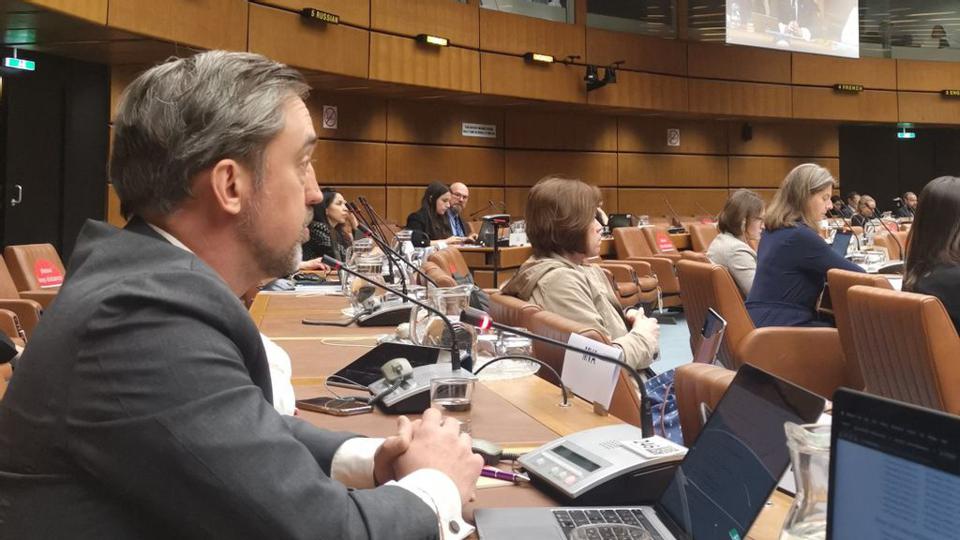
Director of the Lunar Policy Platform, Antonino Salmeri, Space Law Advisor for the Secure World Foundation, Chris Johnson, Executive Director for the Open Lunar Foundation, Jacob Malthouse, and President of For All Moonkind, Michelle L. D. Hanlon presented the Lunar Policy Handbook at the 62nd legal subcommittee meeting of the United Nations Committee on the Peaceful Uses of Outer Space in Vienna, Austria on the 27th of March. The handbook is intended as a guide to governance and coordination mechanisms on the lunar surface. Photo by Donna Lawler.
For All Moonkind, the Open Lunar Foundation, the Secure World Foundation and the Space Generation Advisory Council, are among a host of civil organizations from around the world that act as observers in United Nations Committee on the Peaceful Uses of Outer Space meetings.
And with the U.S., Russia, Japan, Spain, Germany, India, Canada and Mexico all sending missions or payloads to the Moon in the next year alone, lunar governance is drawing more attention than ever.
“The time is now, or soon to arrive, when the development of rules for the Moon is no longer just a theoretical or academic exercise,” said Chris Johnson, Space Law Advisor for the Secure World Foundation. “Member State delegations seem to be becoming interested in lunar governance. Perhaps we’ll see the international community embrace the vision of an ambitious, enterprising lunar future.“