

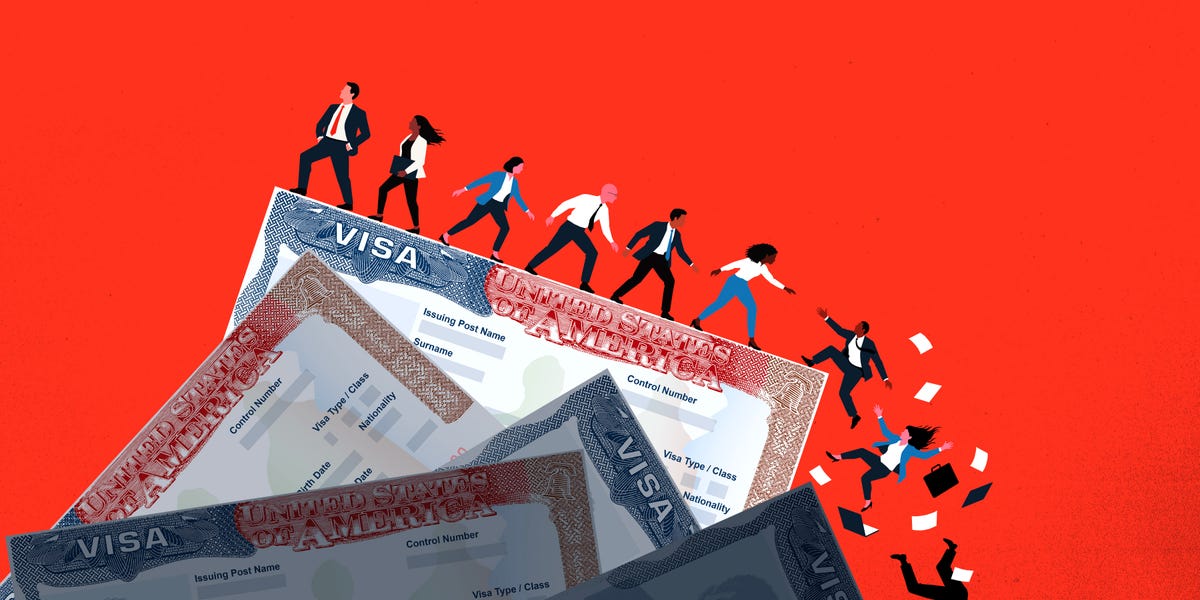
The shifting landscape of H-1B visas is starting to reveal distinct beneficiaries and those left behind.
The Trump administration has rolled out reforms targeting multiple legal immigration routes, including the H-1B visa program for skilled international workers and the Optional Practical Training (OPT) work permit for foreign graduates of U.S. institutions.
On Thursday, Vice President JD Vance revealed a new push to tighten the green card process for employees at select tech firms, such as Microsoft and Adobe.
Themoneytimes has been tracking how skilled immigrants adapt to these shifting immigration rules through its ongoing H-1B Fallout series, which launched a year after Trump first imposed a $100,000 fee on certain H-1B applicants.
The publication has explored where global talent is migrating, the unseen costs borne by those entering the H-1B system, and personal accounts from people at various points along the visa journey.
To assess who gains and who suffers under the updated H-1B framework, Themoneytimes consulted immigration attorneys and policy researchers and reviewed H-1B application records from the initial three quarters of the past three fiscal years.
Ted Chiappari, head of immigration law at Duane Morris, told Themoneytimes that none of the recent H-1B rule or policy adjustments appear designed to advantage one employer over another.
Nevertheless, a pattern is emerging: organizations with financial resources and workers possessing sought-after expertise are gaining a relative edge amid mounting uncertainty around H-1B regulations.
Each year, the U.S. allocates 85,000 H-1B visas. Despite demand continuing to exceed availability, applications for the March 2026 H-1B lottery declined by over 38% compared to the prior year, according to U.S. Citizenship and Immigration Services.
Trump’s proposed $100,000 H-1B fee for new applicants remains stalled in court. Chiappari noted that this is likely the primary factor behind the drop in filings.
The administration has consistently framed its reforms as efforts to eliminate abuse of the H-1B program and safeguard American workers — a view supported by USCIS. Spokesperson Zach Kahler emphasized that employment-based visas should complement, not replace, domestic labor.
The White House and the Department of Labor did not provide responses to requests for comment.
Winner: Workers earning high salaries and possessing niche skills
A key regulatory shift that benefits certain applicants is the wage-tiered H-1B selection process. Replacing the traditional random lottery earlier this year, it prioritizes candidates in higher pay brackets.
Additionally, basic math plays a role. When an employer must spend an extra $100,000 on top of a worker’s salary, they typically do so only for individuals earning significantly more than that amount.
This trend is visible in hiring data, particularly in sectors driven by generative AI growth. Certified H-1B applications for data scientists rose nearly 25% year-over-year in 2026 — the sharpest increase among occupations with over 5,000 applications. Computer and information research scientists experienced an even steeper climb, with filings up close to 40%.
Both roles offer lucrative compensation. According to figures from May 2025, data scientists earned a median annual wage of $120,230, while computer and information research scientists averaged $140,300 — far exceeding the national median income of $50,980.
Note that certified applications don’t always translate into visas issued and may reflect changes to existing employee records. Still, they serve as an indicator of momentum within the H-1B ecosystem. Full-year H-1B hiring statistics are expected later this year.
Catherine Macris, a partner at Fragomen, observed that workers in highly specialized, high-demand areas like technology may find themselves in a stronger position given recent emphasis on “specialization, compensation benchmarks, and employer compliance preparedness.”
Niche roles not only attract premium pay but also align more easily with evolving H-1B eligibility and wage guidelines, Macris explained. Employers can more convincingly argue that such hires require international recruitment rather than local sourcing.
Winner: Tech companies
Over the past few years, tech firms leading the expansion of generative AI have become central to economic growth. Their dominance extends to H-1B visa utilization as well.
Companies in the tech sector are frequently top recruiters of elite global talent and often maintain comprehensive immigration compliance frameworks, placing them in a favorable position to operate under the current climate, according to Fragomen’s Macris.
Among major tech employers, certified applications decreased by just 6.5%, compared to a 10% decline across all industries. For fast-growing AI leaders like Nvidia, Anthropic, and OpenAI, application volumes are rising sharply, underscoring how closely workforce shifts mirror wider economic developments.
Loser: Startups lacking the budget for the $100K fee
Smaller startups, which lack the capital or legal infrastructure needed to compete in the H-1B lottery, represent another group facing headwinds, according to Gaurav Khanna, an economics professor at UC San Diego.
“Large corporations like Nvidia and Salesforce aren’t discouraged by these charges, but startups certainly are,” he said. He warned that this disparity could hinder innovation within the startup ecosystem.
Loser: Organizations relocating foreign staff from abroad
Firms with extensive international operations that move personnel from overseas branches to the U.S. are especially exposed to tightening policies, said Lynden Melmed, a partner at BAL.
Service providers capable of outsourcing tasks globally will increasingly struggle to justify relocating workers to the U.S., Khanna added.
Khanna speculated that the most affected entities include outsourcing giants like Infosys, TCS, and Cognizant, along with businesses dependent on their services. Together, these three firms saw a 30% drop in certified applications year-over-year.
Vice President Vance reinforced the administration’s position during remarks on October 8, criticizing outsourcing agencies involved in facilitating overseas worker placements in the U.S.
“These firms are just as guilty — if not more so — in cases of visa fraud as any American company,” Vance stated.
Audit and accounting professionals encounter comparable hurdles. Year-over-year, certified applications for accountants and auditors fell by 25%.
Applications from the Big Four accounting firms dropped approximately 30% during the same period.
Loser: Academic institutions, recent graduates, and entry-level workers
Early-career individuals and recent alumni are expected to be disproportionately impacted due to lower earning capacity, according to Fragomen’s Macris.
Organizations relying heavily on junior talent — such as consulting and accounting firms with strong campus recruitment programs — “may face increased pressure” under this structure, she noted.
Their difficulties contrast sharply with the relative stability enjoyed by well-compensated, experienced professionals.
For educational institutions responsible for preparing these workers, challenges persist, Chiappari said, citing limited budgets compared to private-sector competitors when navigating the complexities and expenses of today’s H-1B system.
Certified applications from the top 50 schools featured in the 2027 U.S. News & World Report rankings declined by 14% between 2025 and 2026.