

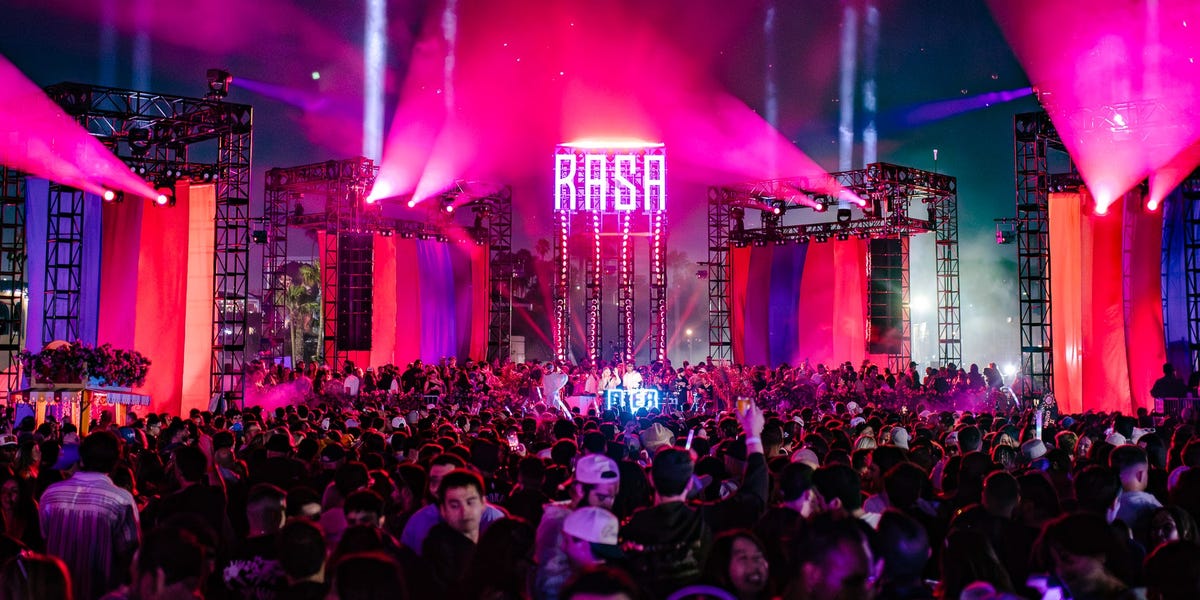
“Live experiences serve as the strongest hedge against AI,” said Paul Martino, managing partner at Bullpen Capital. “The venue where you can escape AI is a concert.”
…
While many venture firms are investing billions into artificial‑intelligence companies, a handful are placing a contrary wager on a classic, low‑tech sector: live concerts. They believe that as daily life shifts more onto digital screens, the appeal of real‑world experiences will only grow.
Martino belongs to a small group of about a dozen venture investors who have contributed roughly $9.5 million to RASA World, a Los Angeles startup that organizes electronic dance music festivals and global live events. Earlier this month, it hosted an EDM festival for 3,000 people on the San Francisco waterfront. This weekend, it is holding a two-day festival on the Santa Monica pier featuring DJs Arodes and Claptone, with an expected crowd of 8,000 people.
RASA was founded in 2023 by three serial tech entrepreneurs, making it decidedly for tech people, by tech people. Rather than spend money on expensive acts, the company has used its capital to hire engineers and data specialists to build what cofounder and CEO Ahmad Muhaisen described as an internal “super tool” to combine the data from ticketing, social interactions, and attendance.
A key draw for venture capitalists is that the founders speak in the lingua franca of venture-backed software. Muhaisen said investors often arrive expecting to meet a slick “nightlife promoter” only to be pleasantly surprised when he throws around terms like customer-acquisition cost, lifetime value, and scalable distribution.
“They suddenly realize we’re tech founders,” he said.
Muhaisen, a Lebanese computer‑engineering graduate, relocated to the United States, co‑founded a fintech startup, and then departed in 2022 to launch a venture centered on the events he had been throwing in San Francisco.
“These events started with 50 people in my house,” Muhaisen said. “Suddenly, there are a thousand people showing up and renting beautiful venues.”
Muhaisen wants RASA to become the “Palantir” of the concert business: an intelligence layer that gives an event producer a much more detailed picture of its customers, their social ties, and what draws them back.
He explains that RASA focuses less on total spend and more on the number of friends each attendee brings.
“We know in our system the top thousand people who are responsible for inviting 20,000 people,” Muhaisen said. The company can then reward those people with free tickets and upgrades.
Muhaisen favors the term “experience,” and emphasizes scenic (and Instagram-friendly) settings rather than headlining DJs. This is not Coachella. Anyone looking for Tiësto or Calvin Harris will be disappointed.
“If you’re going after bigger and bigger names, the margins suffer because it’s a finite group of talent that everyone is fighting for,” he explains.
Consistent with Silicon Valley’s restrained culture, the events also forgo bottle service and cocktail rounds.
“If a person has fun at our events without drinking, then we know it’s a good event,” Muhaisen said.
RASA takes some inspiration from Burning Man, which has attracted tech elites for decades. But as the demographic of that event gets older, RASA is trying to appeal to younger audiences who want something they can go to in the city on the weekend.
“There are people who have not been to Burning Man, but want that community feel,” said Semil Shah, a general partner at Haystack Ventures, which backed RASA. “They don’t want to go out into the woods or the desert for days or weeks. They want to have a more contained experience.”
Over the summer, Bullpen Capital’s Martino went to a RASA concert hoping to get a quick escape from conversations about AI, which dominate tech circles these days. He did not quite succeed.
“It is funny to go to a RASA event and see some of the biggest tech cheerleaders talking about AI,” he said, adding he was eventually relieved to see them take at least a momentary break to just focus on dancing.
“Thank God we got them away from their AI for 25 minutes,” he said.