

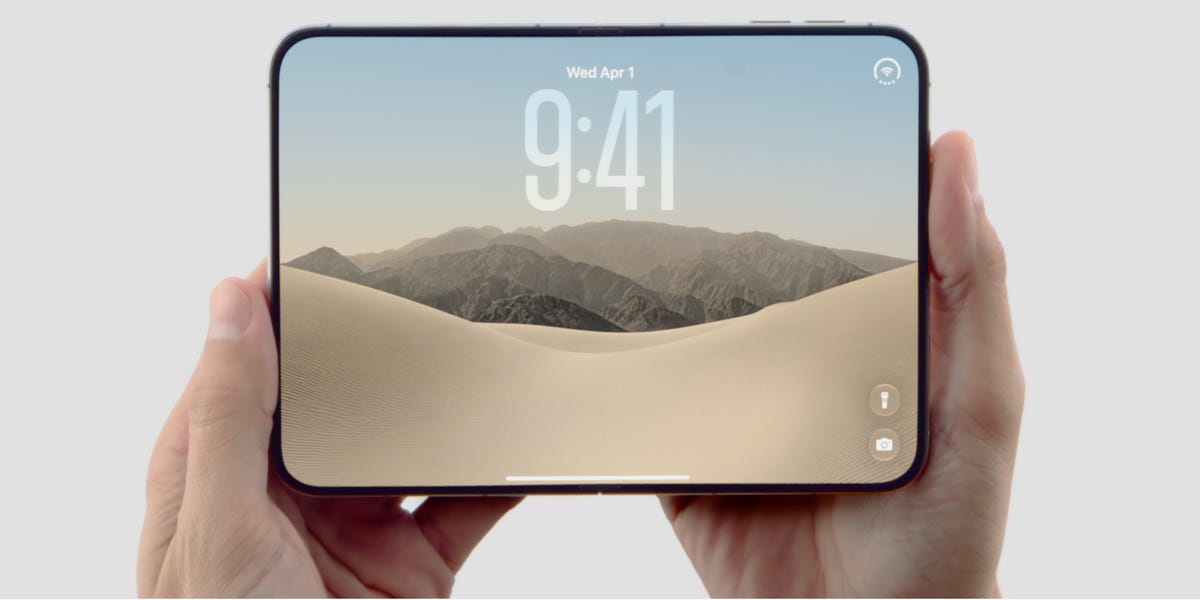
Since its 2007 debut, the iPhone maintained a consistent design: a flat, rigid rectangle. Apple is now departing from that traditional form factor.
Apple introduced the innovative foldable iPhone Duo on Tuesday during its annual September hardware event, representing the most significant design evolution in the phone’s history.
CEO John Ternus criticized competing foldable devices as feeling like two phones forced together unnaturally. He emphasized that the new phone features a display designed to feel as natural and intuitive as an iPad.
The device incorporates dual screens: a smaller front panel when folded and a large standalone display when fully unfolded. Upon opening, additional displays extend to each side of the hinge mechanism.
This model measures 50% larger than the iPhone 18 Pro Max and 80% larger than the 18 Pro variant.
Apple announced pricing for the iPhone Duo at $1,999.
Shattering the iPhone’s Design Conventions
Apple is not alone among tech giants exploring foldable technology. Competitors such as Samsung continue expanding their offerings, while Chinese manufacturers including Honor and Oppo provide more affordable and slim alternatives. Notably, some Huawei devices feature double-folding capabilities.
Despite this innovation, the shift represents a transformative departure for Apple, which had previously refined the original 2007 design by Steve Jobs.
Design lead Christopher Stringer described the creative journey behind the iPhone’s silhouette during the 2012 legal battle with Samsung. The team initially explored an “extrudo” prototype featuring a distinctive lozenge profile before settling on the iconic rectangular form we recognize today.
Following the 2012 trial conclusion, Apple secured its design patent—a rectangle with rounded corners—confirming ownership of the signature aesthetic.
Over subsequent years, Apple continuously refined various aspects of the design, extending the display size, eliminating the traditional home button, experimenting with color schemes, adding new side controls, and developing more lightweight, slimmer versions.
Despite numerous iterations, the fundamental rectangular framework remained consistent throughout development.
The latest foldable maintains core elements of Apple’s heritage, unfolding into a familiar rectangle with rounded corners.
Yet, this iteration introduces fresh possibilities to the market, demonstrating Apple’s continued willingness to innovate beyond established conventions.