

In May 2022, I found myself yearning for a fresh chapter.
I had devoted the previous two decades to reconstructing my life after losing my husband in the World Trade Center during the 9/11 attacks — raising a toddler and a six-year-old solo, relocating across the country to Seattle, authoring books on grief, and rekindling my passion for painting.
With both children now college graduates pursuing their own paths, I found myself alone and untethered for the first time since my twenties. I felt unmoored.
Then my daughter shared a YouTube video featuring a young couple with small children restoring a château in France.
They echoed my late husband and me years ago, when we renovated historic homes in cities like London and Boston while raising young kids. As newlyweds, we’d fantasized about someday living in Europe, perhaps a modest cottage in the French countryside, but that dream faded when his career moved us to the US.
Watching those videos reignited that long-dormant vision — and I realized this might be the ideal moment to pursue it.
I traveled to France hoping to acquire a property I could transform into a retreat haven for creative souls.
I loved the notion of restoring a building in a place I’d once dreamed of inhabiting while also following my passion for art and human connection. Lonely in Seattle, I ached to create an overseas sanctuary that would inspire people to gather, reflect, dream, and begin anew.
My initial concept was vague: find a place to host creative retreats for writers and artists.
So, single and in my late fifties, I planned a scouting trip to France to examine historic properties for sale. Touring heritage buildings while savoring the French countryside proved to be perfect solo travel for me.
I sought properties with multiple bedrooms that didn’t require massive structural overhauls, weren’t distant from international transit hubs, and sat in regions with mild winters. Toulouse seemed an ideal starting point.
Over three weeks, I drove more than 600 miles inspecting châteaux, manor houses, and farmhouses — many derelict, or beside busy highways, or isolated in remote areas. I consulted real estate agents daily and repeatedly pulled over to peer through gates at stunning estates.
I returned to Seattle empty-handed, assuming the château fantasy would fade — instead, it intensified. The retreat center concept solidified in my mind, and within a year I was back, viewing more potential properties.
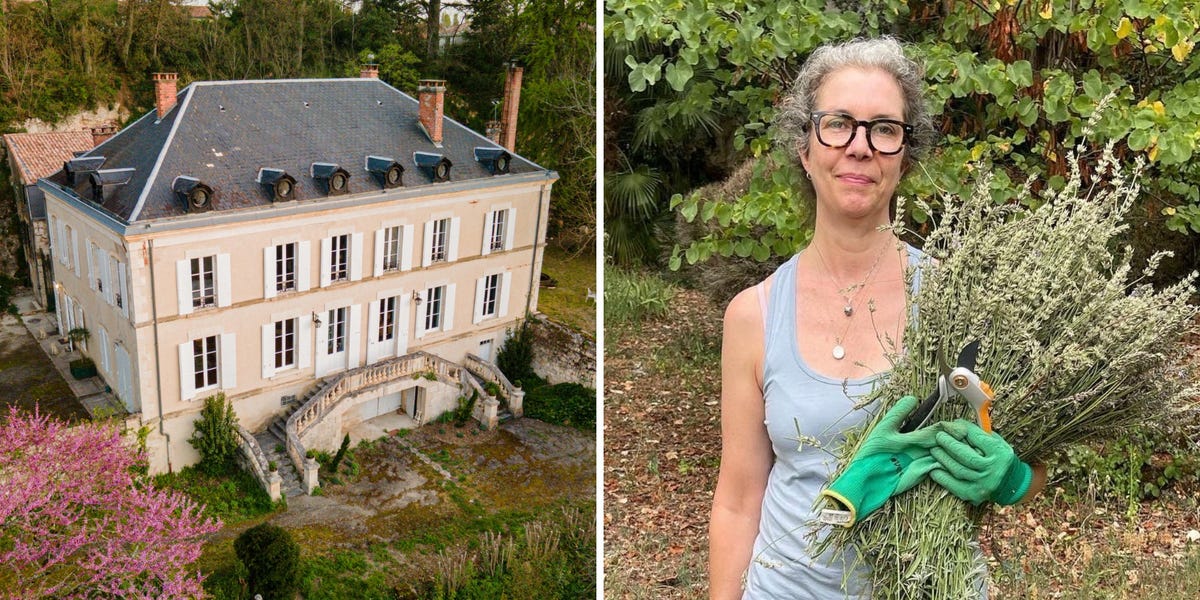
Finally, I discovered a neglected manor house tucked into limestone cliffs, where the outbuildings were actual caves. After spotting it online, I persuaded my real estate agent to leave his area and show me the property.
Château de Borie in the Lot-et-Garonne region of southwestern France, between Toulouse and Bordeaux, had sat vacant for several years. It boasted 12 bedrooms and 12 bathrooms, and crucially, updated septic, electrical, plumbing, and heating systems.
After viewing over 15 properties across two separate trips, I knew having these modern essentials already installed in an older building was a rare advantage. I convinced myself the property was in a condition I could manage alone — it merely needed an interior refresh and furnishings.
After a one-hour viewing, I impulsively submitted a lowball offer, nearly 70,000 euros below asking. Within 30 minutes, we agreed on 610,000 euros.
Unable to schedule a return visit before my flight the next day, I relied on the few photos I’d taken to remind me what I’d committed to.
As I progressed with the purchase and business planning, doubts still plagued me.
Back in Seattle, I questioned my judgment as I arranged translation of 50 pages of French legal documents.
I took out a home equity loan on my Seattle residence, which, combined with savings, would let me pay cash for the house, since securing a French mortgage would be extremely difficult.
To help obtain a visa, I had to draft a business plan for my half-formed retreat concept to earn a “real and serious business” certificate — a name I found amusing. As silly as it sounded, this exercise helped crystallize my vision.
Still, I lay awake nights, acutely aware I’d be leaving my home, my children, my life in Seattle. How would I manage two households when I often struggled with one? Could I run a business solo? What was I thinking?
Yet three months later, I was back in France (accompanied by a friend and translator) for closing, signing what felt like a thousand pages. Later, champagne in hand, I found myself — for only the second time — at that massive green front door, turning the key.
The following days and months brimmed with cleaning, painting, and wrestling with heavy shutters during a particularly violent thunderstorm.
Eventually, the hard work bore fruit — and I’ve built a life I’m proud of, even with its challenges.
At my daughter’s urging, I began documenting every step on YouTube and Instagram as “Chateau Chronicles” — it helped promote my business, and over time I amassed more than 100,000 followers and subscribers across platforms.
I hosted my first retreat — a sketchbook-and-yoga week for 14 people — in fall 2023, just one year after purchasing the château. Prices ranged from 2,900 to 3,400 euros for the week, depending on the room. It sold out almost immediately.
Attendees flew in from across North America and even Australia to sketch. Some were established artists, others complete beginners, and the week was magical.
We gathered around tables laden with secondhand brocante treasures or in the château garden to sketch, visited other châteaux for cooking lessons and regional wine tastings. Even three years later, the WhatsApp group I created for attendees remains active.
Since then, I’ve hosted everything from writing retreats to a supper club with a Michelin-trained chef. Four years later, the retreat business sustains itself, generating gross income of around 80,000 euros annually.
My goal isn’t endless scaling, but deepening. To attract the right people, offer something authentic, and send them home transformed.
The people who come here are often at a crossroads — in their careers, identities, or relationships — seeking a reset. The château has become a sanctuary for those seeking a place to land during transformation. They typically leave with wonderful memories and an entirely new circle of friends.
However, operating a retreat space in a historic building means something always needs repair.
I handle marketing, manage guest experiences, develop new offerings, and oversee ongoing renovations. I’ve painted most interiors myself.
Even a few weeks away brings consequences — leaking roofs, burst pipes, dead goldfish, falling trees and rocks. I also grapple with language barriers, finding contractors and artisans, complex French bureaucracy, and geological challenges I hadn’t fully anticipated.
Yet I’ve been fortunate to find help through volunteers and friends, both new and old. And by now I know which windows stick, and I have a special broom for clearing spiderwebs.
My life and business are now rooted in France, and I’m grateful.
What I thought would be a part-time venture has become my full-time existence. Though it’s demanding work, this place continues to inspire and frustrate me in equal measure.
Life in France isn’t always easy, but my days here are rich with beauty, incredible food, and a constant stream of new friends.
I feared leaving my kids in the US would be hard — and it can be — but when they visit, I get a week or so of uninterrupted time with them, more than the occasional dinner if we lived in the same city.
I treasure those moments. I even recently hosted my daughter’s wedding at the château, a truly magical experience.
Reinvention, it turns out, is something I share with so many women in their fifties and sixties who are done apologizing for wanting a life filled with joy, depth of meaning, and beauty.
Widowhood forced me to reinvent myself, but also granted the incredible freedom to make the impulsive decisions necessary to live my best, unexpected life.