

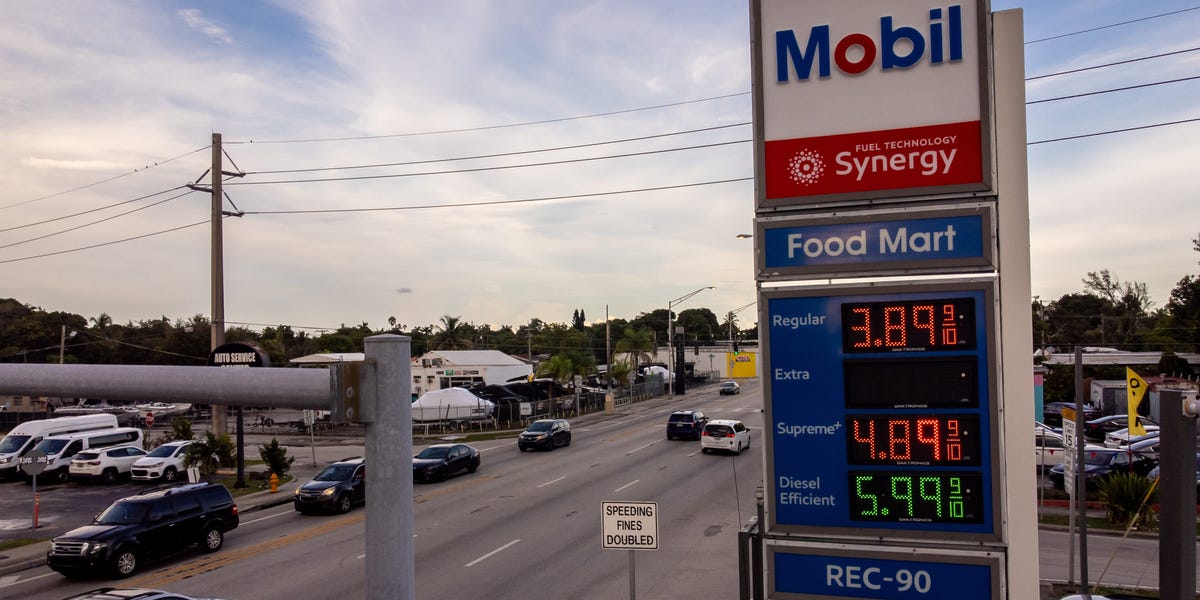
Set aside concerns about gasoline costs. The nation is now growing anxious over unprecedented diesel prices.
In recent weeks, legislators and economists have intensified their scrutiny of diesel prices hitting all-time highs, a trend that continues unabated even as crude oil and gasoline prices have retreated. While crude oil has fallen back from $100 per barrel, diesel reached a new record of $6.52 per gallon on Tuesday, per AAA figures.
This represents a 77% surge year-over-year, outpacing the 40% rise in regular gasoline and the 32% climb in Brent crude over the same period.
Several factors explain diesel’s sharper ascent. While crude prices are pressured by a supply chokehold at the Strait of Hormuz, diesel—a petroleum derivative—is primarily constrained by diminished refining capacity following recent attacks on energy infrastructure in the Middle East and Russia. Combined diesel exports from those regions plummeted 75% year-over-year in August, the International Energy Agency reports.
Though diesel attracts less public attention than pump prices for gasoline, it underpins the U.S. economy, powering shipping, agriculture, construction, and mining. Heavy-duty trucks—the primary movers of goods from food to machinery to “nearly all products people consume,” according to the Energy Information Administration—run on diesel. The fuel also indirectly powers roughly two-thirds of farm and construction equipment, Nobel laureate Paul Krugman noted in a Monday Substack post.
“Forget crude oil; distillates are the issue now,” the Nobel economist stated, emphasizing that rising diesel costs feed inflation more directly and increase the likelihood of Federal Reserve rate hikes compared to gasoline price spikes. Reducing borrowing costs has also been a key economic objective for President Donald Trump.
Bank of America analysts recently labeled diesel prices the “key real-economy pressure point” in a client note.
Supply Bottleneck Described as ‘a Total Mess’
The Trump administration and lawmakers have recently focused on the diesel crisis.
Republican legislators are advocating for a 90-day halt on U.S. diesel exports, a move that could theoretically ease domestic supply constraints and reduce prices.
Meanwhile, Trump has urged Ukraine and Russia to end their prolonged conflict, which has disrupted Russian refineries that contribute to global diesel supply.
“Russia has unfortunately lost control of its Diesel Oil Industry due to its War with Ukraine,” Trump posted on Truth Social Monday, warning that the “whole World” is suffering as a “large number” of diesel refineries go offline.
Separately, sources told the Financial Times this week that Trump pressed Ukraine’s president to cease attacks on Russian refineries during a call dominated by discussion of “diesel, diesel … diesel.”
“It’s clear the president recognizes the problem is diesel, not Saudi oil output,” veteran energy analyst Paul Sankey, president of Sankey Research, told Bloomberg Tuesday.
No simple fix exists for lowering diesel prices. While an export embargo would reduce U.S. prices initially, refiners might gradually cut production as margins shrink, eventually pushing prices back up, Sankey noted. An export ban could also trigger a supply “disaster” for regions like Europe.
“It’s a total mess,” Sankey summarized of the diesel predicament.
Fundstrat Research economic strategist Hardika Singh warned that $7 diesel could be on the horizon as supply pressures intensify.
“Diesel prices have surged to records, leaving the economy and stock market vulnerable to unraveling,” she wrote, citing the potential fallout for inflation and interest rates.