

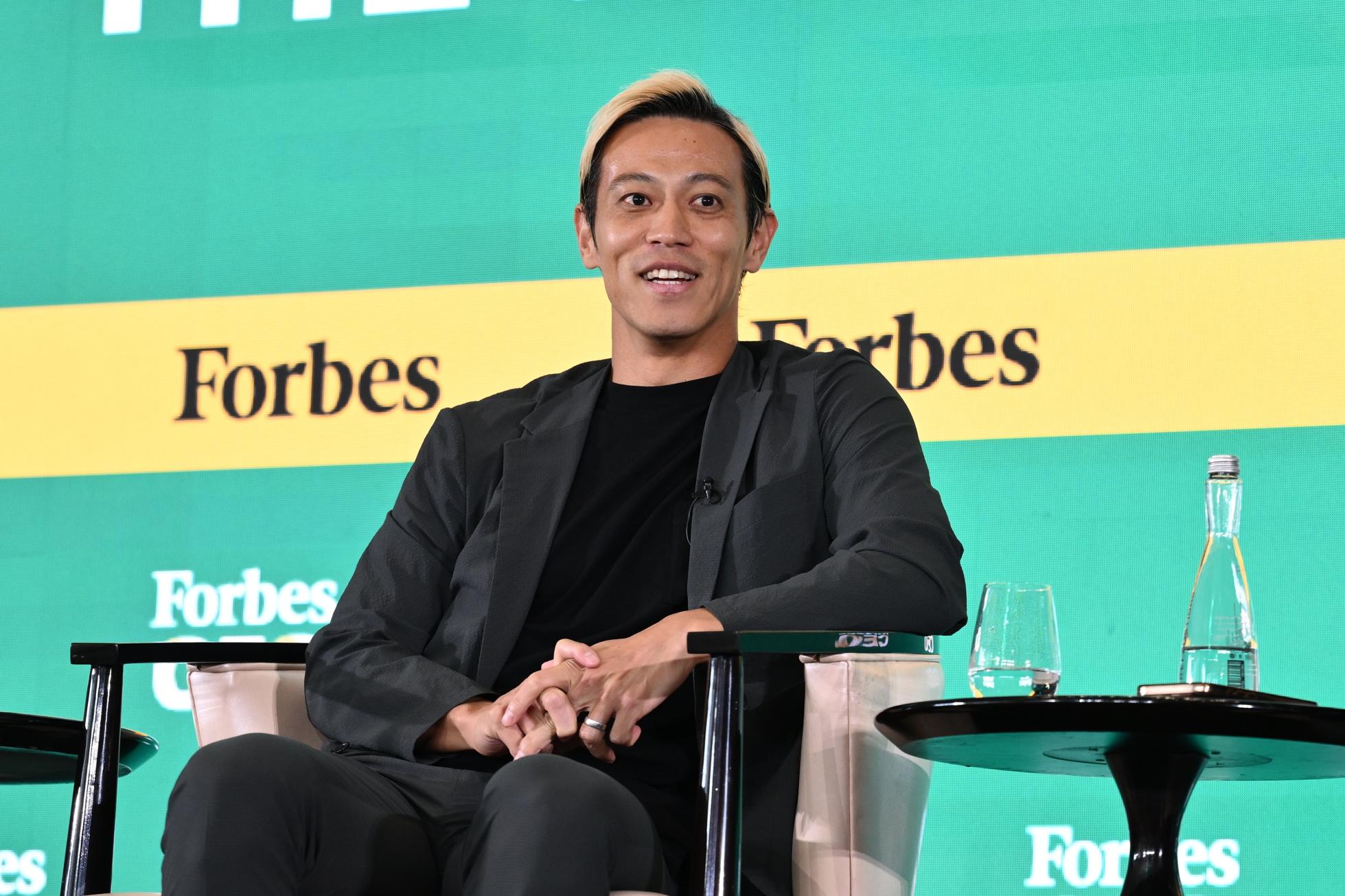
Over a two-decade football career, Keisuke Honda was a versatile midfielder for both club and country. He has played for a variety of top clubs around the world, including in his native Japan, the Netherlands, Russia, Italy and beyond. Now, Honda, 39, is remaking himself as a venture capitalist with his VC firm X&KSK. Launched last year, the firm’s most recent fundraising in January drew 15 billion yen (around $100 million) from blue-chip investors including Sumitomo Mitsui Banking and Strategic Business Innovator (SBI).
As a venture capitalist, Honda displays a versatility similar to his performance on the field. While his investments are focused mainly on Japan, his interests span a broad range of industries. Honda recently discussed his low-profile firm and its investment strategy with Forbes at the Forbes Global CEO Conference in Jakarta.
One of X&KSK’s most exciting portfolio companies, expected to be unveiled this month, is a Japanese robotics startup specializing in humanoids. “They’re going to compete with Unitree,” Honda says. The startup is currently in stealth mode and is raising a “big” funding round from investors that should soon be announced.
Humanoids—AI-powered, human-like robots—have become an investor favorite following the widespread adoption of AI. For example, shares of Shanghai-listed Orbbec have risen about 80% this year, propelling its founder and CEO, Howard Huang, to billionaire status in September. Other major investments: Samsung Electronics acquiring a controlling stake in Rainbow Robotics for approximately $180 million last year, and Doosan Group’s collaborative robots unit, Doosan Robotics, raising $312 million in a 2023 IPO, South Korea’s largest public listing that year.
Another undisclosed AI-related portfolio company backed by Honda operates in nuclear fusion. That investment comes at a time when major global tech companies like Alphabet and Microsoft are increasingly exploring nuclear energy as a potential solution to plug surging electricity demand from their AI data centers.
X&KSK’s nuclear fusion startup, Honda explains, employs the helical method, an alternative to the more common tokamak approach for generating fusion energy. Both methods use magnetic fields to trap extremely hot plasma, allowing atoms to fuse. The key difference is that the helical method uses only external twisted coils, while the tokamak design also requires a strong electric current through the plasma.
“The helical [method] has been researched for a long, long time, and actually they have done a lot of great R&D recently,” Honda explains. “But for political reasons, I believe, it’s not easy to be replaced.”
Despite the hurdles, Honda sees “huge potential” for the helical method in Japan. Since the devastating 2011 nuclear disaster (the worst since Chernobyl), Japan has been gradually returning to nuclear power. Recently, the government approved the restarting of the world’s largest nuclear power plant, Tokyo Electric Power Co.’s Kashiwazaki-Kariwa, in Niigata prefecture. Additionally, a plant on the Japanese island of Hokkaido is close to resuming operations after receiving local government endorsement.
Once he can publicly reveal the identities of his portfolio companies, Honda plans to leverage his other asset: his name and fame. “Even people who are not interested in football know me,” says Honda, who has nearly 1 million followers on Instagram and 1.6 million on X. “Founders want me to invest in their companies for the marketing side.”
Honda refers to his approach as a VC as “branded capital.” Under this model, his firm provides both financial capital and branding support. “Great founders have access to money, so they always select the investors,” he explains. “So branded capital has a huge advantage because marketing is very important for founders today.”
MORE FROM FORBES GLOBAL CEO CONFERENCE