

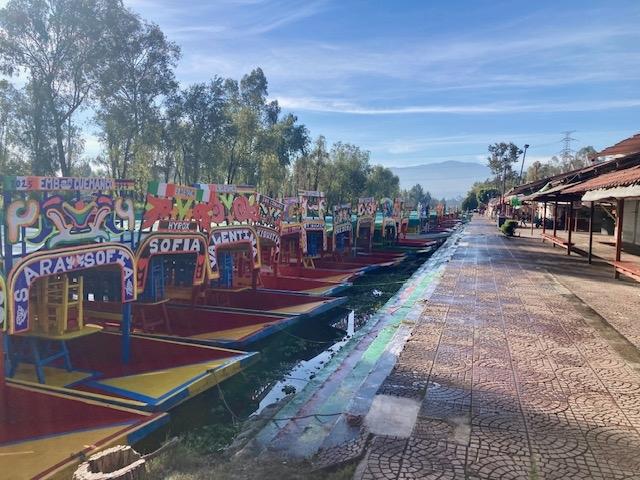
Arriving at the port of Xochimilco in Mexico City, I was greeted by a long line of colorful trajineras, or flat-bottom gondolas, that are used to take visitors out onto the area’s myriad canals.
And when I say a long line, I mean long. I counted more than 100 boats tied up in the narrow canal, and my friend, a Mexico City local, said that this was nothing, that other ports of entry to Xochimilco had even more.
Xochimilco is one of the most-visited areas in Mexico City. It is noted by UNESCO as one of the most important sites in the region for its pre-Hispanic history and ancient agricultural technology, though most visitors today experience Xochimilco through a kind of festive lens rather than its deep historical roots or ecological importance.
The trajineras that cruise around Xochimilco’s canals were historically much smaller, more drab, and used for navigating between the traditional chinampas, or floating farms, that provided the growing Aztec empire with food and showed off the people’s ingenuity when first settling the large valley that is modern-day Mexico City.
Flash forward to today, and the floating farm has given way to the floating fiesta—that is, the boats are larger, painted in bright colors, and used to take people out into the canal system on a scenic cruise, where they listen to modern mariachi music, dance, drink, buy food from floating vendors, and perhaps visit “the creepy island of dolls.”
These are the boats that line the dock, painted in modern Mexican colors. We walk past them, farther down to where a much smaller trajinera awaits. We shove off, propelled not by a motor, but by a long pole that a conductor standing on the back uses to push us along.
Our guide starts out by explaining that this tour will be very different than others in Xochimilco. We aren’t going to drink anything alcoholic, he tells us, and we won’t listen to any mariachi. Instead, we will go back to the ancient roots of this place, learn about what makes it special, and understand why it’s here in the first place.
He tells us that the drinking culture here is popular, and perhaps even fun. But unless we continue to teach the history, everything will eventually be lost.
“Everything changed for me when I came here and met the indigenous, local people,” says Roberto Berdeja Pulido, Owner of Mitote Tours. “All the knowledge they had that is being lost, people would rather come and drink than learn the real truth of the area. That’s something we need to transform if we want to save the culture and experience here.”
A Bird’s Eye History Of Xochimilco
Berdeja’s Mitote Tours is one of a handful of tour companies trying to go against the grain here at Xochimilco in an attempt to pull visitors away from the contrived “fiesta boats” and introduce them to the real reason the area is viewed as important.
Xochimilco is located about an hour by car from Mexico City’s city center, and it is considered one of the most historic natural landscapes the city has to offer. Here, we come to the interesting intersection of Mexico City’s pre-Hispanic world, its colonial transformation, and the current influences of modern urban life, all in one place.
Xochimilco’s story begins with what are known as “chinampas,” simply described as a floating garden system that was created more than 700 years ago in the 1300s. Each individual chinampa is an “agricultural island” of its own, literally built by layering mud, reeds, and grasses on top of the water.
Today, these chinampas are large and stationary, anchored by the roots of willow trees (and, at times, by other modern tactics). But back in the day, these floating islands were often small and narrow—less than 1,000 square feet—with some capable of being moved around the water system (Berdeja jokes that if you didn’t like your neighbor back then, you could simply move your land).
Built on a shallow lakebed, they allowed the Xochimilcan people to turn marshland into fertile farmland. The original purpose was to provide food for the growing population of the Aztec capital (Tenochtitlan).
Nowadays, some chinampas are still farmed by indigenous people, such as the ones Berdeja visits on his tours. But others have been bought and repurposed, forgoing traditional agriculture for more modern uses, like soccer fields, wedding venues, or refreshment stations for the fiesta boats—a trend that Berdeja regrets.
A Modern Drinking History
One of my first questions about Xochimilco was how the drinking boat culture got started. I was curious about when and why people first thought it would be fun to paddle the canals in this fiesta style. Was this something the original inhabitants did?
According to Berdeja, the tradition of exploring Xochimilco by boat is much more recent, owing its roots to the cultural revolution that took place during the reign of President Porfirio Díaz in the late 19th and earth 20th century.
After the Spanish arrived and the Aztec empire fell, the canals and chinampas of Xochimilco remained essential, providing colonial Mexico City with produce and flowers.
President Diaz is often associated with the romanticization of Xochimilco’s canals thereafter, for it was during his presidency in the late 19th century that people began using trajineras for leisurely cruises—that is, the “high society” groups of the time began to frequent Xochimilco for picturesque outings aboard painted trajineras.
While there was no single reason or specific event that kicked off this new era, it did fit in overall with Diaz’s vision for Mexicans to indulge in more leisure time (like the European cultures he admired). The popularization of Xochimilco was also aided by on-going improvements in transportation infrastructure, which allowed more people in the center of Mexico City to reach rural areas outside the city.
By the 1930s, an outing on a colorful trajinera was considered a signature activity for Mexican families, couples, and school groups. Later decades brought more international visitors and the addition of modern touches, like mariachi music, floating vendors, and the festive vibe that we see today.
New Tours Focus On History, Farms
Our destination on the tour with Berdeja was to visit and explore a chinampa that was still being used for traditional purposes. In this case, the owner farmed medicinal plants, crops (corn), and raised a couple head of cattle. The land was beautifully maintained, the garden in bloom, and I remember the soil was this dark, rich, almost purple-ish color.
Xochimilco is a UNESCO World Heritage Site and one of the last functioning chinampa landscapes in the world. It’s a point that Berdeja doesn’t want his guests to forget. He wants to be a part of a new wave of ecological, culinary, and cultural tours in Xochimilco, tours that reconnect visitors to the true essence of the place and remind them of its fragility.
One example is the axolotl, or ajolote, a beloved amphibian famous for its ability to regenerate limbs and organs—so famous that it appears on the 50 peso bill. It once thrived in these canals but is now endangered because of the impacts of habitat loss, pollution, and the introduction of invasive species.
We ate lunch on the farm, a meal made from ingredients grown there, or just nearby, a tamale with fresh cheese and seasonal veggies. We also learned about Chinampalina, a restaurant in the city that creates dishes especially sourced from Xochimilco.
Cruising around the waterways, hearing the stories and seeing the various ways in which the chinampas are managed today, visiting the farm, it all really put things into place. I saw the deep connection to the past here, and the way that modern life has derailed it. But it also gave me hope, that folks like Berdeja are out there, trying to keep the connection alive. Check it out for yourself on your next visit to Mexico City.