

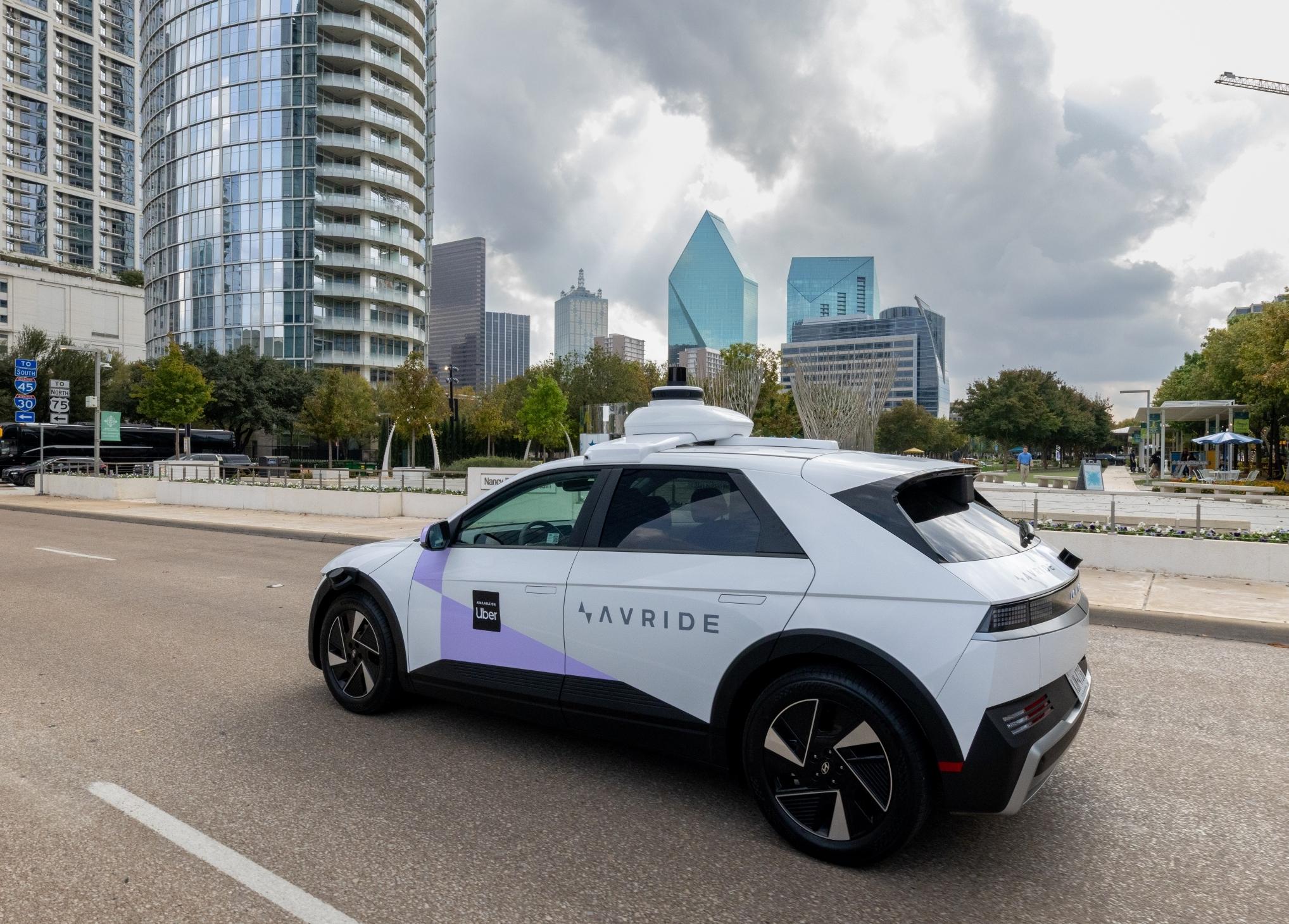
Uber is expanding its push into the rapidly growing self-driving vehicle market with a new robotaxi service in Dallas that begins today. The rideshare giant is deploying a fleet of autonomous vehicles developed by startup Avride, which also makes delivery robots.
Avride’s vehicles can be booked with the Uber app for travel within a nine-square-mile section of downtown Dallas. For now, the vehicles–modified versions of Hyundai’s electric Ioniq 5 hatchback–will operate with human safety drivers in the front seat as a precaution, the companies said. Riders will be charged the UberX, Uber Comfort or Uber Comfort Electric rate – with no expectation of tipping. Industry rival Waymo also plans to take its robotaxi service to Dallas next year.
Uber’s project with Austin-based Avride is one of more than 20 autonomous business partnerships it has launched or announced over the past two years, including operating robotaxi fleet depots for Waymo in Phoenix, Austin and Atlanta. Last week, Uber began operating a robotaxi service in Abu Dhabi with China’s WeRide, which it said is the first such fully autonomous service outside of the U.S. and China. In October, Uber joined Avride’s Dutch parent, Nebius, in a $375 million funding round to help build up its operations, which include sidewalk delivery robots used by Uber Eats in Austin, Dallas and Jersey City.
“Robotaxis are what we’ve been building from day one,” said Avride CEO Dmitry Polishchuk. “Building on the success of our autonomous delivery partnership, we’re now expanding our collaboration with Uber and bringing our core technology to passenger mobility.”
Like Waymo, Zoox, China’s Baidu and WeRide, Nuro and almost all driverless vehicle developers except Tesla, Avride’s robotaxi is loaded with sensors to maximize safety. Each vehicle in its Dallas fleet uses 13 cameras, five laser lidars for 3D images and four radars to detect hard objects.
Though Avride is a relatively new company, its roots stretch back to 2017 when it was the self-driving unit for Russian tech company Yandex, operating autonomous test vehicles in Michigan. Following the start of Russia’s assault on Ukraine in 2022, Polishchuk and much of his team decided to split off from Yandex and start Avride as a fully independent U.S.-based company.
“Avride has zero to do with Russia anymore,” Yulia Shveyko, a company spokesperson, told Forbes. “No financial connections; no development; nothing.”
Avride has plans to expand its robotaxi service to other markets beyond Dallas but Shveyko declined to say how soon that might happen. Uber, however, intends to have autonomous vehicles from its many partnerships operating on its network in 10 cities or more by the end of next year.