

The holidays are a ritual built on shared history, yet Coca-Cola’s 2025 holiday ad campaign bets on AI efficiency over emotion. Can true nostalgia survive when the human touch is removed from the recipe?
Spring break in California wasn’t supposed to look like this. Being from Massachusetts, I had packed for Los Angeles with a specific goal: to escape Massachusetts in March. I wanted sand, sun, and the beach. Instead, I found myself nearly 100 miles inland, severely underdressed and shivering in snow at 7,000 feet on Big Bear Mountain. There was a funny kind of dissonance to it—flying across the country to get away from winter, only to stare up at a massive log cabin that felt less SoCal and more New England.
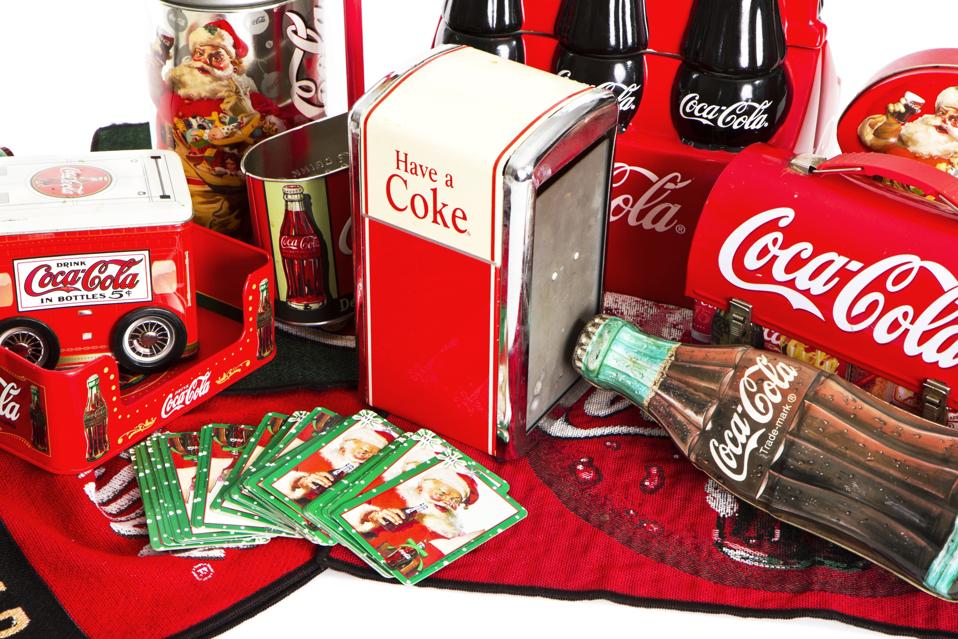
Inside, I forgot about my frozen toes pretty quickly. The cabin had the kind of warmth you notice before anything else. It belonged to my ex-husband’s aunt. She was a New Englander too, which explains why she had turned the whole place into her own Christmas corner: tin Santas on the walls, ceramic polar bears on a shelf, and a basket of oversized pine cones by the hearth. In the corner sat an old glass-bottle Coke fridge with the low mechanical sound older appliances make. It felt like walking onto the set of a Hallmark movie—the kind where the cynical city protagonist finally admits they love the holidays.
Standing there, surrounded by all that red-and-white memorabilia, it clicked. This wasn’t just brand loyalty. It was a shared language. Coca-Cola had managed to bottle up a specific memory and sell it back to us. I thought about the 1995 holiday ad, the one with the glowing trucks cutting through the snow. That commercial felt like Christmas to me. Coca-Cola wasn’t just selling a drink; it was selling a place in the holidays.
That’s why seeing the AI-generated holiday ad return this year, in 2025, feels so jarring. The snow and the glowing lights are there, but the feeling isn’t. It makes you wonder whether a childhood memory can be generated at all, or if the technology meant to keep the magic alive is actually smothering it.
The Santa We Know (And The One We Don’t)
Coca-Cola didn’t just show up for the holidays. They told us what Santa looked like. According to the Atlanta History Center, before the 1930s, Santa Claus was often depicted as a spooky elf or a gaunt bishop. It wasn’t until Haddon Sundblom began his legendary run of illustrations for Coke that the “warm, friendly, pleasantly plump” Santa became the global standard.
Even the famous polar bears, which debuted in 1993, were born from a human moment. The History Center notes that the animation was based on the campaign creator Ken Stewart’s own Labrador puppy. These weren’t just marketing assets; they were characters born from human observation.
The Trucks That Defined Christmas
Then came the trucks. The 1995 “Holidays Are Coming” ad worked because it was a feat of genuine craft. Coca-Cola didn’t just ask a computer to “imagine a truck”; they hired Industrial Light & Magic, the wizards behind Star Wars, to bring the vision to life. The physicality of the trucks, the warmth of the incandescent bulbs, and the cinematic quality made it feel grounded in reality.
The irony is that Coca-Cola still relies on that reality. Even as they flood our feeds with AI-generated renders, they are simultaneously running their Holiday Caravan tour across the country. Right now, families are bundling up to go stand in front of a real truck, take photos with a real Santa, and buy physical merchandise from the holiday store.
This creates a strange disconnect. The brand is betting on the efficiency of AI for our screens, yet relying on the heavy lifting of reality for our streets. The fact that the Caravan tour remains a massive draw proves that the symbols aren’t enough on their own. They need to be anchored in the real world. We don’t just want to see the truck generated by a prompt; we want to see the breath steam in the air next to it.
What Happens When Nostalgia Goes Artificial?
That’s why the return of the AI-generated holiday ad this year hits such a sour note. Remember last year? In 2024, Coke tried to modernize this legacy using generative AI. They worked with studios like Secret Level and Silverside AI to render snowy landscapes without ever picking up a camera. The backlash was instant. People called it soulless, dystopian, and cheap.
Yet, despite that reception, Coca-Cola has doubled down. The technology is better this time around, but the result still leaves us cold. Executives are share that this year’s technology achieves “physics-driven realism,” allowing them to scale content faster than ever. The issue is that this confuses physics with feeling. The ad captures the texture of the snow, but not the sensation of the cold.
The digital perfection highlights exactly what is missing: the human imperfection that makes a moment feel real. Coca-Cola has defended the move by noting that the campaign’s music was performed by real artists—a strange consolation. It feels like a restaurant promising that while the steak is synthetic, at least the salt is organic.
Why Manufactured Nostalgia Feels Fragile
Nostalgia isn’t just about what we see; it’s about emotion, memory, and connection. Algorithms can’t fully grasp that.
Back in that cabin on Big Bear, I didn’t feel the sharp excitement of a kid unwrapping a toy. I felt something enduring. In that moment, Coca-Cola became bigger than a brand. It was a visual language that connected people to a shared feeling.
New research confirms that this missing “soul” isn’t just a vibe—it’s a real problem. A study published this week in the International Journal of Information Management highlights the risk of replacing human creativity with synthetic media. The research suggests that while AI can replicate visual patterns, it fails to replicate the “perceived authenticity” required to build trust.
By ignoring this, Coca-Cola isn’t just taking a creative risk; it’s betting against its audience. The glossier the video gets, the more eerie it feels to the viewer.
The Magic That Algorithms Can’t Replace
Coca-Cola’s holiday ads have always been more than marketing—they’ve been invitations to join in the magic of the season. But as this year’s campaign shows, the emotional connection that defines nostalgia can’t be manufactured.
In food culture, trust is built on shared experiences. Nostalgia thrives on authenticity—the kind that grows over years, not pixels. Coca-Cola can adopt new tools, but the magic only holds when the work still feels human. That’s what built their holiday mythology in the first place, and it’s what this year’s AI campaign can’t quite touch.
The polar bears might not be real, but the feelings they evoke are. And in a world of AI-generated everything, those feelings are more valuable than ever.