

After two weeks in Belém, the defining image of COP30 is not a sweeping agreement or a breakthrough clause. It is the roadmaps.
This word appeared again and again in the final days. Roadmaps for climate finance. Roadmaps for the transition away from fossil fuels. Roadmaps for forest protection.
When negotiations reached the hardest questions, delegates reached for another planning document. That might sound like diplomatic failure, but it is not entirely.
Roadmaps, although imperfect, have become the main tool the global climate process still has. In the political landscape of 2025, they may be the only tool that can hold a divided world together.
Paris Is Still Alive, Although Only Just
The outcome from COP30 verified a shift that both scientists and policymakers have quietly acknowledged for years. The goal of keeping global warming within 1.5 degrees was once described as “keeping 1.5 alive”. The language has now changed to “keeping 1.5 in sight”.
The world is not moving toward the Paris target. It is drifting away from it, and the likely path now sits between 2.5 degrees and three degrees of warming. Some recent findings from James Hansen’s group indicate an even higher trajectory.
The Paris Agreement relied on voluntary national commitments. This worked politically in 2015. It no longer works in 2025. Only 119 of 195 signatories have submitted extended targets for 2035. The combined effect of these new targets falls short by roughly one third of what science says is required.
The ambition of Paris created alignment. It has not created the necessary reduction in emissions.
Roadmaps Everywhere At COP30
When countries could not agree on binding mechanisms, they defaulted to planning documents. The Baku to Belém climate finance roadmap, for example, acknowledges that the world needs at least $1.3 trillion per year.
Yet the only collective figure and goal that governments managed to agree on was $300 billion through the New Collective Quantified Goal on Climate Finance. Much of this money will likely be offered as loans on commercial terms rather than grants.
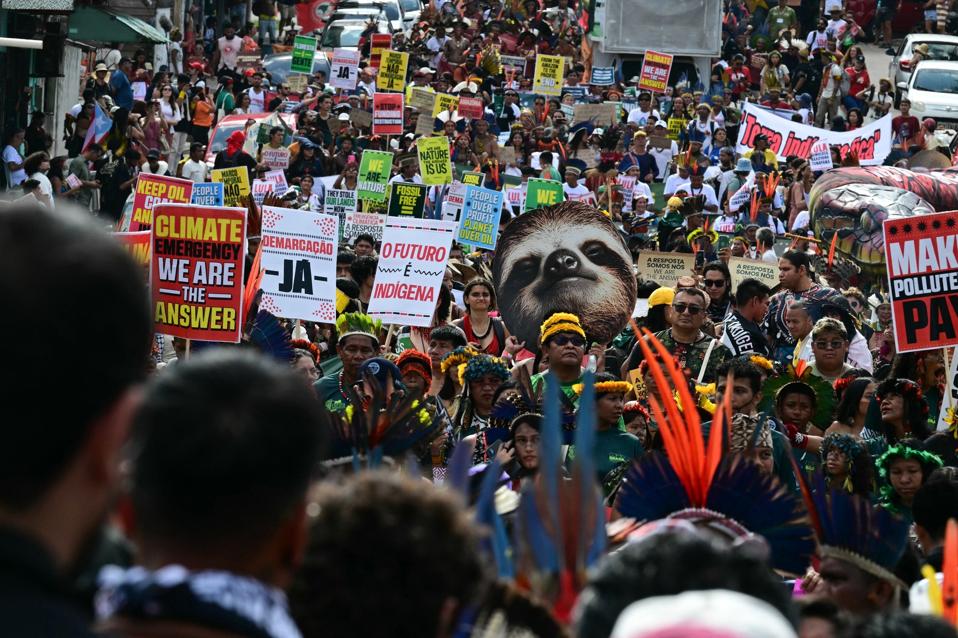
Protests in Belém highlighted how unfair this structure is for countries that face the most severe climate impacts despite having contributed the least to historical emissions.
A similar pattern unfolded around fossil fuels. More than 80 countries wanted strong wording on the phase out of coal, oil and gas. Negotiators were unable to reach agreement, and the outcome was yet another roadmap, this time placed entirely outside the official COP text. It holds no formal status.
The number of countries that resisted clearer language on fossil fuels became a point of debate, although the central group of obstructing nations was familiar to anyone who follows climate diplomacy.
Critics will argue that this represents failure. In reality a roadmap provides something essential. It provides a shared direction at a time when shared commitments are politically impossible.
The challenge now is to ensure these roadmaps lead toward solutions rather than toward a political maze.
The Missing Amazon Text
Belém, surrounded by rainforest, hosted what was described as the Amazonia COP. There was strong momentum behind an initiative to permanently protect tropical forests.
Norway pledged approximately $3 billion over ten years. A new Tropical Forests Forever Facility launched with $6.7 billion from Brazil, Indonesia, France, Germany and Norway.
The goal is to reach $25 billion. An additional $1.8 billion was pledged for forest and land tenure initiatives. Yet none of this appeared in the final COP text. It became another roadmap.
Given the importance of rainforest carbon sinks, this is one of the most concerning omissions in the entire process.
There Were Still Positive Signals At COP30
Even with slow progress, COP30 delivered advances. Countries agreed to triple adaptation finance by 2035, reaching $120 billion per year. The Belém Mission to 1.5 degrees and the Global Implementation Accelerator were launched to speed up national climate plans. These are also voluntary and cooperative initiatives.
These initiatives aim to support the transition described in the Global Stocktake, even though they did not become part of the official decision text.
Research institutions also played an important role. SINTEF and NTNU participated in side events and presented practical solutions for reducing emissions in the most challenging sectors.
According to Marianne Karlsen, Norway’s Chief Negotiator, who spoke at a briefing meeting, such evidence-based input remains essential at COP meetings.
What COP30 Really Tells Us
COP30 confirms that the world has moved from a phase of goal setting to a phase of damage management. The prospect of remaining within 1.5 degrees is highly unlikely, and so future COP gatherings will focus on stabilizing a world that is warming more quickly than anticipated.
This makes communication crucial, especially across generations. One of the greatest risks in climate action is the belief that someone else will solve the problem.
Younger generations already see the world they are about to inherit. The question now is whether today’s leaders will use what remains of the Paris framework to reduce harm, accelerate the transition and prevent the most severe outcomes from becoming impossible to avoid.
In theory the direction of travel is already clear. The official language from COP28 called for “transitioning away from fossil fuels in energy systems in a just, orderly and equitable manner in order to achieve net zero by 2050 in keeping with the science.”
The reality looks very different. The world is drifting away from the 1.5-degree goal in a way that is unjust, chaotic and inequitable, with little regard for fairness, stability or scientific advice. The net zero target for 2050 is not yet impossible, but it is becoming more difficult.
Roadmaps cannot replace firm action, yet they still provide direction. In the present geopolitical climate, they may be the only foundation available to build on, and using them well will determine how much of the remaining climate window the world can still preserve.