

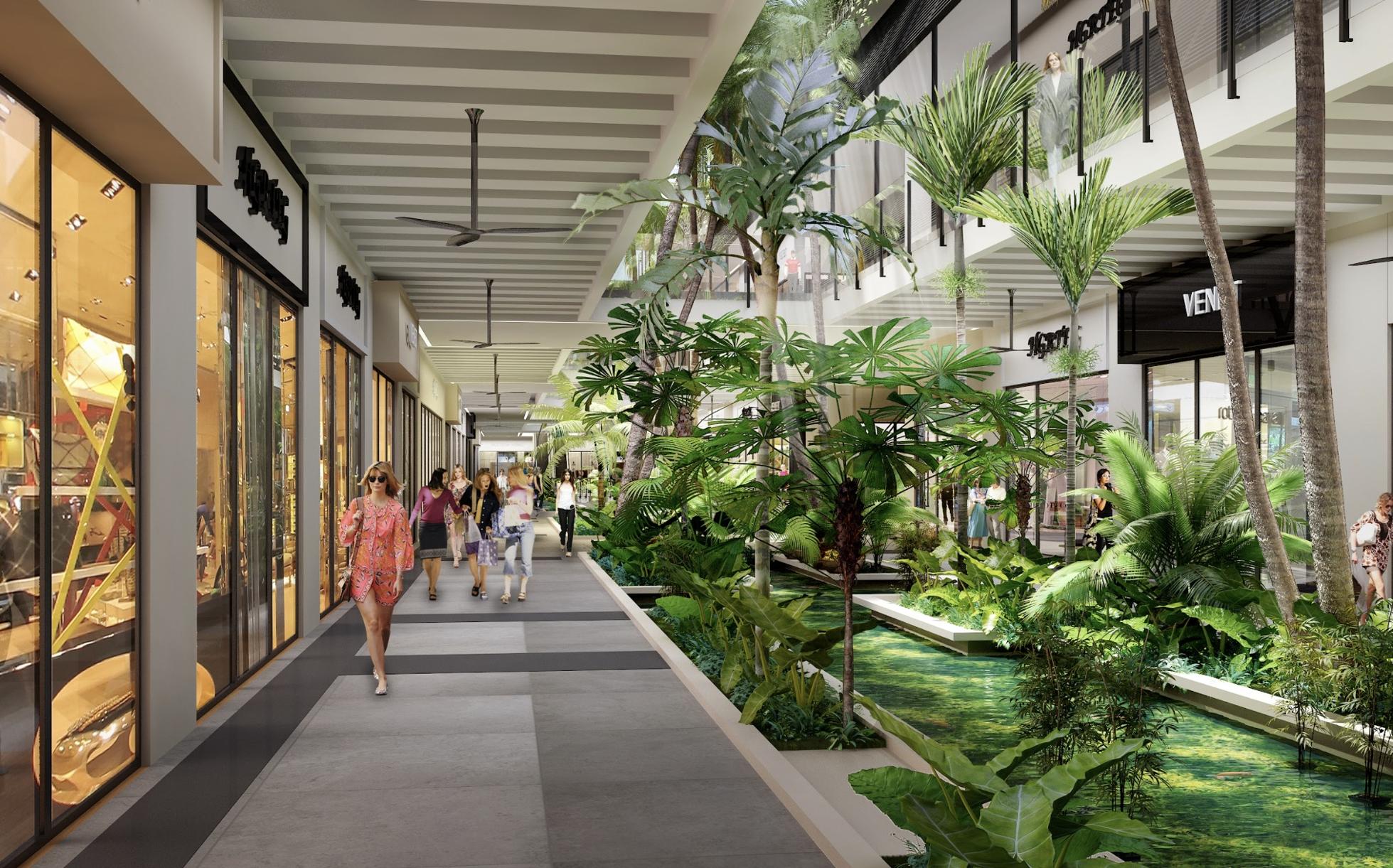
Under a perpetual canopy of sun-drenched palms and with a seemingly never-ending parade of luxury vehicles in its valet line and stylish international shoppers browsing its designer stores, Bal Harbour Shops remains an exception to Miami’s constant reinvention. Its proximity to the Atlantic provides a comforting ocean breeze, while koi-filled ponds and sun-basking turtles create the feeling of a private, curated paradise. Visitors come from far and wide, not just for world-class fashion and jewelry, but for the art, fine dining, beautiful people-watching, and an ineffable sense of leisure that has defined the Shops for six decades. As you walk the open-air terraces lined with the world’s foremost maisons, you hear many languages, but one unites them all – the language of uncompromising global luxury.
Growing up in Miami, a visit to Bal Harbour Shops was always much more than just a visit to the mall; it was a special occasion, one that called for dressing up and a mindset of quiet sophistication. The Shops carried the air of a private club, where style and discretion were the true currency and the setting was impeccably choreographed. We would dine beneath the palms at white-clothed tables that felt more Riviera than retail, as models glided past us between courses, offering an early education in elegance.
As Bal Harbour Shops celebrates its 60th anniversary, my decades of memories take on renewed meaning. What began as a bold idea on the edge of a sleepy village has become a global landmark, one of the most influential luxury destinations in the United States and a strategic stop on any international traveler’s Miami itinerary. Today, celebrities and socialites are as easily spotted here as couture – Hailey Bieber, Beyoncé and Jay-Z, Victoria Beckham, Kim Kardashian, Pharrell Williams, and Eva Longoria among them – many of whom have been known to close down boutiques for private shopping experiences.
A Radical Vision: Creating the first open-air luxury shopping mall
The story of Bal Harbour Shops begins in 1946, when one visionary, Stanley Whitman, envisioned a place that would merge commerce with nature. Between 1954 and 1962, he studied shopping centers across the country and imagined something entirely different, an open-air destination where limestone walkways, tropical gardens, and natural light would replace the enclosed air-conditioned walls of traditional retail. He wanted shopping to feel like a stroll through a resort rather than a transaction.
That dream became reality in 1965, when Bal Harbour Shops opened its doors with tenants such as FAO Schwarz, Martha’s, Maus & Hoffman, and Abercrombie & Fitch. Instead of bright lights and artificial décor, there were palm trees, fountains, and sunlight, an aesthetic shift that encouraged visitors to linger. The concept would redefine the future of luxury retail and inspire countless open-air shopping destinations around the world.
The Great Coup: Anchoring a Global Vision
In 1971, Whitman achieved what many believed impossible when he convinced Neiman Marcus to open its first location outside of Texas, anchoring his open-air mall. Five years later, Saks Fifth Avenue joined the party, making Bal Harbour the only destination in the country to host both department store legends under one sky. This retail coup permanently altered the investment landscape of American luxury.
By the late 1970s, Bal Harbour Shops became a magnet for European fashion houses seeking a refined U.S. gateway. In 1977, Whitman and Dr. Aldo Gucci personally signed the lease for Gucci’s first standalone American boutique, an audacious move that proved Fifth Avenue was no longer the only path to prestige. A decade later, Gianni and Donatella Versace brought their unmistakable Italian glamour to the Shops, ushering in an era of bold sophistication that still defines Bal Harbour today.
By the 1990s, Bal Harbour Shops had evolved from a retail destination into a cultural institution. Chanel, Cartier, and Bulgari joined the fold, solidifying its reputation as a sanctuary of craftsmanship and style.
In 1994, Carpaccio opened its terrace café, transforming lunch beneath the palms into a Miami tradition, where securing a coveted table remains a seasonal sport. The new millennium also expanded the Shops’ artistic identity. The Dorothy Blau Sculpture Garden, unveiled in 2001, showcased outdoor works by Ernest Trova, Beverly Pepper, and Alexander Lieberman, blending fine art seamlessly into the retail experience.
Women’s Wear Daily, in 2002, ranked Bal Harbour the most productive shopping center in the nation. When Matthew Whitman Lazenby, grandson of the founder, assumed leadership in 2003, he embraced the philosophy that true luxury isn’t about expansion, it is about deepening the shopping experience. That commitment continued with the opening of Makoto in 2011 under restaurateur Stephen Starr, elevating Bal Harbour’s culinary profile to match its fashion pedigree.
Big things are coming to Bal Harbour Shops in 2026. The expansion will bring a wave of new retail and dining, and guests can already taste the excitement with China Grill and Slim’s set to open fresh restaurant concepts in the spring. The new chapter also includes more boutiques, more places to eat, and more ways to enjoy the open air vibe everyone loves. It is a bright, lively update to a place that already knows how to wow.
This past week, more than 1,000 of South Florida’s elite gathered under the stars for a black tie celebration to mark Bal Harbour Shops’ Diamond Anniversary. The open-air mall was transformed into a glittering ballroom, with each restaurant presenting its signature cuisine across both levels. Guests in tuxedos and couture gowns floated between boutiques, greeted by champagne flutes and caviar bites as music serenaded the guests on this tropical night.
The atmosphere reached its crescendo with live performances by Chaka Khan and the Gipsy Kings, whose iconic rhythms and soulful vocals turned the celebration into a night of pure magic, a fusion of elegance, energy, and nostalgia that perfectly captured Bal Harbour’s spirit.
The evening’s highlights also included an immersive exhibition by the legendary French fashion house Balmain, celebrating its own 80th anniversary – a fitting tribute to two icons of enduring style. Nearby, Braman Miami displayed its newest Rolls-Royce and Bentley models, their polished chrome gleaming beneath the palms.
The celebration began with a nod to heritage at the Bal Harbour Village Arrival Desk and concluded at Whitman’s Bar, presented by the Greater Miami Convention & Visitors Bureau (GMCVB). Framed by the theme “Vacationland,” the evening embodied Bal Harbour’s defining essence, the convergence of world-class fashion, culture, and hospitality.
As a third generation Miamian, Stephanie Sayfie Aagaard remembers coming to the Bal Harbour Shops as a child. “My mom, my three sisters, and I made Bal Harbour Shops our place. We loved shopping for each other, laughed over long lunches at Coco’s, and greeted the familiar faces who knew us by name. We always ended at the koi pond, watching the fish and turtles move in their calm, unhurried way. Christmas Eve there was our signature tradition including our Dad who would give us the thumbs up every single time we showed him another gift idea for Mom. Now we bring our children. They stand where we once stood, watching the same koi, hearing the same laughter. The tradition continues”.
As President and CEO Matthew Whitman Lazenby reflected, the 60th anniversary milestone was less about the years han the philosophy behind them: “Bal Harbour Shops has always been more than a destination, it’s a living reflection of what makes luxury truly timeless.”
For many of us who grew up in the Miami area, Bal Harbour isn’t just a shopping center, it is an important part of our collective memories; a symbol of refinement, luxury, leisure, and the Miami we are proud to show off to the world. Six decades after its inception – even in a difficult retail environment – the Shops remain a lifestyle destination and a masterclass in how to sell luxury. Here’s to another fabulous 60 years.