

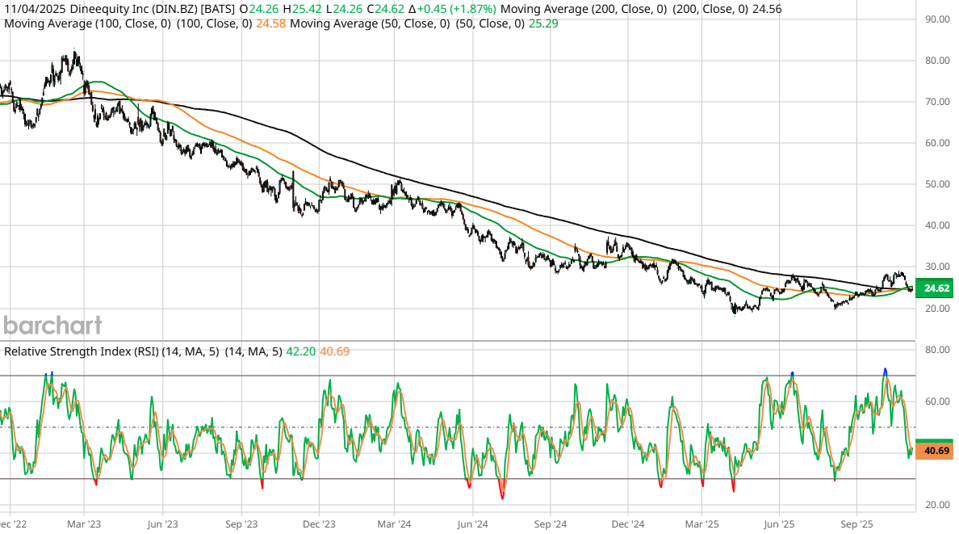
Three empty chairs tell the story of Dine Brands’ board and its failure of corporate governance. The chairs sit in silence, symbolizing the absence of leadership, accountability, and vision. Each one stands as a reminder that Dine Brands Global has allowed oversight to collapse, not by accident but by design. Shareholders have lost more than seventy percent of their value, yet the board responsible for governance and stewardship has left its house half empty.
The numbers confirm the decline. CEO John Peyton has taken home well over twenty-five million dollars since 2021 while net income has fallen sixty percent. Free cash flow continues to weaken. The dividend was cut to finance a fifty-million-dollar buyback, a maneuver that uses shareholder money to mask poor performance.
For passive funds that monitor stewardship, the decline is not noise. It is a governance breach. The people running Dine Brands hold little stock, face little scrutiny, and leave leadership positions vacant. The issue is not strategy anymore. It is ownership.
Inside The Dine Brands Board: Corporate Governance Without Ownership
Every company tells investors that alignment matters. At Dine Brands Global, that promise still fades at the edge of the boardroom table. Of nine directors, most own less than 0.3 percent of the company. Half have never used their own money to buy a single share. Two are nearing retirement, and until now, three board seats remained unfilled. That is not alignment. It is distance. Last week, former private investment banker Howard M. Berk purchased 4,082 shares at about $24.50 each, increasing his stake by roughly 11 percent. While this transaction is positive, it represents only a small step compared to the larger changes that need to occur. The rest of the board still holds negligible ownership.
Richard Dahl has served since 2004 and owns a fraction of one percent. Howard Berk had very little prior to his recent purchase. Michael Hyter and Lilian Tomovich each hold fewer than seven thousand shares. Even the CEO and chair, John W. Peyton, holds just 1.2 percent.
For a company claiming undervaluation, not one independent director has shown meaningful investment until now. Compensation continues to arrive through cash retainers and equity grants, not conviction. Boards are meant to protect shareholder capital by sharing risk, not avoiding it.
When the people charged with oversight have little capital at stake, governance becomes performance, not responsibility. That remains the state at Dine Brands. The recent insider buy may reflect a sliver of alignment, but it does not change the board’s design. What shareholders and franchisees need are directors who invest as well as oversee.
Dine Brands Corporate Governance And The Passive Fund Test
This is no longer just a Dine Brands problem. It is a test for the passive funds that control their ownership base. BlackRock, Vanguard, and State Street have built their reputations on stewardship, accountability, and governance integrity. Their reports speak about the importance of director ownership, board renewal, and experience that supports long-term value.
Yet those same funds continue to back a board that fails every standard they promote. Long tenure, minimal ownership, and vacant seats do not meet any definition of stewardship. The silence of the largest shareholders has become part of the dysfunction.
If these funds continue to vote for a board that owns nothing, fills nothing, and fixes nothing, they are not neutral observers. They are enabling failure. Governance is not measured by statements or scorecards. It is measured by what investors allow when value is destroyed in plain sight.
The Financial Reflection Of Dine Brands Board Decisions
The financial decline at Dine Brands reflects its governance decay. EBITDA is down twenty-one percent year over year. Net income has collapsed by sixty percent. Adjusted free cash flow has fallen from seventy-eight million to sixty-eight million in just nine months. The company’s fundamentals now mirror its structure, bloated at the top, hollow underneath.
Rather than confronting inefficiency, management chose optics. The dividend was cut from fifty-one cents to nineteen cents per share, saving about twenty million dollars a year. Simultaneously, they announced a plan to buy back fifty million shares over two quarters. Shareholders are financing the changes with their own cash, not from growth or performance.
In a supposed asset-light model, general and administrative expenses now surpass fifty million per quarter. No credible explanation has been given for the rising overhead. When predictable royalties can no longer translate into profit, the problem is not economics. It is leadership drift and a board too detached to correct it.
Corporate Governance Without Accountability At Dine Brands
A board must own stock to feel loss. That is the line between representation and responsibility. At Dine Brands, directors approve buybacks, authorize compensation, and issue polished statements without consequence. Shareholders and franchisees, who have real capital at risk, bear the entire cost of their decisions.
Three board seats remain vacant while two proven operators, Chris Marshall and Tom Lewison, wait to serve. Both bring experience in turnarounds and profound understanding of franchise economics. Both have broad support from shareholders and franchisees. Yet the board continues to delay, protecting status over performance.
This is how stagnation becomes culture. It is not ignorance that drives it, but insulation. The directors know the numbers, but they do not feel them. Accountability without ownership is not governance. It is theater. Dine Brands has turned that theater into policy.
The Franchisee Factor In Dine Brands Corporate Governance
The people putting real capital at risk every day are not in the boardroom. Franchisees are the true investors in Dine Brands. They finance remodels, manage operations, and absorb the financial impact of every corporate decision. Yet their voice carries less weight than that of directors who have never bought a single share.
Franchisees sustain the system while management and the board extract value from it. They are instructed when to speak, how to spend, and, recently, when to stay silent. The directive from corporate telling franchisees to avoid speaking with analysts or investors was more than poor judgment. It exposed a culture of control instead of accountability.
When leadership prioritizes silence over performance, it signals insecurity, not confidence. Franchisees built Applebee’s and IHOP into national brands. Through neglect and arrogance, Dine Brands is now eroding that foundation. Those who understand ownership should not be silenced. They should be leading.
A Fix For The Dine Brands Board And Its Corporate Governance Failure
The solution is straightforward. It begins with decisive action, not more statements. Dine Brands does not need another strategy presentation. It needs leadership that acts like ownership matters.
- First, the board must fill its vacant seats with proven operators. Chris Marshall and Tom Lewison have already demonstrated their ability to align performance with accountability. Their experience in turnaround execution and franchise operations is exactly what this board lacks.
- Second, every director should meet a minimum stock ownership requirement. If you sit on the board, you should own part of the company you oversee.
- Third, executive compensation should be tied to free cash flow and franchisee profitability, not adjusted metrics or short-term appearances.
- Fourth, restore transparency. Allow open Q&A sessions after earnings calls and invite franchisee participation at conferences. Finally, begin a formal board refresh process. This is not activism. It is stewardship.
The market has already been priced in disappointment. What it has not priced in is reform. The fix is achievable. The only question left is whether the board will take responsibility or whether shareholders will take it for them.
The facts no longer need explanation. Seventy percent of shareholder value has been lost. Three board seats remain empty. Ownership is nearly nonexistent. Leadership continues to reward itself while investors and franchisees bear the cost.
Corporate governance is not a footnote to performance. It is the source of it. The same board that allowed this decline cannot rebuild trust without change from within. Dine Brands does not need more narratives or investor slides. It needs directors who think and act like owners. Until that shift happens, the only people who truly invested in Dine Brands will remain outside the boardroom looking in.