

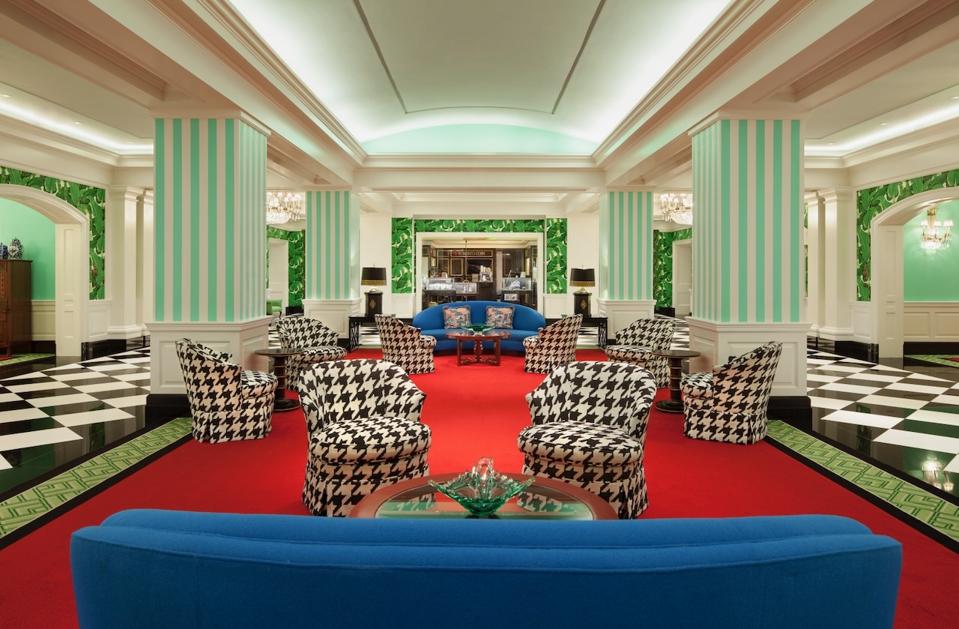
There are designers, and then there is Dorothy Draper.
Considered one of the greatest interior designers of the twentieth century, she created her firm in 1925—a time when women earned considerably less than men. Although the hard-fought right to vote had been granted five years earlier, women continued to face significant challenges to thrive in the workplace. But Draper defied those odds. Today, her firm remains the oldest continually operating design firm in the United States.
Draper was given the title of “Doyenne of Decorating” by Good Housekeeping magazine. Her design mantra was powerful: “Lovely, clear colors have a vital effect on our mental happiness.” To that end, she was the ultimate maximalist. As she wrote in her book Decorating is Fun, “The will to be dreary is a morose little imp.”
Her signature cabbage-rose chintz became a staple of American design. Draper had an unmatched ability to pair black and white with splashes of bright color, blending a mosaic of stripes and florals in ways that felt daring yet harmonious. A maestro of contrast, she could paint a floor bright red and make it work. A rule-breaker in life, too, she was a trailblazer—an independent, divorced woman who launched the first interior design firm in the United States and is credited as a pioneer of modern baroque style.
Ever prolific, Draper’s vast repertoire of commissions included airplane interiors, department stores, private homes, cars (like a pink polka dot truck), and hotels. She also authored three books.
One of Draper’s most iconic achievements was serving as the official decorator and curator of The Greenbrier, a sprawling 11,000-acre resort in White Sulphur Springs, West Virginia. Originally established in 1778, The Greenbrier remains a historic resort with more than 20 restaurants, a casino and spa with sulphur-rich mineral waters.
The hotel has such a devoted staff that team members who have been with the resort for 20, 30, even 50 years are as common as the bright colors adorning the walls. In fact, many staff veterans consider those who have worked there for a mere decade to still be newbies.
Aside from its decor, The Greenbrier is a hotbed of activity. With more than 55 offerings, at any time guests can engage in carriage rides along the vast property, falconry, historic tours, alpine climbing, bike rentals, white water rafting, kayaking in the region’s pristine rivers and lakes, and even a rare look inside the top-secret emergency fallout shelter. Now declassified, the bunker was built to be a relocation facility for Congress.
In 1963, Carleton Varney, who worked closely with and was mentored by Draper, took over as head designer of The Greenbrier. In 1966, he became president of Dorothy Draper & Company, continuing Draper’s vision for more than six decades until his death in 2022. Throughout the decades, he remained devoted to her vision and design aesthetic. He was also her fierce champion. “Dorothy Draper, along with so many other women, really made a difference in defining women’s places in the world, and that she did it by bringing color and joy,” he said.
Even nearly a century later, Draper’s vision remains embedded in every corner of The Greenbrier. As Merriweather Franklin, the resort’s interior design project manager says, “The Greenbrier will always be known for Dorothy Draper and her iconic style.” While the pieces feel museum-worthy, they are designed for living. Guests are encouraged to curl up on elegant sofas and enjoy the comfort as if they were in their own grand manor.
Draper didn’t just decorate The Greenbrier—she helped redefine it. Her fearless mix of color and texture, her grand flourishes, and her deep understanding of how people live and gather created an aesthetic that is welcoming and timeless. Through Carleton Varney’s leadership, her legacy endures with every floral fabric, every cozy corner that makes visitors feel at home—make that a very grand home. And even all these decades later, Draper’s make-your-own-rules-and-live-boldly edict remains. As she once advised, “If you love something it will work. That is the only real rule.”
Merriweather Franklin offered more insight.
Jeryl Brunner: How was Dorothy Draper able to design a luxury resort that still feels like a home to guests?
Merriweather Franklin: By adding details like the fireplaces, framed portraits, and lamps on end tables, Draper created a space that feels cozy and very homey. One element she added throughout the main hotel were walls that created rooms within the corridors, making the once long hallways feel more like a private residence.
Brunner: So how did Carleton Varney keep that alive?
Franklin: Carleton Varney continued that legacy by adding antiques and artwork, along with rooms that feel grand and luxurious while still maintaining the charm of a grand manor. He always made it a point to keep the Draper look alive while adding his own spin on the décor, too.
Brunner: Are there any touches at The Greenbrier that guests might overlook, but that are uniquely Dorothy Draper?
Franklin: Dorothy Draper was responsible for creating the Modern Baroque look. There are elements like the plasterwork seen throughout the hotel, as well as the ornate decorations over doorways in the lobbies, that make The Greenbrier unique to her style.
Another interesting fact is that she designed three floral prints that are still used as wallpaper or fabric today, specifically for The Greenbrier. The first is the infamous Rhododendron print that can be found in the guest room hallways on the walls. The second pattern is the Fazenda Lily, which adorns the draperies and tufted-back lounge chairs in the Main Lobby. Fazenda Lily has shades of pink, red, green, blue, and a touch of purple that really pop against the red leather sofas and Jefferson Blue painted walls.
Brunner: Is it true that the pattern that Dorothy Draper designed for the Victorian Writing Room has stayed the same since she designed it in the 1940s?
Franklin: The third pattern Dorothy Draper designed was for the Victorian Writing Room. This room was featured on the cover of House Beautiful in 1948 after the reopening of The Greenbrier Hotel and has not changed since. The fabric is called Fudge Apron and features a grand floral pattern with reds, greens, yellows, blues, and other colors.
Dorothy Draper named it Fudge Apron because she was inspired by the Southern ladies who made fudge of all different colors, and the way those colors stained their aprons looked somewhat like a floral arrangement. Merriweather Franklin recommends that visitors take a moment to sit in the Victorian Writing Room and maybe write a letter home to a loved one on the historic desk that lives in this room.
Brunner: If Dorothy Draper could walk through The Greenbrier today, what do you think would make her the most proud?
Franklin: I believe she would be most proud that most of her original designs have stayed the same, but also that Carleton Varney, her protégé, really took what she taught him and ran with it. The Greenbrier will always be known for Dorothy Draper and her iconic style, but I think she would be so very proud that when Carleton took over the company, he really stayed true to her vision and design elements.