

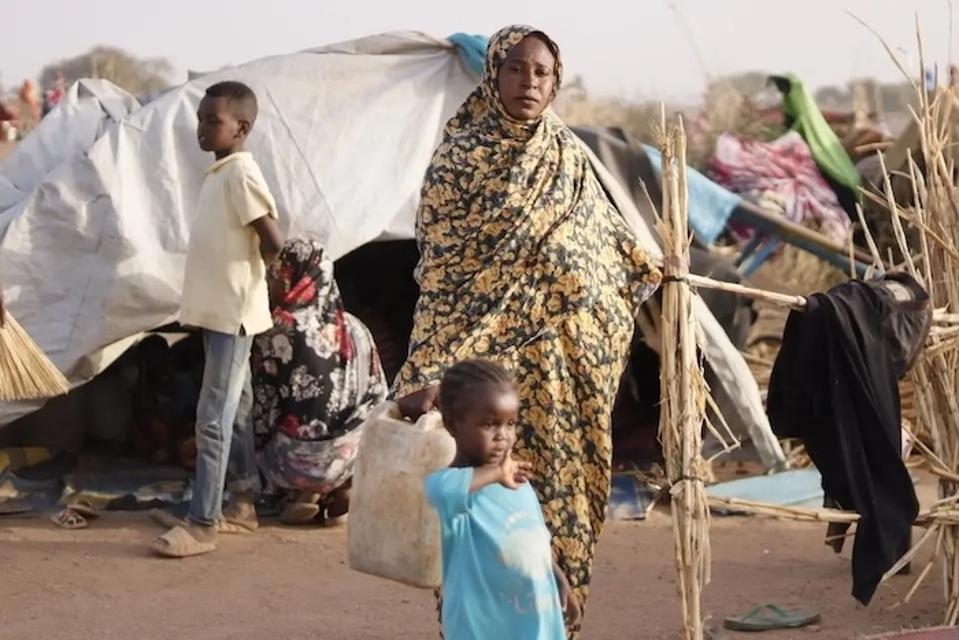
A mother’s journey through conflict and survival in North Darfur.
Ongoing conflict in Sudan has pushed millions of people out of their homes, cutting them off from the services they need to survive
Seated next to her makeshift shelter, Amani wraps her youngest child in a colorful toub, a traditional Sudanese women’s garment, to protect her from the cold, carefully covering the baby’s head. She doesn’t have much to wrap her newborn in, having left most of her belongings behind when she and her young children recently fled the clashes in Al Fasher.
Just a few months ago, Amani had been looking forward to her baby’s birth. Together with her family, she anxiously waited for the arrival of the new addition and the celebration that would follow.
But as her due date grew closer, fighting in her neighborhood escalated, engulfing the entire village.
“We hid under the beds throughout the day and only came out in the evening,” Amani recalled.
This went on for days. With no end in sight, the family had to flee. From Al Fasher, they moved to Hirja for a night before continuing to Zamzam. But the situation there was even worse. With each move, Amani became more exhausted, and every new condition posed greater risks to her life and the unborn baby.
“There was no food, no water and no one to help us.”
Soon the rain started, and the family’s situation grew worse. For days, they survived on rainwater and bread from strangers.
Amani worried constantly about her baby. Was she eating enough? Was the baby still healthy? All she wanted was to give birth safely and to have a healthy newborn.
But before they could settle in the oasis where they had briefly found shelter, fighting closed in again. By now, her baby was almost due. With no hospital in sight and no health workers around, Amani was forced to deliver in unsafe and high-risk conditions.
Watch the video: “What if I die?”
Delivering on the side of the road
Amani is one of thousands of women in Sudan who are unable to access maternal and newborn health services during pregnancy and delivery during the ongoing conflict. With health systems severely disrupted, unsafe deliveries are increasing, putting the lives of both newborns and mothers at grave risk.
As her family fled between Sharga and Tawila, Amani went into labor. Her baby arrived by the roadside with support from her mother and nearby residents.
“I gave birth under a tree, lying on a small mat,” she said. “I didn’t know if I would live or die — or what would happen to my children if I didn’t make it. I was filled with fear.”
Too weak to carry her newborn or continue the journey, Amani rested for a week before finally reaching Tawila with her family. She remembers being fed only a mixture of water and flour to support her recovery from childbirth.
Related: Staggering Scale of Need in Sudan
How to help mothers and children in Sudan
For mothers like Amani, postnatal care during emergencies is nearly impossible to access — yet it is critical for survival and long-term recovery. In Sudan, 70 percent of health facilities are nonfunctional. In safer areas, health facilities still in operation are overwhelmed by waves of displaced people struggling to access critical care.
Amani and her family are among the thousands of displaced people in Tawila who have fled violence in Al Fasher, Zamzam, Abu Shouk and other IDP camps in North Darfur. To respond to the crisis, UNICEF has activated mobile clinics to reach vulnerable and displaced communities. Through 14 primary health care centers and two mobile clinics, critical services — including immunization, maternal care and nutrition — are provided to those in need.
With the war now in its third year, sustained support for children and their families in Sudan is more critical than ever. Please donate.
Learn more about How UNICEF Supports Children in Sudan