

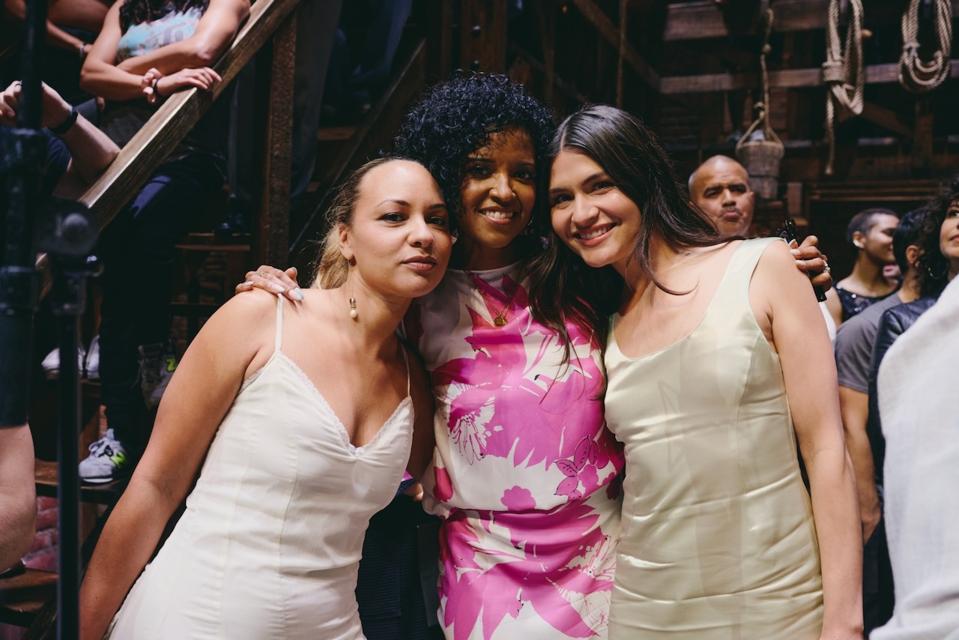
This past week, Hamilton celebrated ten epic years on Broadway. After a joyous performance on August 6—a fundraiser for the Hispanic Federation’s Immigrants: We Get the Job Done Coalition and the Public Theater, where Hamilton began—Hamilton producer Jeffrey Seller got onstage at the Richard Rodgers Theatre and addressed the crowd.
“How lucky are we to be in this room right now?” said Seller, who went on to share, “There’s a lot of history around us.” He noted that the Richard Rodgers Theatre was home to the original productions of Guys and Dolls, How to Succeed in Business Without Really Trying, and Chicago. “But guess what?” he added. “Hamilton is the longest-running show in the history of the Richard Rodgers Theatre.”
More than 100 Hamilton performers, including swings, standbys, and 23 original cast members, stood onstage to honor the show. As Lin-Manuel Miranda made his entrance, he fittingly led with the song lyrics, “I may not live to see our story, but I will gladly join the fight, and when our children tell our story, they’ll tell the story of tonight.”
The night was a major milestone for many. For Jeffrey Seller, it marked another professional triumph in his storied career.”
In Seller’s memoir Theater Kid, he recounts how he was taunted for living in a low-income neighborhood just north of Detroit, in a place mockingly nicknamed “Cardboard Village.” The cheaply made homes could not withstand tornadoes, and their inhabitants were considered just as defective.
“It’s the neighborhood where parents have less: less money, less education, less stability. And the kids are deemed less: less smart, less cooperative, less likely to succeed,” writes Seller in Theater Kid.
But as a child, he found refuge climbing the massive backyard maple tree that had two giant trunks, strutting branches, and thousands of green leaves. “I would be Jack, the tree my beanstalk,” says Seller, as he imagined himself climbing to the top of the tree, flying over the clouds, and soaring through the sky.
Not only would Seller take flight, he soared to unimaginable heights. A producing legend, his shows—Rent, Avenue Q, In the Heights, and Hamilton—transformed musical theater and won a collective 22 Tony Awards. The only producer who has mounted two Pulitzer Prize–winning musicals, his productions have reached more than 43 million people and grossed over $4.6 billion.
A groundbreaking musical, Hamilton seamlessly incorporates pop, R&B, and hip-hop into a Broadway musical. It also inspires new generations to go to the theater. The show also casts actors of color so that a diverse audience can see themselves included in the story of how the nation came to be. As Miranda has said, “The show reflects what America looks like now.”
And if that’s not enough, the show’s Hamilton Education Program (aka EduHam) incorporates the musical to get high school students seriously juiced about American history and the Founding Era. Inspiring thousands of students from more than 1,300 schools to learn about the show’s context in history—and engaging them to create their own creative expressions—EduHam is a springboard for them to make their own magic.
In his deeply personal memoir, Seller reflects on his incredible journey from a childhood marked by poverty and pain, with a father who bankrupted the family, to becoming a Tony Award–winning force. Not only is Theater Kid a master class in storytelling, the book is about art, life, and the complexity of family—and having the courage to soar through the sky. Especially when you don’t have all the points on your proverbial roadmap figured out.
Seller shares the inspiration behind Theater Kid, his evolving relationship with risk and resilience, and how EduHam continues to shape future citizens—on and off the stage.
Jeryl Brunner: What inspired you to write Theater Kid?
Jeffrey Seller: I have been asking myself for years: How did I get from here to there? From this neighborhood the kids derisively called Cardboard Village—a neighborhood in Oak Park, Michigan, just north of Eight Mile—to doing Rent on Broadway and then to Hamilton. I had no connections, no money. I thought, how do you do it? So this book is my way of answering that question.
Brunner: What kept you going when you first got to New York?
Seller: Drive. I thought, I will not stop. I will persevere. I didn’t use highfalutin words like persevere, but I just knew nothing is going to stop me. I have so much love for these musicals. I have so many ideas. And I had the arrogance to think I was better than everybody else. So I was like, so you better go prove it.
Brunner: How has your relationship with risk, rejection, and resilience evolved since those early days?
Seller: I have always had courage. It’s a quality that I believe is innate. And in spite of my courage, I’m super afraid of rejection. If I’m asking someone to go to a movie and they say, “I’m not available,” it can be very painful. But finally, through my own late-life maturation, I have gotten over that, where I have finally taken in that it’s not about me.
Brunner: How did you get over it?
Seller: I remember when I was a booker I used to sweat when I would try to sell a one-week engagement of Blood Brothers. If they said no, I would take it as rejection.
But I needed to make a living. You have to make the booking. You have to raise the $10 million. I never had a net. If I don’t make the rent, no one else will. I moved to New York in 1986. At my first job I made $205 a week. That was $820 a month, minus $400 for rent, minus $120 for the guaranteed student loan payments. So now we’re down to less than $300 a month to pay for utilities, subway, The New York Times, and food. When you don’t have a net, you make it work.
Brunner: This year marks the 10th anniversary of Hamilton. And EduHam, the educational program connected to the show, has connected thousands of students to theater in profound ways and also connected them with history and their own creativity. Why is the program important to you?
Seller: We are creating the citizens of tomorrow. Not just the theatergoers. Not just artists, but teachers, doctors, engineers, community leaders, representatives and mayors, cooks and hairstylists. We are creating the citizens of tomorrow. And the most important ways in which I’ve wanted to use my resources is to help children receive opportunities they otherwise would not have been able to receive.
That includes after-school theater programs, college tuition, and EduHam. And the chance to learn American history, see the power of theater unfold on that stage, and participate in its very creation through their creation of scenes and monologues and songs and poems and dances. When we participate, our experience is richer and the outcomes are deeper.
Brunner: Theater Kid is filled with so many great stories—like the devastating pain of Rent creator Jonathan Larson’s death while dealing with the meteoric success of the show and bringing it to Broadway, or unexpectedly winning the Tony for Avenue Q. What was one of the most challenging sections to write?
Seller: Writing the Rent section just kind of came right off of my fingertips on the computer. I have lived with the experiences of developing the show for 30 years now. So it just poured out of me.
The hardest part of the book to both write and reread was my father asking 19-year-old me for money. It was very painful for me to read it out loud, and then to do it again with Danny Burstein [who played Seller’s father on the audiobook], who was so brilliant. I still cry when I read that because I’m so sad, angry, and ashamed of my father. I’m a 60-year-old man. I have a 22-year-old daughter and a 21-year-old son. And the notion of me showing up and asking them for money is still unbelievable to this day.
Brunner: How did writing Theater Kid change you?
Seller: It was a catharsis and a great sense of accomplishment. I had wanted to do this for many years. I had been frightened. I was stymied by the question, how do you connect the dots? I questioned whether or not I had the skill and talent to pull it off, and writing it was ultimately an amazing challenge.
And by writing the book, my own appreciation for and love for my father grew. While I was holding him accountable for his many decisions and behaviors that harmed our family, I was also zeroing in on any time I ever asked him to take me to an audition. A rehearsal. A performance of a show at another theater. He always answered with the same sentence—because he had brain damage, so his vocabulary wasn’t as big anymore.
And the answer was, “Get in the car.” By repeating that quote over and over in the book, I thought, yes. He always said, “Get in the car.” And wasn’t that a beautiful thing?