

A stock market is due for a correction when the metrics used to read it show extreme, near-extreme or unusual readings. There is no guarantee that such conditions will lead to selling. It’s entirely possible that further excited buying of key sectors may keep the indexes riding high.
Nevertheless, these are indicators being closely observed by Wall Street’s money managers and their AI-driven algorithms. Each one is a slightly different variation on market performance based on price action. These are not “sentiment” readings, strictly speaking.
5 Stock Market Key Indicator Issues
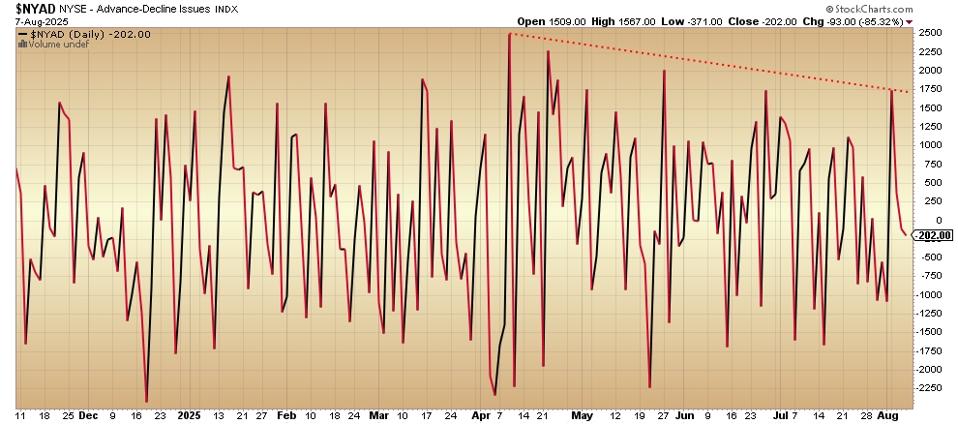
New York Stock Exchange Advance-Decline Issues index:
Although the S&P 500 and the Nasdaq 100 have continued to make new highs above their April highs, this index is failing to do so. The number of advancing issues has dropped and the number of declining issues has gained. This breadth measurement demonstrates how a few heavily weighted tech and social media names have distorted sentiment readings.
The S&P 500 Bullish Percent Index:
The index hit a high in May and — despite new highs for the S&P 500 — has steadily dropped much lower since then. The “bullish percent” index is a widely followed measure of the market’s underlying strength (or lack of it) based on the percentage of stocks in bullish point-and-figure patterns. The divergence between this and the S&P 500 price movement is a display of weakness for stocks.
The Vanguard Total Stock Market ETF/Gross Domestic Product
This ratio is a broad measure of the economic value investors gain when they are purchasing stocks. It peaked at the beginning of 2025 and dropped significantly by the end of February. Note how the relative strength index (RSI, below the price chart) peaked in late 2021 and has since declined. This is another negative divergence for stock markets.
The Price-Earnings Ratio for the S&P 500:
The price paid for the index in terms of the component stocks’ earnings peaked at near 45 in the year 2000 as dot-com mania unfolded. After dipping to just under 15 by 2009, the p/e ratio has climbed again to almost its highest since the overall peak. I remember the early to mid 1980s when an investor could purchase well-run big caps for p/e’s of 8 and 9 but not that many took advantage of it.
Price to Book Ratio of the S&P 500:
This measure is the highest it has ever been: investors pay 5.2 times book value. In 2009, the price was just under 2 times book. When analysts mention book value they are talking about what the company is worth when its total debts are subtracted from the amount of its total assets. Basically.
Stats courtesy of FinViz.com. Charts courtesy of Stockcharts.com and Multpl.com.
No artificial intelligence was used in the writing of this post.
More analysis and commentary at johnnavin.substack.com.