

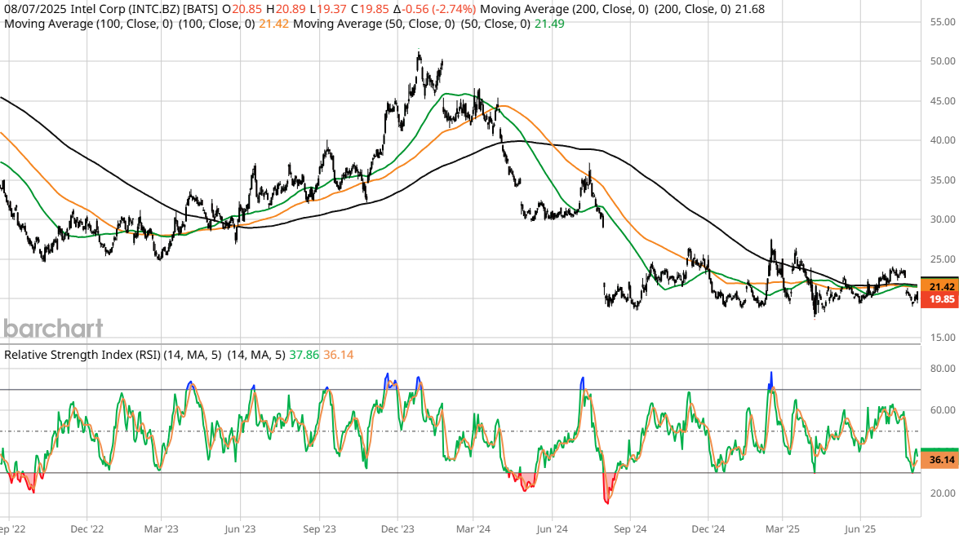
When politics meets poor performance, something usually breaks. Donald Trump has called for the Intel CEO to resign. Sometimes, it’s the stock. Sometimes, it’s the leadership. Smart investors position for both. Donald Trump is accusing Lip-Bu of being “highly conflicted” over alleged ties to Chinese semiconductor firms isn’t just a political jab. It’s a moment of clarity for shareholders. Beneath the theatrics lies a deeper signal: a company already battling structural drift is now facing governance questions in full view of the public market.
Intel’s Long Slide
Intel’s decline didn’t happen overnight. It’s been a slow, painful unraveling, one I laid out in detail back in February 2025 as a cautionary tale for investors who confuse brand legacy with strategic competence.
Over the last five years, Intel’s stock has lost roughly 60% of its value, underperforming not just the S&P 500 but also its closest competitors by a wide margin. NVIDIA has surged more than 1400% in that time, and AMD has more than doubled, both capitalizing on explosive AI demand and delivering with ruthless execution. Intel, by contrast, has misfired on multiple fronts, including product rollouts, foundry strategy, and talent retention, leaving it stuck in a bloated middle.
In May 2024, I wrote that Intel didn’t just need an engineer; it needed a visionary. Someone who could reset the narrative, reallocate capital with precision, and rebuild market confidence. That never came.
By July 2025, the story shifted again. Now it wasn’t just a turnaround problem; it was a sum-of-the-parts story. Beneath the surface, Intel’s foundry business, when valued independently, could represent the kind of hidden asset that attracts strategic buyers. But to unlock that value, leadership would have to get out of its own way.
Trump’s call for resignation may sound political, but what it really exposes is what investors have sensed for years: Intel’s leadership problem is its value problem.
The Case For Change At Intel
The market has already voted: current leadership doesn’t have its trust. Since 2021, Intel has authorized tens of billions in share buybacks while simultaneously bleeding market share and falling behind on execution. Capital was thrown at optics—while competitors like AMD and NVIDIA invested in product, process, and partnerships.
Intel’s foundry business is the clearest example of mismanaged potential. On its own, it could be worth a significant portion of the company’s current market cap. But under Intel’s umbrella, it’s been burdened by cost overruns, leadership churn, and unclear strategic direction. Investors aren’t rewarding the segment because they don’t believe this team can monetize it properly.
In my June Forbes piece, I laid it out plainly: “Inaction is costing shareholders. But pressure from markets, media, or politicians can accelerate value unlocks.” That pressure is here now, louder than ever.
A proper sum-of-the-parts valuation shows the whole is worth far more than the market currently reflects. But for that value to be realized, structural change isn’t optional; it’s mandatory. That means divesting or spinning off the foundry business, refocusing Intel’s core, and most importantly, leadership that the market believes can execute.
Trump’s comments may have sounded like political theater. But to investors, they should sound like a starting gun.
What Trump, Activists & Strategic Buyers Might See
Activist investors know the formula. Leadership stumbles, hidden value is ignored, and then the pressure mounts. The catalyst? Change at the top.
Intel fits this situation. It’s not just undervalued and underutilized. Trump, activists, and strategic buyers will look beyond the headlines and see a classic restructuring case. The foundry business, currently dragging on margins and perception, could be spun off or divested entirely. As a standalone entity, with the right management and partners, it would attract both strategic and sovereign capital, especially as global chip capacity becomes a national priority.
Internally, Intel remains bloated. Layers of bureaucracy slow execution, create no accountability, and obscure product focus. Operational streamlining is the fastest path to margin expansion and renewed investor trust.
And here’s the real kicker: a leadership change doesn’t just fix optics. It sends a market signal. It says, “We’ve heard you.” That alone can trigger a re-rating, even before structural moves begin.
We’ve seen this playbook before and it has come in a different disguise with Trump and Intel. GE’s breakup unlocked over 400% in shareholder returns. PayPal’s spinoff from eBay allowed each business to flourish on its own. Broadcom, under Hock Tan, is the blueprint for focused execution, acquiring only what fits, cutting what doesn’t, and compounding shareholder value relentlessly. Intel isn’t structurally different; it just lacks direction. Like GE before it, the value is there. What’s missing is the will to act. The combination of political pressure, strategic interest, and activist involvement could be the ignition. The pain investors feel now. That’s the market opening the gates for those ready to lead, not follow.
The author owns Intel stock.