

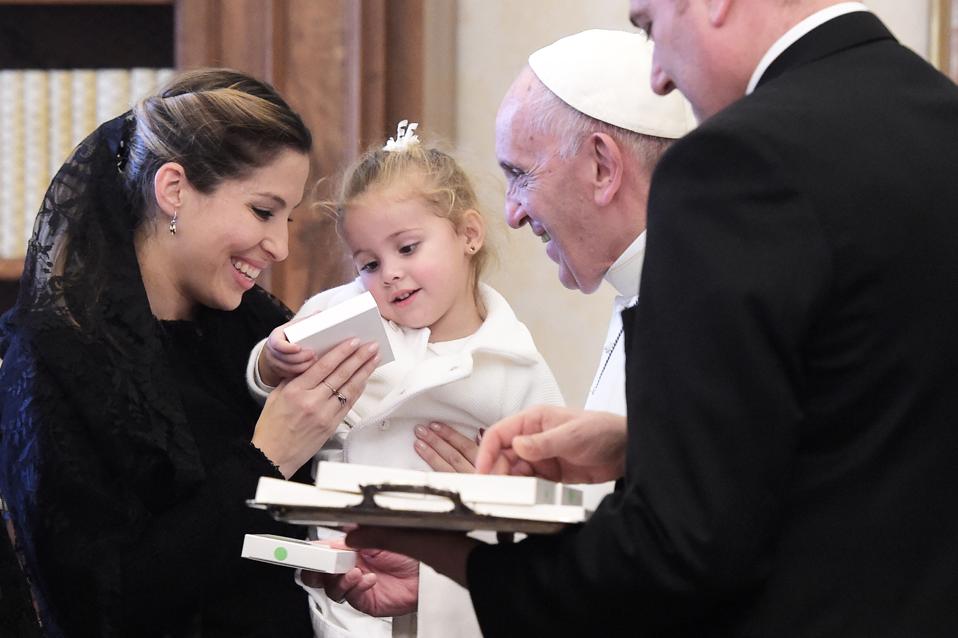
As the world mourns Pope Francis, who died yesterday at 88, his legacy takes shape, not as a revolution but as a quiet recalibration of norms. This is particularly true of his treatment of women within the Catholic Church, where his papacy will not be remembered by sweeping reform but by something subtler: a deliberate rebalancing. Since his election in 2013, Francis never challenged Church doctrine on women. Yet he did something quietly radical in a system long shaped by silence and hierarchy. He listened. And in turn, he acted. In an organization defined as a bastion of male hierarchy these subtle shifts were seismic.
Pope Francis’s Approach to Women in Leadership
His impact was not in bold proclamations but in his approach to personnel. Francis appointed more women to senior Vatican roles than any pope before him. Just months before his passing, he named the first-ever female prefect of a Vatican dicastery and the first woman to serve as the Vatican City government president. Milestones previously unimaginable. Earlier appointments included Sister Nathalie Becquart, who in 2021 became the first woman with voting rights at the Synod of Bishops. By 2024, lay and religious women participated and voted in key synodal sessions previously exclusively reserved for bishops and cardinals.
Historic Reforms Under Pope Francis
These weren’t isolated acts of inclusion. In 2022, a sweeping reform of the Roman Curia formally decoupled governance from ordination. For the first time, laypeople—especially women—could hold high-ranking Vatican offices traditionally reserved for clergy. Pope Francis also codified women’s long-overlooked ministries in 2021, officially recognizing lay roles such as lectors, acolytes, and catechists—many of which women had informally held for generations.
The Limits of Pope Francis’s Feminist Approach
His feminist credentials, however, came with some glaring limitations. While promoting women’s leadership, he maintained firm opposition to ordaining women as priests or deacons. Despite two papal commissions studying the diaconate question—first in 2016 and again in 2020—neither produced definitive recommendations. For critics, this illustrated a papacy that initiated dialogue without reaching resolution.
As many would have expected, he also remained steadfast in his condemnation of abortion. However his views on this issue were extreme to the point they became sensationalist headlines, controversially likening it to “hiring a hitman” in various public addresses. During a visit to Belgium in 2024, comparing abortion to homicide he said, “Is it right to hire a hitman to solve a problem?” These remarks ignited significant backlash, particularly in Belgium, where they prompted a surge in de-baptism requests and public outrage.
Theological Framework and Mixed Messages
Pope Francis often framed his position within the “Marian vs. Petrine” theological model, in which the Church is symbolically feminine—receptive, nurturing, and maternal—but its authority remains Petrine or male. Supporters saw this as an attempt to honor femininity within the bounds of tradition. Detractors argued it essentialized women, casting them as symbols of purity and intuition rather than leaders with agency.
And then there were the mixed messages: urging respect for women while using outdated metaphors—referring to women as “spinsters,” calling gossip a “woman’s thing,” and once praising “politicians with pants.” These off-the-cuff comments gave ammunition to those who accused him of using progressive optics to mask his conservative instincts.
Progress Amid Resistance
Still, others saw in Pope Francis something more important than perfection. They saw steady progress. Argentine journalist Elisabetta Piqué, a longtime confidante, and papal biographer depicted him as a pope who respected and empowered women in meaningful ways, especially as he navigated a deeply resistant clerical culture. And his actions, more so than his words support that view. He created real pathways for women to lead within the Church, to be heard, and, for the first time, to shape its future.
Pope Francis’s Broader Vision for Women’s Dignity
Pope Francis also elevated the dignity of women beyond church walls. He condemned gender-based violence, human trafficking, and economic inequality. He spoke frequently about the global wage gap and called for better representation of women in politics, business, and academia. His feminism may have been framed in Catholic terms but extended into the secular world with striking clarity.
The Lasting Impact of Pope Francis’s Papacy
In a 1.3-billion-member institution built on tradition, change is not measured by speed but by its trajectory. There is no denying Pope Francis shifted the direction of women. He nudged the Church toward a more inclusive future, even as he left some of its most painful debates unresolved. His legacy may ultimately be defined not by what he ended or declared but rather by what he opened and began. The doors, dialogues, opportunities and conversations, that nudge pontification towards progress, and the notion that power in the Church need not always wear a collar.