

Oil futures spiked on Thursday (January 11, 2024) following U.S.-U.K air strikes on Yemen’s Iran-backed Houthi rebels who have been attacking commercial shipping in the Red Sea.
Newswires report strikes on Yemen’s capital, Sanaa, and on the port of Hudaydah, a Houthi Red Sea stronghold, following a confirmation by the Pentagon. The development follows repeated hints by officials from both countries over the course of the day, and an emergency briefing of ministers and senior parliamentarians by U.K. Prime Minister Rishi Sunak earlier in the day.
At 18:51 EST on Thursday, ahead of the markets opening in Asia, the Brent and West Texas Intermediate (WTI) front-month crude futures contracts were up by over 2% at $78.48 and $73.20 per barrel respectively.
Singapore and Tokyo-based sources in Asia are expecting a risk premium of another couple of dollars on Friday, depending on the scale of the escalation. No further updates have been provided by the U.S. or U.K.
It comes after the U.S. Central Command (Centcom) confirmed earlier in the day that an attack repulsed by the U.S. and U.K. navies on Tuesday was the 27th, and heaviest, such attack on commercial shipping by Houthi rebels since November 19, 2023, despite repeated warnings.
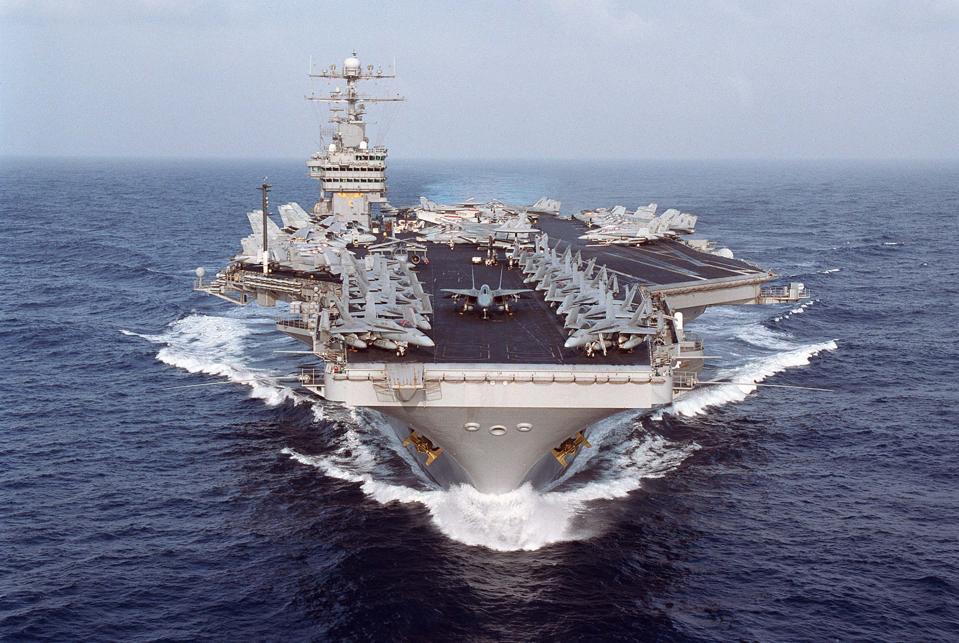
The latest attack comprised of Iranian-designed attack drones, anti-ship cruise missiles and ballistic missiles were launched from Houthi-controlled areas of Yemen. All of the projectiles were shot down by warplanes from the aircraft carrier USS Dwight D Eisenhower and by four destroyers – USS Gravely, USS Laboon, USS Mason and HMS Diamond – all of which are deployed on security missions in the Red Sea.
They are part of Operation Prosperity Guardian, a multinational international maritime security coalition created in response to the Houthi attacks, anchored by the U.S. and U.K.
The Operation aims to protect shipping in the Red Sea – one the world’s most important routes for energy and consumer cargoes. It is a key oil supply artery between Europe, the Middle East and Asia via the Suez Canal accounting for over 10% of global sea seaborne crude, according to maritime services and information provider Lloyd’s Register.
Any ship or oil tanker passing through the Suez Canal to or from the Indian Ocean has to transit this way navigating the Bab al-Mandab Strait – a 20 mile-wide sea channel at the southern tip of the Red Sea between Djbouti and Yemen – where majority of the Houthi attacks have happened.
The targets of Houthi attacks are ships purportedly heading to Israel. Following an escalation of hostilities between Israel and Hamas in Gaza, the Houthis came out in support of the latter. But the waves of attacks have of late become more indiscriminate in nature against largely foreign-owned vessels.
As part of Operation Prosperity Guardian, U.S. navy warships have joined vessel fleets and personnel from the U.K., Bahrain, Canada, Denmark, Greece, Netherlands, Norway and Seychelles. France, Italy, Spain and India are also independently patrolling the maritime corridor.
Thursday’s escalation follows the destruction of Houthi gunboats by U.S. Navy after an attempted hijacking of a commercial vessel in the Red Sea on December 31, 2023. In other developments, the United Nations Security Council passed a resolution on Wednesday demanding an immediate end to the Houthi attacks.