

Electric cars don’t have to be big and expensive. At least not really big and expensive. As the lineup below demonstrates, manufacturers are finally seeing economic sense in making EVs that are more compact and sell for a lower price, while still earning a profit.
The list below is by no means comprehensive, and it includes some EVs that aren’t available in the US. But it goes to show that small electric cars are on their way, and in some cases they include enticing vehicles from the likes of Volkswagen and Volvo, as well as Chinese firms like BYD and, of course, Tesla.
Will 2024 be the year that we finally see the so-called Model 2? I think it’s entirely likely, but asking when the smallest Tesla yet will go into mass production is another question altogether, and one I suspect comes with an answer somewhere north of 2025. Before then, the small EV market is about to grow thanks to the upcoming Volvo EX30, Renault 5 and Fiat 500e, which finally lands in the US this year, after a European debut back in 2021.
Volkswagen ID.2
When Volkswagen announced the ID.3 in 2019 it seemed obvious that a family of electric cars would be built around it. Next came the larger ID.4 and ID.5, and now we’re eagerly awaiting a production version of the ID.2all concept revealed by VW in March last year.
Roughly the size of the company’s current-generation Polo hatch, the ID.2all concept will eventually become the ID.2, a small and (somewhat) affordable electric car designed primarily for town and city use. In a world where electric cars mostly remain larger and more expensive than either equivalently-sized gas-powered relatives, the ID.2 and its compact footprint is something to get excited about.
Volkswagen says the car, which is due into production in 2025, will have a range of up to 450 km (280 miles), while being “as spacious as a Golf” and “as affordable as a Polo”. For some context, the current VW Polo is priced from about £20,000 here in the UK, which is about $25,000 in the US.
Even more exciting are VW’s plans to put a second compact concept, called the ID.GTI into production. Based on the ID.2all, this is VW’s first attempt at a battery-powered car carrying its famous GTI badge, along with the brand’s iconic red detailing and tartan interior. I can’t wait to see what the production version, due in 2027, will be like.
Kia EV2 and EV3
Sticking with the ‘2’ designation, next we have the Kia EV2. Like Volkswagen, Kia’s electric car naming structure began with room for expansion in both directions, in this case with the EV6. The Korean company is about to release the EV9 large SUV, and recently announced a production version of the EV5, another SUV, alongside a pair of smaller electric concepts called the EV4 and EV3.
The EV4 is a sedan likely to sit somewhere between the Tesla Model 3 and Model S, while the EV3 is a compact SUV. Few technical details have been shared, other than how all of Kia’s electric cars will use the modular E-GMP platform, as also used by its relatives Hyundai and Genesis.
Tantalizing, Kia has also acknowledged plans for an even smaller car, expected to be called the EV2. Speaking to Autocar, the company said this car has a target price of around £25,000 ($30,000) in the UK and is due to land in 2026. Kia might even be considering an EV1, but let’s not get ahead of ourselves for now.
Tesla Model 2
Tesla hasn’t revealed a new car since the Model Y back in 2019, but ever since then there have been rumors of Elon Musk’s company building a smaller EV. Shadowy teaser images and design sketches of such a car have been shared by Tesla numerous times over recent years, with the most recent sighting coming during the automaker’s 2023 Investor Day.
The company has suggested how such a car could cost from $25,000 (about £20,000) and it would likely be aimed at the European and Chinese markets where demand for compact EVs is greater than in the US. Tipped to be manufactured at its European factory in Berlin, Germany from 2025, Tesla’s smallest and cheapest car to date could rival other low-cost EVs like the MG 4 EV and BYD Dolphin, as well as the upcoming Volkswagen ID.2 and Renault 5.
If the Model 2 is to hit such an aggressive price point, it will require Tesla to fine-tune its production methods to increase simplicity and reduce costs in every area of the car’s development and manufacturing process. Tesla has previously said how a new platform could reduce construction costs per vehicle by around $1,000.
Musk said in December 2023, “We are working on a low-cost electric vehicle that will be made at very high volume,” adding with his usual exuberance, “The revolution in manufacturing that will be represented by that car will blow people’s minds. It’s not like any car production line that anyone’s ever seen”.
Renault 5
A production version of the revived Renault 5 will make its debut at the Geneva Motor Show on 26 February. It is expected to be priced from €25,000 in Europe (equal to about $27,000) in markets where EV incentives are still available. Britons should expect to pay about £30,000 for the electric Renault city car when it arrives on their shores in 2025, while it is unlikely to land in the US.
To take on the new electric Mini and Peugeot E-208, the retro-styles Renault 5 was revealed in concept form back in 2021, complete with an adorable, chunk aesthetic, five-door layout and bright yellow paintwork. Measuring just 3.92 meters (154 inches) long, the car will be powered by a 52 kWh battery pack and claims to offer a range of up to 248 miles. A smaller 40 kWh battery with a reduced range will arrive later. The 5 will use a 400 volt system and its maximum charging speed is expected to be around 130 kW.
Smaller than the electric Renault Megane E-Tech, the 5 will be the first car to use the AmpR Small platform, which comprises a bespoke architecture designed specifically for small electric vehicles.
BYD Dolphin
Chinese automotive giant BYD is poised to overtake Tesla this year as the world’s biggest electric car maker. Its smallest car is called the Dolphin and in the UK it’s priced from £26,000 (about $33,000).
The Dolphin is a small five-door hatchback, with a 45 kWh battery pack that delivers a claimed range of 211 miles in the base model. The mid-range model has a larger 60 kWh battery with a claimed range of 265 miles, while the most premium version of Dolphin has a panoramic roof and wireless phone charging, but still only costs a little over £30,000 ($38,000) after tax, neatly undercutting even the entry-level Volkswagen ID.3.
The dashboard features a 12.8in touchscreen that electronically rotates between portrait and landscape, with the latter intended for watching videos while parked at a charger. Speaking of which, the Dolphin can only manage a maximum charging speed of 88 kW, putting it a little behind many of its rivals. That said, if you mostly charge overnight and home and don’t cover long distances with stops at rapid chargers, the Dolphin could be an enticing left-field option.
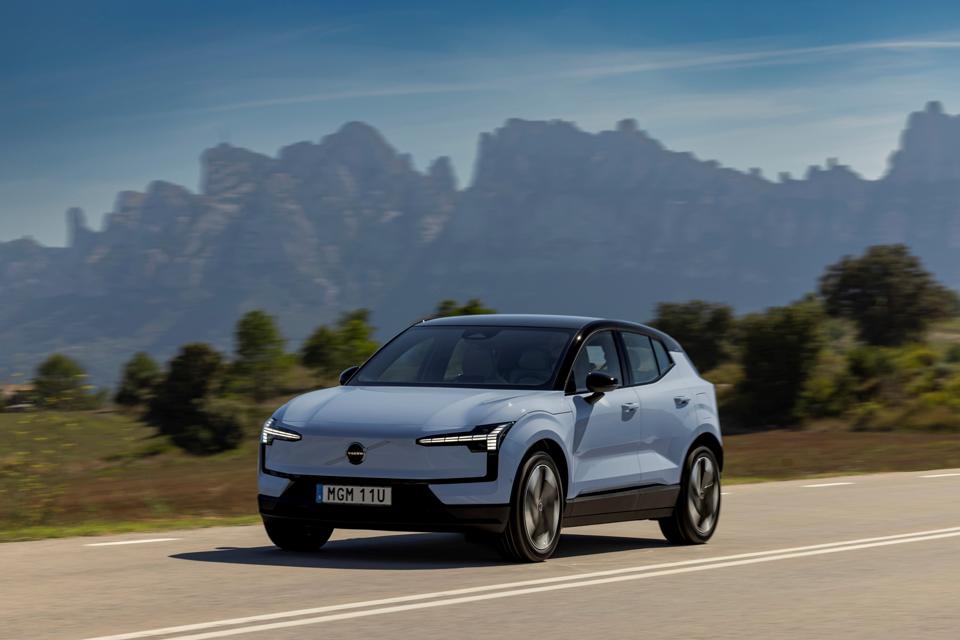
Volvo EX30
Volvo’s smallest car also happens to be its quickest, with the dual-motor version of the EX30 producing over 400 horsepower and sprinting to 60 mph in just 3.4 seconds. That’s the sport of performance you’d expect from a top-notch supercar just a generation ago.
Absurd performance aside, the circa-$40,000 Volvo EX30 is a clever little electric car, with an attractive design and a minimalist interior made from a whole host of recycled materials, from denim jeans and plastic window frames, to the rope of abandoned fishing nets.
The more sensible single-motor version is still quick, with a 0-60 mph time of 5.4 seconds, and its 64 kWh battery has a claimed range of around 225 miles. It’s a small car by US standards, but one that cleverly packs a lot of interior space into a compact footprint, while also being nicely designed and fun to drive.
Fiat 500e
Fiat has dragged its heels a bit here, since the 500e has been available in Europe for a couple of years already. That said, it should be worth the wait as this is a compact EV packed full of Italian charm. Little details include an image of the Turino skylight drawn into the wireless phone charger, and how the car emits a pedestrian safety noise that sounds like an orchestra is driving by.
The Fiat 500e is powered by a single electro motor sending 118 horsepower to the front wheels and posting a 0-60 mph time of 8.5 seconds; that’s about the same as the last-generation electric Fiat 500 but the new model is a fair bit larger than its predecessor. In Europe there are two battery capacity options – 24 kWh and 42 kWh – with only the latter coming to the US and promising a range of about 150 miles.
DC rapid charging is capped at 85 kW, but since the battery is so small Fiat says 31 miles of range can be added in just five minutes. US prices for the 2024 Fiat 500e start at $34,095 and deliveries should begin in the first quarter of the year.