

Topline
The Supreme Court said Wednesday it will take up two cases concerning the approval of abortion drug mifepristone, potentially limiting access to the medication as it’s become a more prominent abortion method in the wake of the high court overturning Roe v. Wade in June 2022.
Key Facts
The Supreme Court will hear cases brought by the Food and Drug Administration and mifepristone manufacturer Danco Laboratories over the legality of the abortion pill, both challenging an appeals court ruling that revoked updates to the drug’s government approval.
Anti-abortion rights plaintiffs originally sued to block FDA approval of mifepristone entirely, but the 5th Circuit Court of Appeals only rolled back updates that made the drug available through telehealth and through the mail, and the Supreme Court said Wednesday it will only consider the legality of those updates and will not take up the question of whether mifepristone should be totally banned.
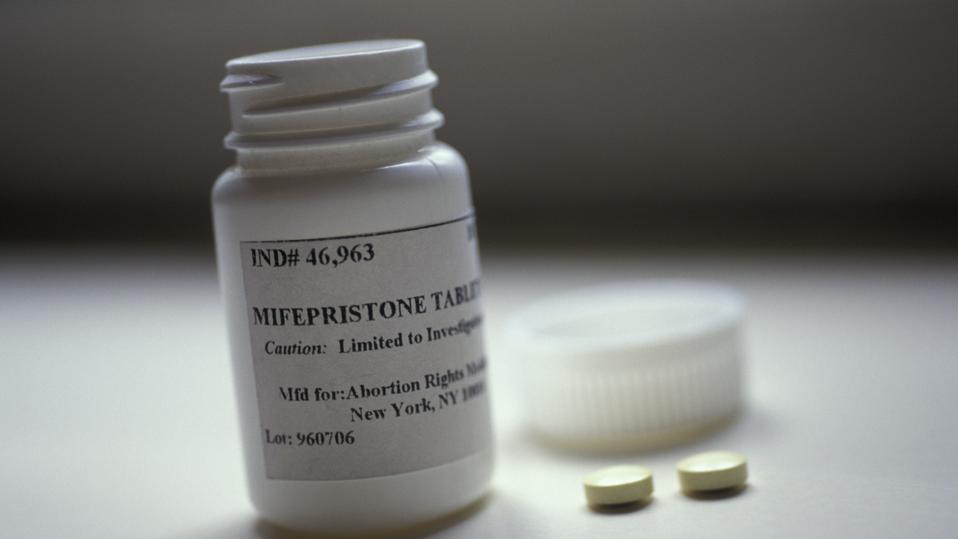
Mifepristone is one of two drugs that’s taken to terminate a pregnancy—it stops a pregnancy, and then a second drug, misoprostol, induces contractions to expel the tissue—and it is approved for use up to 10 weeks into a pregnancy, though in practice it’s often used until weeks 12 or 13.
The drug must be prescribed and cannot be obtained over the counter, and historically it’s only been available in-person from a physician or clinic certified to prescribe mifepristone, or more recently, prescribed through telehealth appointments and dispensed through mail-order pharmacies approved to supply the drug.
The Food and Drug Administration finalized regulations in January that now allow mifepristone to also be dispensed at brick-and-mortar retail pharmacies after being prescribed by a medical provider, after those pharmacies become certified to dispense it and agree to certain criteria.
Major retailers including CVS and Walgreens largely agreed to carry mifepristone in states where abortion is legal—but then faced backlash from anti-abortion rights activists, leading Walgreens to walk back its decision in at least some states—though at least some independent pharmacies have started carrying the drug, Politico reported in October.
Lawmakers in many GOP-led states have also introduced or floated legislation that could threaten access to medication abortion or punish people for using it—though pregnant people have been able to skirt state-level abortion bans by obtaining pills through the mail or traveling to nearby states—and Wyoming became the first state in March to enact a ban on abortion pills specifically, which was subsequently blocked in court.
What To Watch For
The Supreme Court hasn’t scheduled when it will hear oral arguments yet in the mifepristone case, but the court will hear the case and issue a decision sometime before its term ends in June 2024. If the court rules against the FDA and Danco and restricts access to mifepristone, the drug’s availability would revert back to how it was before updates were enacted in 2016 and 2021. This would take away the ability to be prescribed mifepristone via telehealth or receive the drug through mail delivery, meaning the medication would only be able to be prescribed and taken in person at a physician’s office. It would also only be available through the first seven weeks of pregnancy, rather than 10.
Tangent
If access to mifepristone is restricted, telehealth patients will still be able to have a medication abortion using only misoprostol. The drug—which has been subject to fewer legal attacks than mifepristone—can be taken on its own to terminate a pregnancy, though it is marginally less effective and carries more side effects than using mifepristone. The FDA has not approved a misoprostol-only abortion regimen, but the World Health Organization and other major groups, including the American College of Obstetricians and Gynecologists, have recommended the protocol as an acceptable alternative if mifepristone isn’t available.
Big Number
53%. That’s the percentage of all abortions in the U.S. that were medication abortions in 2020, the most recent year for which data is available, according to the pro-abortion rights Guttmacher Institute. Research has consistently shown medication abortion to be highly safe and 99.6% effective in terminating a pregnancy, with only 0.4% of medical abortions resulting in serious complications. The FDA reports only 28 deaths have been reported in patients “associated with mifepristone” between September 2000 and June 2022, though it notes it’s not clear if those deaths were actually caused by mifepristone, as they may have been due to other factors.
Key Background
Medication abortion through mifepristone and misoprostol was first approved by the FDA in 2000. Though widely used even when abortion was legal throughout the U.S., the abortion drugs have gained attention in the wake of the Supreme Court overturning Roe v. Wade in June 2022, as they’re an easier way for patients in states where the procedure is banned to more easily obtain an abortion as clinics providing surgical abortions have shut down. The wave of state-level bans on abortion has prompted new tactics to make abortion pills available, such as mail-order services—and mail-forwarding services that can help skirt state bans—and abortion providers setting up mobile clinics on the borders of states where abortion is outlawed. According to VICE News, more than 20,000 packets of abortion pills were shipped using covert methods in the six months after the Supreme Court’s decision in an attempt to circumvent state bans. The FDA’s expansion of mifepristone to retail pharmacies was part of the Biden Administration’s broader efforts to blunt the impact of the Supreme Court’s ruling, as the administration has pointed to medication abortion and the fact the FDA has authorized abortion pills for use nationwide as a key way of counteracting state bans. The DOJ also issued a legal opinion clarifying that abortion pill can be mailed to states where abortion is banned under federal law, though it remains to be seen how that will be impacted by the Supreme Court’s opinion.
Surprising Fact
In addition to abortion, mifepristone can also be used for other medical conditions, though it remains to be seen how the Supreme Court’s case could impact access in those cases. The drug can also be used for miscarriages and early pregnancy loss or used off-label for other gynecological uses, such as treating uterine fibroids. Mifepristone is also used at a separate dosage as a treatment for Cushing’s syndrome, a rare endocrine disease that overproduces the hormone cortisol—which mifepristone blocks—and clinical trials have examined how the medication can be used to treat such conditions as multiple forms of cancer and depression.
Further Reading
Supreme Court Agrees To Hear Abortion Pill Cases, Determine Whether Pills Should Be Restricted (Forbes)
Mifepristone Ruling: Here Are The Unintended Health Consequences Of Attacks On Abortion Pills (Forbes)
What is medication abortion? Your questions answered (Association of American Medical Colleges)
Information about Mifepristone for Medical Termination of Pregnancy Through Ten Weeks Gestation (U.S. Food and Drug Administration)
The Availability and Use of Medication Abortion (Kaiser Family Foundation)
Abortion Pill Providers Experiment With Ways to Broaden Access (New York Times)