

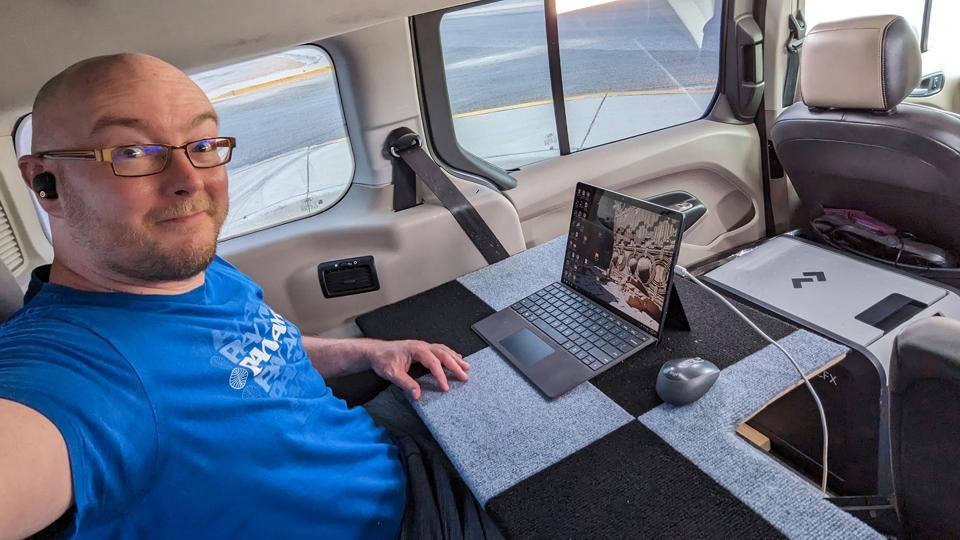
Technically, you don’t need to build a bed in a campervan conversion. You don’t even need a bed, really. You could get a collapsible cot, an inflatable mattress, or if you’re made from hardier stuff than I, you could just sleep on the floor of the van. I wanted something a little more comfortable. After all, I was building this van as a tent replacement. If I wanted to sleep on the hard ground using an air mattress, I could have done that in my Miata (and I have).
From the beginning I had designed in my head a sort of “day mode” and “night mode.” In day mode I could sit comfortably and work, ideally with a desk of some sort, and then convert that into a bed to sleep on. With the limited size of the Transit Connect, and my even more limited skills, I had my work cut out for me, pun intended.
Follow my travels on my YouTube channel and check out my book about budget travel, appropriately named Budget Travel for Dummies. Also, check out the previous installments of this series:
- How To Build A Campervan Intro: What’s A Campervan?
- How To Build A Campervan Part 1: The Perfect Van (Also video)
- How To Build A Campervan Part 2: Adding Solar Power! (Also video)
- How To Build A Campervan Part 3: To Seat, Or Not Two Seats (Also video)
- How To Build A Campervan Part 4: Wiring Solar And Batteries (Also video)
Building a bed with minimal materials and even less talent
I watch with awe at the many YouTubers who craft these elaborate and gorgeous van interiors. Cabinets, fold-out this, soft-close that, it’s insanely impressive. This is not a skill I have acquired. I do own a saw (thanks dad!) and know which end of the hammer is the business bit (the pointy part, right?). I figured with some enthusiasm and willingness to fail catastrophically I could get something done.
What I needed was a bed and a desk, somehow squeezed into the back of a minivan. I also needed to work around the fridge, batteries, and various electrical gear. The key, I figured, was that I wouldn’t need the bed and the desk at the same time. So what I designed was a movable, multi-piece design. Basically, an OSB sandwich that I could slide out, open-faced if you will, into two different configurations.
The bottom piece of this contraption is a piece of OSB, roughly 2’ by 4’. I went with OSB despite its weight because I needed something fairly rigid, as you’ll see. This is on short 2×4 and 1×4 legs that lets it sit above the batteries and electrical equipment. It’s also the same height as the rearmost drivers-side seat when it’s folded down. I drilled some 2-inch holes in this to reduce weight a little and increase the airflow to the batteries and charge controller.
The next layers are two identical pieces of OSB, the same width as the base piece. One of these OSB panels has two 2×4 runners that go the length of the board. During “night mode” I’ll fold down the rear seat, slide these two pieces over, and then the piece of OSB without the runners slides forward to rest on the top of the refrigerator. It all slides nicely and supports my weight, even sitting in the middle, thanks to a bit of overlap between the two pieces.
On top of this bed I started with an air mattress, which worked ok, but I’ve since upgraded to two layers of 2-inch memory foam. This is quite comfortable and doesn’t take up that much more space than the air mattress. A sleeping bag works great when it’s cold, but on warmer days, I just use bedsheets.
The Result
Without adjusting the driver’s seat, I have a little over 6-feet of space from the back of the seat to the rear hatch. If I move too much in my sleep I’ll push against the seat or the hatch, but it’s enough room and way better than a tent. To make the sliding easier, as well as improve the overall look, I bought some carpet squares with adhesive backing (not shown in the above video, as I added them later). Probably not the most aesthetically pleasing van interior, but definitely good for my skill level.
I’ve discovered a few minor issues with this setup. One, the fridge turns on several times during the night, causing a whine and rumble that’s transmitted through the bed and into my head. It has woken me up enough that I’ll probably start turning the fridge off at night. It’s well insulated, so unless I have something especially perishable, it’s probably fine. I’ll test this at some point and see how much the temperature goes up overnight. Fortunately, there’s a temperature readout on the front.
While the bed works, it is quite heavy. I might try to drill some holes in both pieces like I did with the bottom piece. It’s not like I need to lift it or anything, but maybe if I lose some pounds (in the bed or me), I’ll get fractionally better MPG.
Lastly, and this isn’t an issue confined to my build, but if I’m parked on any kind of slope, it’s really noticeable. One of my first nights in the van I hadn’t noticed it, only to wake in the morning crushed up against the driver’s seat with a crick in my neck. I was more careful after that.
As you can guess, this sleeps one. I plan to build it out so the bed is the entire width of the van. You never know when you might get houseguests. Most likely this would be the opposite design, with the front half of the bed resting on the folded-down middle row passenger-side seat, then a single OSB piece for the other half (over the batteries). This could be supported by a short, loose, piece of 2×4. That way it can all slide back together with ease. This is in the queue for 2024.
Day Mode
With the expectation of needing to work during the day, perhaps without a picnic table and a view, I wanted to also build a makeshift office. This is why I kept the drivers-side rear-most seat. During the day, I’d slide the bed back into its berth, and slide out the one final piece to this apparatus: a desk.
I made the desk out of much thinner laminate, which was significantly more expensive than the OSB, but far lighter and much more pleasant to the touch. I sanded the hell out of the OSB and while it has never given me a splinter, I was glad to cover most of it with carpet (see image at top).
I cut out a section, just enough so the entire piece can sit flush against the back of the middle seat and not press into my belly. I added legs that slot into one of the pre-formed pockets in the side of the Transit so it’s stable. This gave me a broad surface to put my laptop, mouse, phone, etc. All the electrical is right there, so I can plug in and have essentially unlimited power. When I’m driving, the desk sits on top of the bed stack, upside down, its legs holding the foam bedding in place.
Overall, though, it has been a great success. I’ve had several multi-week trips in the van, working while I went, and even had my first video meeting with the editors of my book.
Up Next
With all the core features built and installed, the van was entirely usable. Functional, though definitely not complete. So up next: accessories and a final kitting out. Stay tuned.
If you want to watch this build from the beginning, check out this playlist: